The Swiss artist Zimoun’s motorized cardboard sculptures are whimsical explorations of physical properties. He regularly assembles small armies of simple objects that, in combination, rapidly escalate into complex systems. He has gotten better and better over the years at documenting his work. The visuals in this recent video, for example, of a suspended grid of little boxes, suggest a virtual rendering, filmed as the materials are in such a bright white space.
The virtual-ness of the video reinforces the fundamentals-first quality that is the foundation of Zimoun’s installation art. Listen as the light brown cubes — each assembled with brown tape and hung with stark black strings from a panel as white as anything in George Lucas’ THX-1138 — gently rumble. There is white noise, and pink noise, and brown noise, and there is Zimoun noise.
The Assignment: Make music by processing a static sound.
/ By Marc Weidenbaum
Each Thursday in the Disquiet Junto music community, a new compositional challenge is set before the group’s members, who then have just over four days to upload a track in response to the assignment. Membership in the Junto is open: just join and participate. (A SoundCloud account is helpful but not required.) There’s no pressure to do every project. It’s weekly so that you know it’s there, every Thursday through Monday, when you have the time and interest.
Deadline: This project’s deadline is the end of the day Monday, May 29, 2023, at 11:59pm (that is, just before midnight) wherever you are. It was posted on Thursday, May 25, 2023.
Tracks are added to the SoundCloud playlist for the duration of the project. Additional (non-SoundCloud) tracks appear in the lllllll.co discussion thread.
Disquiet Junto Project 0595: Filter Progression The Assignment: Make music by processing a static sound.
This project is the second of three that are being done in collaboration with the 2023 Musikfestival Bern, which will be held in Switzerland from September 6 through 10. The topic this year is « √ » — as the organization explains: “the radical, or square root symbol and the power of its symbolism are central to the festival and these will be translated into music in multifarious ways.” All three projects will engage with the work of Éliane Radigue, who is the Composer-in-Residence for the 2023 festival.
We are working at the invitation of Tobias Reber, an early Junto participant, who is in charge of the educational activities of the festival. This is the fifth year in a row that the Junto has collaborated with Musikfestival Bern.
Select recordings resulting from these three Disquiet Junto projects may be played and displayed throughout the festival.
Step 1: Choose a static sound, such as a field recording of a specific place, or a held tone, or a recording of noise.
Step 2: Experiment with animating the static sound selected from Step 1 by slowly, subtly, manually modulating it, using only filter frequency and resonance.
Step 3: Record a track resulting from the techniques you developed in Step 2.
Eight Important Steps When Your Track Is Done:
Step 1: Include “disquiet0595” (no spaces or quotation marks) in the name of your tracks.
Step 2: If your audio-hosting platform allows for tags, be sure to also include the project tag “disquiet0595” (no spaces or quotation marks). If you’re posting on SoundCloud in particular, this is essential to subsequent location of tracks for the creation of a project playlist.
Step 3: Upload your tracks. It is helpful but not essential that you use SoundCloud to host your tracks.
Step 4: Post your track in the following discussion thread at llllllll.co:
Step 5: Annotate your track with a brief explanation of your approach and process.
Step 6: If posting on social media, please consider using the hashtag #DisquietJunto so fellow participants are more likely to locate your communication.
Step 7: Then listen to and comment on tracks uploaded by your fellow Disquiet Junto participants.
Step 8: Also join in the discussion on the Disquiet Junto Slack. Send your email address to [email protected] for Slack inclusion.
Note: Please post one track for this weekly Junto project. If you choose to post more than one, and do so on SoundCloud, please let me know which you’d like added to the playlist. Thanks.
Additional Details:
Length: The length is up to you. Sometimes longer is better.
Deadline: This project’s deadline is the end of the day Monday, May 29, 2023, at 11:59pm (that is, just before midnight) wherever you are. It was posted on Thursday, May 25, 2023.
Upload: When participating in this project, be sure to include a description of your process in planning, composing, and recording it. This description is an essential element of the communicative process inherent in the Disquiet Junto. Photos, video, and lists of equipment are always appreciated.
Download: It is always best to set your track as downloadable and allowing for attributed remixing (i.e., a Creative Commons license permitting non-commercial sharing with attribution, allowing for derivatives).
For context, when posting the track online, please be sure to include this following information:
More on this 595th weekly Disquiet Junto project, Filter Progression (The Assignment: Make music by processing a static sound), at: https://disquiet.com/0595/
This went out this evening to paid This Week in Sound subscribers: a playlist from Amulets, Drowse, Tuonela, and the collaboration of Jeremiah Fraites and Taylor Deupree.
These sound-studies highlights of the week originally appeared in the May 23, 2023, issue of the Disquiet.com weekly email newsletter, This Week in Sound. This Week in Sound is the best way I’ve found to process material I come across. Your support provides resources and encouragement. Most issues are free. A weekly annotated ambient-music mixtape is for paid subscribers. Thanks.
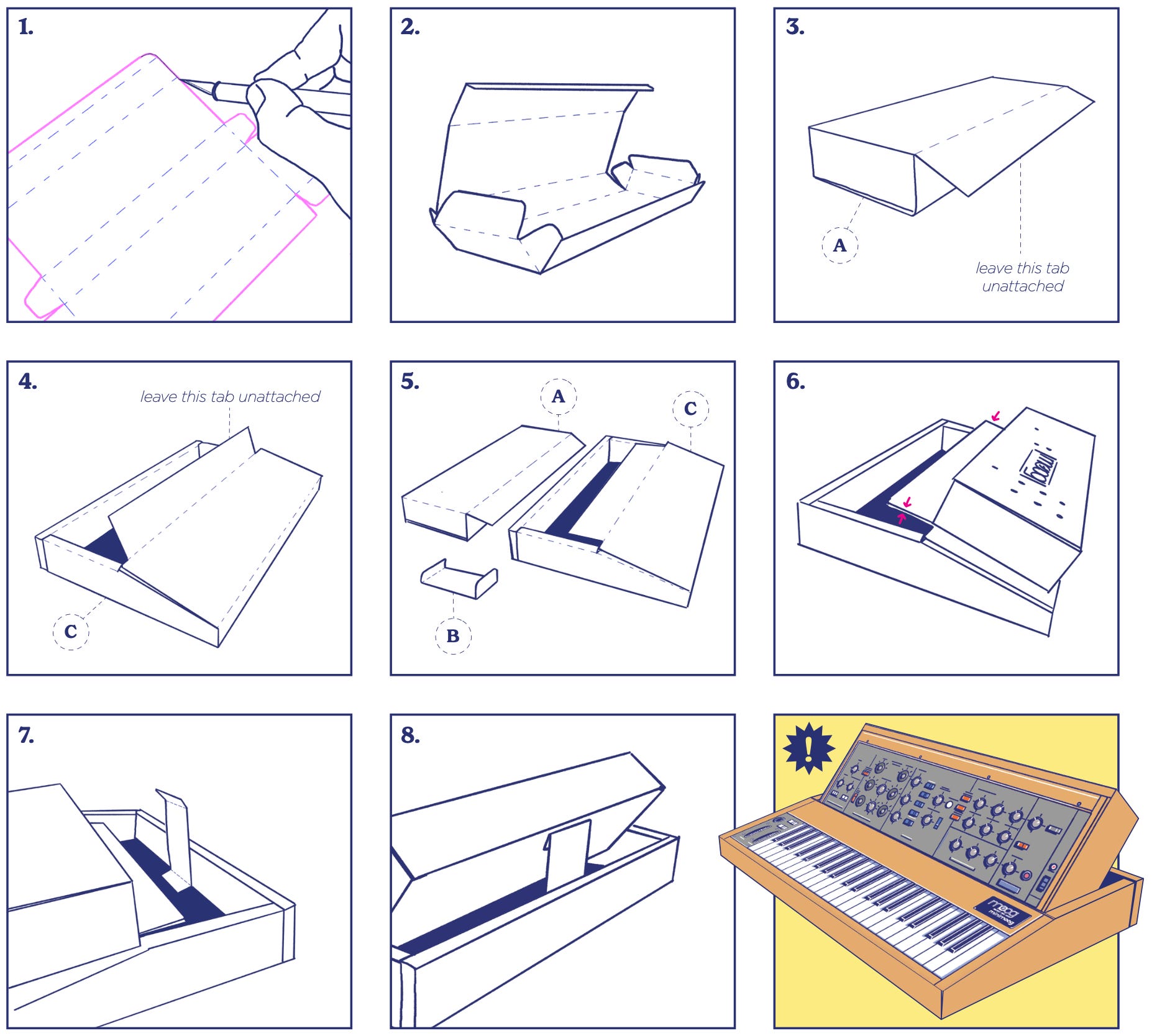
▰ SILVER SYNTH: There’s a cool new website (minimoogmodeld.com) that explores the Minimoog Model D on the occasion of the 70th anniversary of Moog Music, founded in 1953. “Designed by Pentagram partner Yuri Suzuki, the mini site — called the Minimoog Model D Factory — features an interactive eight-room house in which every chamber leads to a different experience, including a virtual Minimoog Model D that you can automatically adjust to distill the sounds used in different famous songs that span decades, styles, and creators, including Air and Frank Zappa,” writes Jesus Diaz for Fast Company. (Though that article seems to suggest that 2023 is the 70th anniversary of the Minimoog Model D, which I think actually came out at the start of the 1970s.)
▰ CHIRP UP: “The special thing about birdsongs is that even if people live in very urban environments and do not have a lot of contact with nature, they link the songs of birds to vital and intact natural environments,” said Emil Stobbe, an environmental neuroscience graduate student at the Max Planck Institute for Human Development and author of one of the studies.” (Read on the Washington Post’s website for free, thanks to a gift link.) Thus: “research also suggests that listening to recordings of their songs, even through headphones, can alleviate negative emotions.” (Thanks, Mike Rhode!)
▰ ROCKETS, MAN: We live close enough to the future that the phrase “the busiest spaceports in the world” can be used in the course of everyday life, and yet a question lingers as to whether those launches are bad for the environment. At least researchers are collating evidence: a team has been granted “close to US$1 million in funding from the US Army Corps of Engineers over 3 years to measure the soundscape and monitor a host of endangered and threatened species living near the Vandenberg base.” The study is multimedia, per an article in Nature: “Cameras will capture how animals react to rocket-launch sounds: for example, whether birds abandon their nests or change their foraging or mating behaviour. Audio monitors will pick up whether they alter their songs in response to the noise, in the same way that people yell after loud noise exposure. The birds will have some resilience, Hall says. ‘But at some point, there’s going to be a threshold where that resilience is overcome.’”
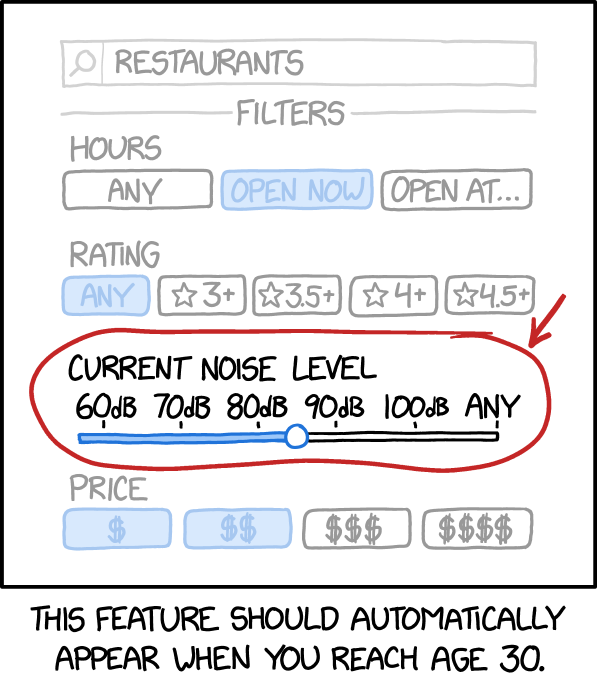
▰ X FACTOR: The great XKCD comic, by Randall Munroe, addressed restaurant noise in a recent post titled “Noise Filter.” Just one question: while comedy norms suggest the punchline (“ANY”) should be at the end of the phrase, don’t UX design norms suggest it should be on the left, since presumably it means an even lower threshold? (Thanks, Mike Rhode — and the Creative Commons license)
▰ TAKING SIDES: Does one of your ears seem more attentive than the other? Is it the left one? Science suggests this is the norm: “We demonstrate here that there is a preference in terms of space, and not hemisphere, with a clear pre-eminence of the left auditory space for positive vocalizations,” write Tiffany Grisendi, Stephanie Clarke, and Sandra Da Costa (all based in Switzerland) in the conclusion of their research, published in Frontiers in Neuroscience. Writes Mischa Dijkstra in a summary: “One aspect that affects the emotional ‘valence’ of sounds — that is, whether we perceive them as positive, neutral, or negative — is where they come from. Most people rate looming sounds, which move towards us, as more unpleasant, potent, arousing, and intense than receding sounds, and especially if they come from behind rather than from the front. This bias might give a plausible evolutionary advantage: to our ancestors on the African savannah, a sound approaching from behind their vulnerable back might have signaled a predator stalking them. … Now, neuroscientists from Switzerland have shown another effect of direction on emotional valence: we respond more strongly to positive human sounds, like laughter or pleasant vocalizations, when these come from the left.” (Thanks, Glenn Sogge!”)
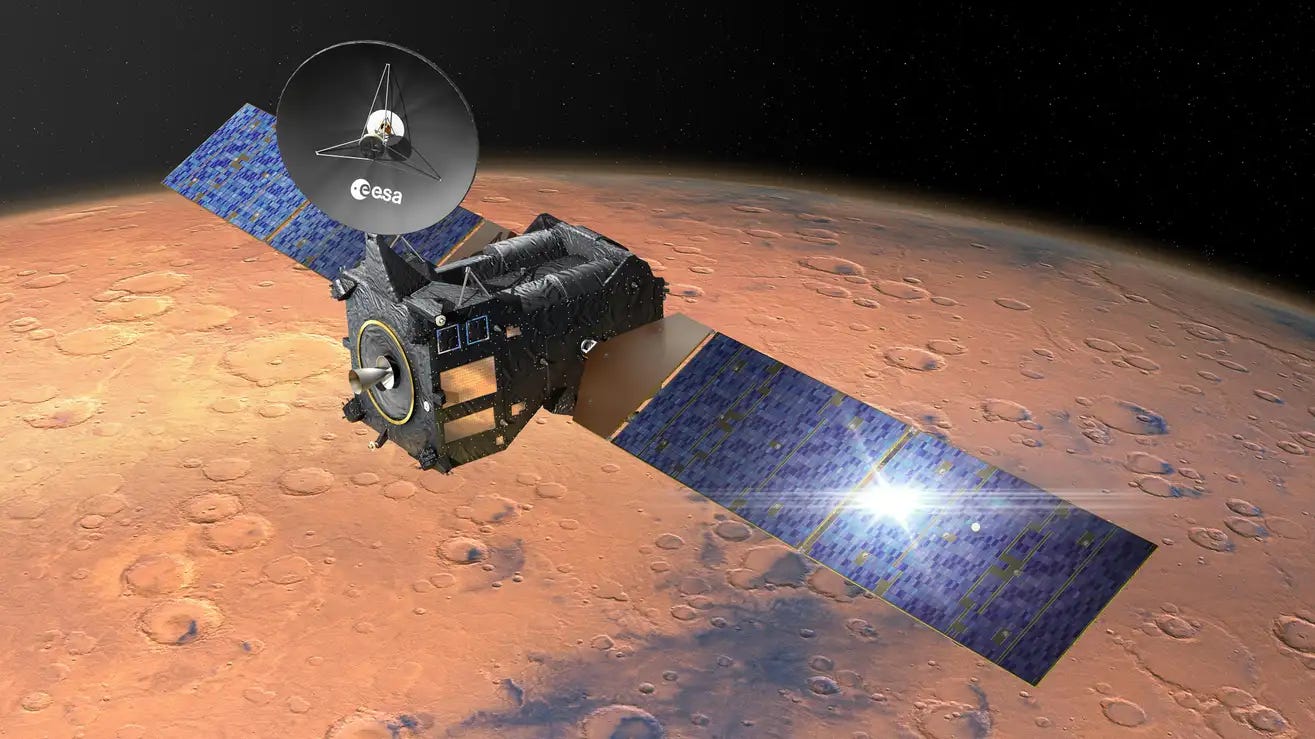
▰ MARTIAN CHRONICLE: SETI is doing a simulation of an alien transmission: “On May 24 at 3:00 p.m. ET, the European Space Agency’s ExoMars Trace Gas Orbiter (TGO) will transmit an encoded message to Earth. A trio of ground-based radio observatories will attempt to receive the signal when it arrives 16 minutes later. The signal, an encoded message developed by artist Daniela de Paulis and her colleagues, will then be made available to the public, who are invited to try to make sense of the message,” per gizmodo.com. Because we live in 2023, the post-receipt decoding will occur on a Discord server (and this is pretty funny: when I signed up for the server I had to “prove” I was human, by using one of those CAPTCHAs — now that is meta). The image below shows an artist’s depiction of the Trace Gas Orbiter, from the ESA.
▰ IF I COULD: Scientists are coming to the aid of the endangered California condor, thanks to a high-tech egg. The New York Times spoke with Kelli Walker of the Oregon Zoo, which is doing the experiments: “Small data loggers tucked inside the shells can track the temperature and movement of the eggs. An audio recorder captures the sounds in the nest, which the zoo will play back to the eggs in the incubator. ‘Developing embryos can hear things through their shells,’ Ms. Walker said.” The goal of the effort is “to better replicate natural conditions in the artificial incubators that are key to its condor breeding efforts.” (Read for free thanks to this gift link — and thanks, Mike Rhode!)
▰ EPA FILTER: A non-profit group called Quiet Communities, Inc. (quietcommunities.org) is suing the EPA for “failure to perform non-discretionary duties” related to noise pollution. The weakening of the EPA’s response to noise issues reportedly dates back to 1981 at the start of Ronald Reagan’s two terms as president of the U.S. (Because life can read like a novel, the current administrator of the EPA is named Michael S. Regan.) Apparently the issue isn’t the lack of legislation; it’s about enforcement. “EPA is caught in this bind that they were still legally required to carry out the act, but they haven’t had anybody working on it in such a long time,” says Sidney Shapiro, part of the law faculty at Wake Forest University, who wrote “Lessons from a Public Policy Failure: EPA and Noise Abatement” about the matter.
▰ VOICES CARRY: Since “loss of speech ability can occur very suddenly through medical conditions like ALS,” it might be worth using Personal Voice service, announced as one of Apple’s accessibility features. It’s due to be part of the upcoming iOS 17. A user will be able to “create a synthesized voice that sounds like them for connecting with family and friends.” To explore the topic of augmentative and alternative communication (AAC) apps, MacStories interviewed David Niemeijer, the founder and CEO of AssistiveWare.
▰ INTERIOR MONOLOGUE: I dug this interview with the developer of the game Interior Worlds. One key excerpt: “I’ve played a lot of indie horror, and something I’ve noticed that goes underutilized is the impact of ‘background ambiance,’ like drones and pads. Some games opt for the more ‘classic’ style of atmosphere and music, such as a specific musical score to instill tension, which leaves little room for focus on the environment. The low, subtle rumbling and steady, monotonous drone of sweeps found throughout most of the game gave me more opportunity to let the player soak in their surroundings.” And another: “I liked the idea of having the player’s heartbeat grow louder as they approached the ‘anomalies’ as kind of a way to say, ‘Something’s not right … You’re not supposed to be here.’” Interestingly, Interior Worlds utilizes a system in which the player/character takes photos within the game, much like in Season, which I wrote about this month for The Wire. Unlike in Season, however, I don’t believe that in Interior Worlds you can make audio recordings.
▰ QUICK NOTES: MUBI Music:Blip Vert Report: Spotify reportedly “is developing Al technology that will be able to use a podcast host’s voice to make host-read ads — without the host actually having to read and record the ad copy,” per MSN(per The Ringer founder Bill Simmons). ▰ Tune In: Psychology Today digs into soundscape studies.▰ Forbin Project: ChatGPT’s iPhone app has introduced a speech feature (an Android version is due by the end of 2023 — you know, if civilization gets that far). ▰ Just Winging It: Surprise: living near an airport is bad for your sleep. ▰ On Cue: An episode on NPR looked at (or listened to) classic “needle drops” in movies; NPR’s Ayesha Rascoe spoke with Rico Gagliano, host of the MUBI Podcast (Thanks, Rich Pettus!). ▰ Garden Variety: The Shriek of the Week was the garden warbler, which “lacks the flutey variation of the blackcap, being buzzier and more babbling.” ▰ Screen Dream: Android’s Reading mode, which “can read out any text on your screen using a text-to-speech model,” has gained an update. (Is there an easy way to accomplish this on an iPhone?)