
86: Percent of radio listening that takes place on radio receivers
8: Percent on phones
2: Percent on smart speakers
Source: insideradio.com.
86: Percent of radio listening that takes place on radio receivers
8: Percent on phones
2: Percent on smart speakers
Source: insideradio.com.
This review I wrote originally appeared in the May 2023 issue of The Wire, number 471, the one with Slayer drummer Dave Lombardo on the cover. The article appears here (for the first time from behind the paywall, now that the subsequent issue — the bright red one with the Fall on the cover — has come out) in ever so slightly edited form. As I noted at the time of its publication:
The primary observation I didn’t have room for in the review is that sound is so prevalent in horror that several of the other books in the British Library’s Tales of the Weird series, of which Spectral Sounds is part, employ it in the examples shown at the back of the book in the catalogue, and also on the publisher’s website. What distinguishes the stories in Spectral Sounds is that sound is central to each tale’s narrative, rather than just a colorful element of the mood-setting.
Here’s the review in full:
Spectral Sounds: Unquiet Tales of Acoustic Weird
Manon Burz-Labrande (Editor)
British Library Pbk 315 pp
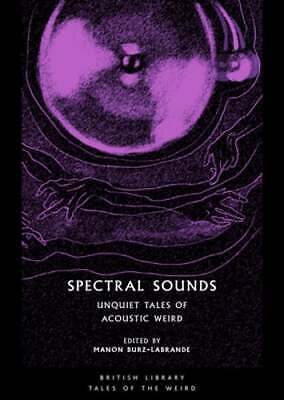
In 1866, Irish writer Ruth Mulholland, then aged 25, published a spooky story in All the Year Round, a periodical edited by Charles Dickens. She was two years old when Dickens exhibited ghostly expertise with A Christmas Carol (1843), in which we’re told “Scrooge was not a man to be frightened by echoes.” Mulholland developed an interest in sound’s potential for horror, and vice-versa. Titled “The Haunted Organist of Hurly Burly,” her tale involves a strange musician claiming to be betrothed to the deceased son of the organ’s caretakers.
“Hurly Burly” and 13 other stories comprise Spectral Sounds: Unquiet Tales of Acoustic Weird. Edited by Manon Burz-Labrande, a researcher and lecturer at Austria’s University of Vienna, the book is part of the British Library’s Tales of the Weird paperback series. Thematically linked sections highlight strange utterances (Thomas Street Millington’s “No Living Voice” from 1872), audible presences (Elizabeth Stuart Phelps’s “The Day of My Death” from 1868), and the post-apocalyptic soundscape (MP Shiel’s “The House Of Sounds” from 1911), among other eerie tropes.
Time does peculiar things to language. Expressions become — in LP Hartley’s formulation — foreign. Hartley’s horror isn’t collected here but we do get Edith Wharton, as well as Edgar Allan Poe’s “Siope — A Fable” (1837), thankfully more obscure than “The Tell-Tale Heart.” The book contains aged sentences that cause the reader to wonder how something once declarative becomes mystifying. Are these Lovecraftian prose poems casting the unfathomable oddness of our world? Oftentimes no, just plain English rendered weird by the years.
A few paragraphs into the opening story, Florence Marryat’s “The Invisible Tenants of Rushmere” (1883), we’re told by the narrator, a physician about to inadvertently rent a haunted house: “The hostages which I had given to fortune had made that strenuous action which attention to my numerous patients supplied incumbent on me.” This seems to mean the doctor works too hard; the reader may sympathize. Placing such a phrase early in the book was wise: it signals the reader to keep alert. Here be linguistic dragons.
Anxiety proves more impervious to time than does language. Archaic as some of the wording in Spectral Sounds may be, the many sources of its dread are familiar, occasionally to the point of feeling samey. Note the “whine of a door” and how “the wind whistled in at the keyhole,” not to mention the “curse of silence” and countless unidentifiable voices from beyond. These same evocations serve contemporary thrill writers and seekers alike to this day. Part of what makes sound so powerful a narrative tool is that the stories’ authors and characters are equally aware of the symbolic portent inherent in the ear’s duty as the human nervous system’s alarm. Algernon Blackwood, in his “A Case of Eavesdropping” (1906), sets a scene this way: “All was still but the howl of the wind, which to his ears had in it a note of triumphant horror.”
The scariest stories leave their mark. You close a book, exit a cinema, or power down the TV only to find that the images, the sounds, the psychic imprint, linger. One additional impact from Spectral Sounds — more obsession than haunting — is the wealth of further readings, both academic and fictional, recommended in the volume’s introduction and each story’s helpful preface. Consider yourself forewarned.
This Junto Profile is part of an ongoing series of short Q&As that provide some background on various individuals who participate regularly in the online Disquiet Junto music community.
What’s your name? Magnus Lindencrona is my real name. Although I don’t consider myself an artist, I have often used my login (gis_sweden) as an “artist name” on different sites, such as Soundcloud, YouTube, and Bandcamp. But I’m not consistent …
Where are you located? I live in a town south of Gothenburg on the Swedish west coast and work in Gothenburg. Commuting to and from work is inspiring as it gives me time to reflect, listen and observe.

What is your musical activity? When I started making my own music, it began with what is called “synth pop” in Sweden. As a student, I had all the time in the world. But now, my head is always filled with ideas that I will never have the time to follow up on. Family, work and horse set the frames for musical excursions. Maybe that’s why I like the Disquiet Junto projects — to get a “compositional assignment.” I have also participated in SP-Forums beat battles. Now I’m a typical bedroom producer and can do what I want. One evening some years ago, I made this:
or
It belongs to an account which I have lost the password for, but I like it that way — make and forget. I know that BBC radio has used sounds made by me from Freesound.
What is one good musical habit? I believe in working with what you have — new gear will probably not help.
What are your online locations? I like to read threads on Lines (llllllll.co) and log in on ModWiggler sometimes. That’s enough for me.
What was a particularly meaningful Junto project? I don’t remember how I found the Junto Project — was it via ModWiggler? I don’t know. But I was fascinated by the experimental spirit. Just throw away conventions and record. Don’t care about likes — that’s my spirit. For me, it’s not important to make a nice track perfectly mastered; I don’t have time for that. Instead, I focus on the idea and creative part.
You mentioned using the gear you have. What do you work with? I consider my little modular synth as my main instrument. The synth is an all analog modular. But if I feel like it I can use DAW, SP-404SX, field recordings or any instrument in the house.
When you do the Beat Battles entries, do you add your own sounds, or just work from the provided samples? When I participate in beat battles I try to use only the provided samples, even if the rules says that you can add drums, bass etc. Working with limitations is fun.
Holly Haworth wrote an excellent essay recently for Nautilus, “What an Oyster Hears,” that might, in an earlier draft, have been titled “What an Oyster Might Hear,” since as she acknowledges early on, the oyster has no ear. However, the oyster does resemble an ear, and thus provides Haworth’s rangy article with plenty of opportunity to reflect on the creature as a living metaphor for so many forms of sonic reception.
There’s its presence at the shoreline, where the two very different habitats of our planet meet. There is the dense audio world beneath the ocean’s surface, which she experiences thanks to the use of a hydrophone. There is the work of acoustic ecologists to use sound for us to better understand the alien realms we live amid. And there is Jonathan Sterne’s proposed connection, from his book The Audible Past, between the rise of canned goods and of canned music (including a quote from John Philips Sousa that sums up modern anxieties many have about Spotify, AI, and their combination.)
To read the article is to witness Haworth’s own perceptions change, improve, elevate, and sharpen. She writes:
“The headphones amplified the sound of the oyster reef while they also made me feel alienated from my surroundings. I quickly noticed that I could hear much of the snapping without the help of the machine. By amplifying the noise and concentrating it in my ears, the headphones had helped to tune my listening, a useful technology. Now I realized what I could hear without them.”
The full piece is at nautil.us.
I do this manually each Saturday, usually in the morning over coffee: collating most of the little comments I’ve made on social media, which I think of as my public scratch pad, during the preceding week (or in this case, the past two weeks). These days that mostly means post.lurk.org (Mastodon).
▰ The hazard lights in this electric car I’ve been driving aren’t mechanical. They make the familiar clicking sound for the first minute or so and then they turn off. The lights keep blinking but they no longer click. It has a vague “We’re done with the charade” vibe. What’s interesting is how it seems that in the transition from fossil fuel to electric, even things unrelated to gasoline end up electrified, rather than being left mechanical. Or something along those lines.
▰ For all the improvements of laptop computers over the years, the one I’m perhaps most thankful for is that the thing is immediately functional when I open it
▰ Sources of late-morning sounds: passing bus, washing machine, creaking of floorboards, neighbor’s garage door, gentle whir of air filter (allergy season), muffled voices as people walk by outside
▰ Sound of the day goes to the tiny, tinny radio on which a construction crew was listening to a sports event, the play-by-play announcement of which was reduced to some exceptionally narrow band of what might be described as the high treble spectrum. From halfway down the block, it was like listening to mice stage whisper, and it grew no more comprehensible as I approached. I’m not convinced the crew even understood much of it, either. It was more like a comforting story being told in an adult nursery.
▰ The best part of Succession ending will be never having to hear that melody again in yet another instrumental arrangement
▰ That thing where you take a handful of awkwardly named wav files that constitute an album and put them in iTunes (excuse me, Apple Music) and fix the song titles and add the year and the track numbers and the art, and then hit save, and it doesn’t break the set into three different mini-albums. And you take a slow breath as you back away and promise yourself never to touch those files again. Whew.
▰ It’s 2023. I don’t need to take my keychain out of my pocket to start the car. I do need to in order to access certain accounts from my computer.