Scratch Pad: 30s, Freesound, Fosse

From the past week

At the end of each week, I usually collate a lightly edited collection of recent comments I’ve made on social media, which I think of as my public scratch pad — and I tag on what books I may have finished reading. Knowing I’ll revisit my social media posts, I’ve found, serves as a positive and mellowing influence on my online activity. I mostly hang out on Mastodon (at post.lurk.org/@disquiet), and I’m also trying out a few others. And I generally take weekends off social media.

Right now, though, I’m on a more extended social media (and adjacent) break, through the start of January 2026. Which raises the question: when I’m on such a hiatus, what constitutes this site’s Scratch Pad, since this Saturday habit is, by definition, a collation of stuff I posted to social media throughout the given previous week? Apparently it’s random notes I make to myself that I would have posted online, plus bits I’ve sent to friends via email and other means. Just because I’ve stopped posting doesn’t mean my brain has stopped making posts. Anyhow, here’s this past week’s roundup:

▰ This week I started posting brief field recordings, each roughly 30 seconds in length, and writing about them. The series is now titled #30s. It’s funny, and informative in its own way, how this began. I went for a walk, which became an unexpected errand, which led to me hearing something (#30 Retail Phase, the sound of a retailer’s shoplifting alarm system), and recording it, and writing about it, and then doing the same three more times: (#30 Play Misty, the city waking to rain; #30 Block Chain, construction noise; and #30 Internal Monologue, the sound inside the household fridge). One chance alteration of a plan blossomed into an ongoing mini-series of interrelated reflective investigations.

▰ I’ve apparently been on freesound.org for over 20 years.

▰ Pondering trying again at Weekly Beats / “Jamuary,” which kick off in a few weeks

▰ On the Lines BBS (llllllll.co) there’s an annual discussion of the upcoming year’s goals, and I made some gestures in that direction.

▰ I just noticed the little waveforms that appear on my iPhone when I’m on a phone call with someone. There is a waveform at the top of the screen (iPhone 17 Pro), a tiny thing to the right of the “dynamic island,” and it shows different colors, on opposing sides of the waveform, depending on who is speaking.

▰ I spend a lot of time on video conference calls. Recently it’s seemed that people have had less difficulty with audio. I don’t know if the interfaces or the underlying technology are getting better, or we’ve just all been better trained at this point.

▰ A backpack remains a central organizing principal of my life. Getting a new one is a milestone of sorts, and requires some reorientation.

▰ Will there ever be another Don DeLillo novel? When will the next William Gibson book be published?

▰ I finished reading two novels this week: Jon Fosse’s Morning and Evening and Sarah Gailey’s Spread Me, respectively the 25th and 26th of the year (not counting a novel’s worth of books I started and didn’t finish). The strongest aspect of Morning and Evening, to me, is the fluidity with which Fosse paints these liminal existential/theological spaces. It was interesting to have completed it right after What We Can Know, by Ian McEwan (Atonement), because both novels have distinct parts one and two. In What We Can Know, there is a lot of part one before the jump; in Morning and Evening, there is precious little. Meanwhile, the “literary” What We Can Do and the “pulpy” Spread Me both take the future impact of climate change as their starting points, and both are lust-heavy. I’m almost done with Jinwoo Park’s Oxford Soju Club, and deep into several others, Middlemarch, House of Leaves, and Midnight’s Children among them. Yeah, too many at once, again. That’s one new year’s resolution deflated before the new year has even begun.
#30s Internal Monologue

Between some milk and hummus

The drone and click and whir and rattle of the devices that populate home often recede into the background — at least until the machines emitting those sounds break. When they break, the rupture in service is evidenced by a change in tonality. Drone becomes whine, click becomes clatter, and whir becomes squeal. Until then, the sounds attain a level of familiarity that verges on the audible realm’s equivalent of near invisibility. In many cases, the sounds are not merely sounds, but hints at sounds, ventures toward sound. The noise of a dishwasher midway through a cycle hints at the unseen oceanic turbulence. Same goes for a dryer and for a refrigerator. I wondered what our refrigerator sounds like from the inside, so I set my phone to record, put it on a shelf between some milk and hummus, and closed the door. The result, the fridge’s internal monologue, feels like something in motion; while the massive structure is, of course, stationery, the noise it makes can sound like a long, slow conveyor belt going off into the distance. If you set this file to loop, the seam created when it repeats will display just how much higher the tone is at the end of the recording than at the beginning. This snippet is just a part of a longer recording, during which the pitch shifting is even more varied. The inner life of the refrigerator is, indeed, more compelling than might be suggested by the light drone one hears through walls from several rooms away.

Recorded on an iPhone 17 Pro at 7:57am on Friday, December 19, 2025, in San Francisco’s Richmond District. Posted to SoundCloud and Freesound. This post is part of a collection of field recordings that last for roughly 30 seconds and are collectively titled #30s.

Stigmatic Ambient Music, Update 2

In which a negative is no longer misrepresented

Back in April I wrote a post about a fake genre, which I had named “stigmatic ambient music.” For months afterward, a search for the name on Google would return statements as if the genre were real, which it wasn’t and still isn’t. This phenomenon was a classic AI feedback loop, in which a negative was misinterpreted as a positive. My original post was not an attempt at culture jamming. I hadn’t acted as if the genre was real. Quite the contrary, the post’s subhead stated clearly that stigmatic ambient music “doesn’t exist.”

Two months after that first post, I wrote an update that noted this ongoing issue with “stigmatic ambient music.” Google persisted in stating as fact that the genre not only existed but flourished sufficiently to deserve a detailed description of its characteristics:

“Stigmatic ambient music is a subgenre of ambient music that blends elements of dark ambient and industrial music to create a soundscape focused on pain, suffering, and psychological distress. It’s characterized by its use of dissonance, harsh textures, and a focus on unease or dread, often achieved through sound design rather than melody.

I bookmarked the Google search results for the non-genre, bounded by the preceding 24 hours, and I made a habit of clicking on the link each morning, and this remained the case day after day, month after month. Nothing of note changed.

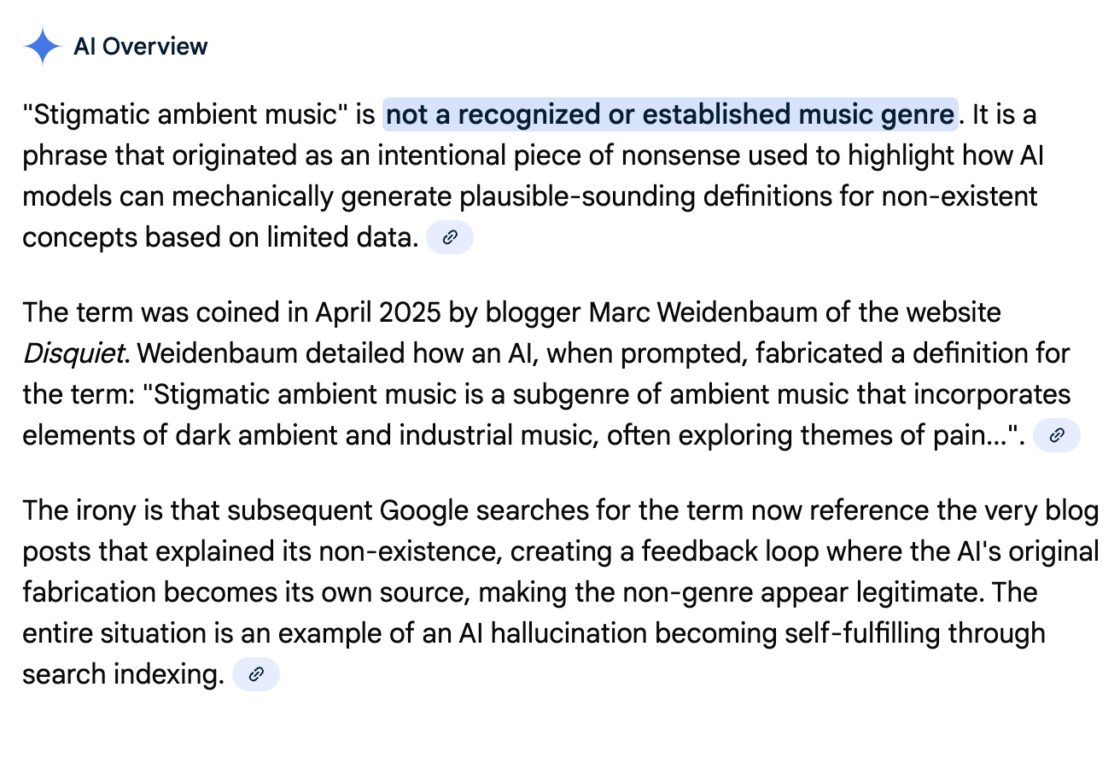
And then today, December 19, for the first time, the search results reflected what had actually happened. This is the text of this morning’s automated summary attributed to Google Gemini:

The word “hallucination” gives me pause, because even if accepted as merely colloquial, it serves as an anthropomorphism that reinforces the problem (that is, the flattering presumption of cognition and awareness), but otherwise the description is, for once, factually accurate.

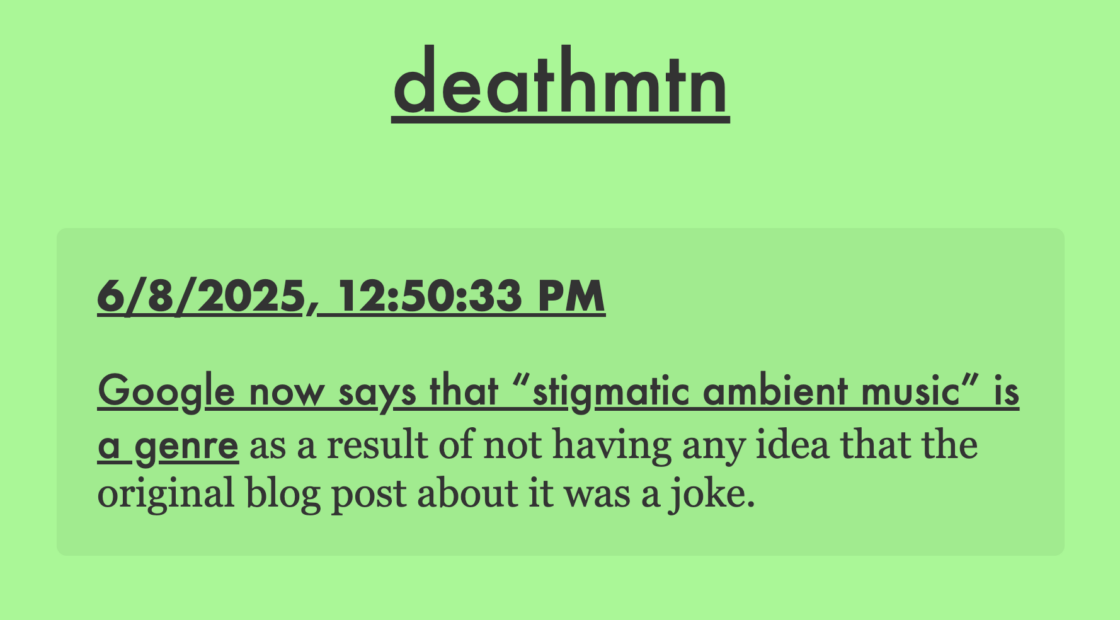
I suspect the change may relate in some way to Google having recently indexed a June 8, 2026, post by software engineer Jim Kang that briefly mentioned my exploration of AI’s response to the non-genre.

This development is good, because the correction has occurred, but less good, in that all it may have required was one sentence from a third party in order to entirely change Google’s AI mind (or “mind”) on the topic.

#30s Block Chain

Early this morning, right when doing so became legal according to local noise ordinance standards, construction began down the block, by “down the block” meaning what was being attacked by a small army of workers was the entire next block and then continuing around its far corner and down the subsequent hill. The rattling was constant, like the world’s largest coffee grinder on a coarse setting. I set about recording the goings-on, but too many other morning noises conflicted. I set down my phone and got to work. The phone and I were eventually drawn back to the window by the sort of beeping that signals a vehicle is backing up. Each time this bulbous alert sounded, everything else quieted down: traffic, footsteps, construction clatter. It was real-world sidechain, in which the relative seeming volume of one set of sounds seemed to drop in inverse correlation with the rise of another sound, in this case the warning beeps. I never did manage to get a good recording of the rattle caused by all the hammering and digging, but if there is anything I am confident of, it is that this morning will not have been the last of that.

Recorded on an iPhone 17 Pro at 9:20am on Thursday, December 18, 2025, in San Francisco’s Richmond District. Posted to SoundCloud and Freesound. This post is part of a collection of field recordings that last for roughly 30 seconds and are collectively titled #30s.

Disquiet Junto Project 0729: Community Remix (Nina)

The Assignment: Rework a shared recording from over 100 years ago

Each Thursday in the Disquiet Junto music community, a new compositional challenge is set before the group’s members, who then have five days to record and upload a track in response to the project instructions.

Membership in the Junto is open: just join and participate. (A SoundCloud account is helpful but not required.) There’s no pressure to do every project. The Junto is weekly so that you know it’s there, every Thursday through Monday, when your time and interest align.

Tracks are added to the SoundCloud playlist for the duration of the project. Additional (non-SoundCloud) tracks also generally appear in the lllllll.co discussion thread.

Disquiet Junto Project 0729: Community Remix (Nina)
The Assignment: Rework a shared recording from over 100 years ago

There is just one step to this project: This week’s project, the next to last of 2025, is a community remix. In an act of globe-spanning asynchronous holiday-season camaraderie, we’ll all work from the same shared source material, a recording that dates back well over 100 years. Download the performance of “Nina” by Hans Kindler (1892 – 1949) and remix it and rework it to your heart’s delight. The recording credits G. B. Pergolesi (1710 – 1736) as the work’s composer, but more recently it has become attributed to Vincenzo Legrenzo Ciampi (1719 – 1762). Access it at:

https://archive.org/details/78_nina_hans-kindler-g-b-pergolesi_gbia0055100a

Tasks Upon Completion:

Label: Include “disquiet0729” (no spaces/quotes) in the name of your track.

Upload: A person participating in the Disquiet Junto should post only one track per weekly project (SoundCloud account preferred but not required). If on occasion you feel inspired to post more than one track (whether to a single account or across multiple accounts), you should clarify which is the “main” rendition for consideration by fellow members and (if on SoundCloud) for inclusion in the SoundCloud playlist.

Share: Post your track and a description/explanation at https://llllllll.co/t/disquiet-junto-project-0729-community-rework-nina/

Discuss: Listen to and comment on the other tracks.

Additional Details:

Length: The length is up to you.

Deadline: Monday, December 22, 2025, 11:59pm (that is: just before midnight) wherever you are.

About: https://disquiet.com/junto/

Newsletter: https://juntoletter.disquiet.com/

License: It’s preferred (but not required) to set your track as downloadable and allowing for attributed remixing (i.e., an attribution Creative Commons license).

Please Include When Posting Your Track:

More on the 729th weekly Disquiet Junto project, Community Remix (Nina) — The Assignment: Rework a shared recording from over 100 years ago — at https://disquiet.com/0729/.