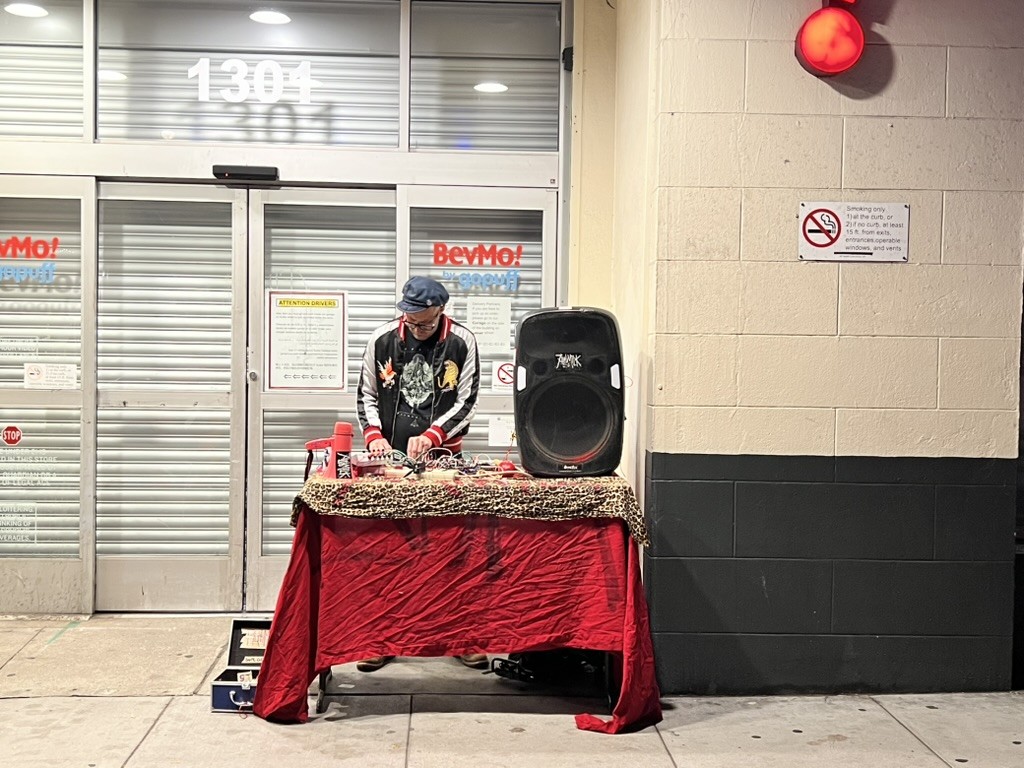
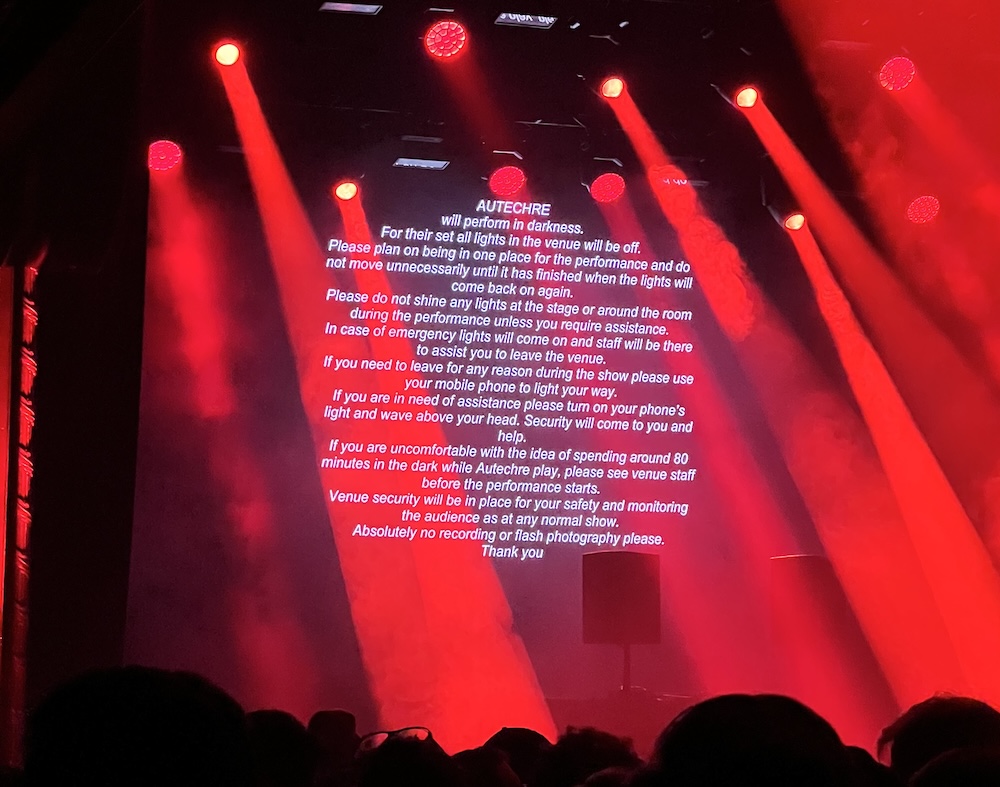
Got a good photo of Autechre’s awesome show at the Regency here in San Francisco:
Bonus points to the musician — FiLTHMiLK, I was informed by Wobbly — who set up across the street from the Autechre concert at the Regency and drew a crowd when the show ended, around 11:15pm.
Oh, and in case the joke up top didn’t register, here is what was projected on the screen in advance of Autechre taking the stage:
The Assignment: Play with and against a steady beat.
/ By Marc Weidenbaum
Each Thursday in the Disquiet Junto music community, a new compositional challenge is set before the group’s members, who then have five days to record and upload a track in response to the project instructions.
Membership in the Junto is open: just join and participate. (A SoundCloud account is helpful but not required.) There’s no pressure to do every project. The Junto is weekly so that you know it’s there, every Thursday through Monday, when your time and interest align.
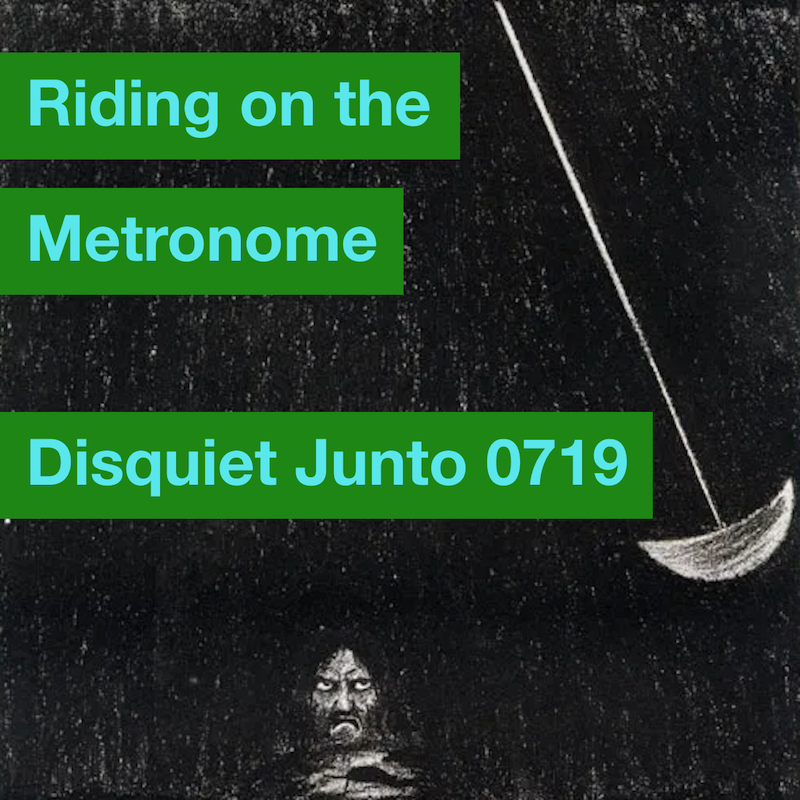
Disquiet Junto Project 0719: Riding on the Metronome The Assignment: Play with and against a steady beat.
Step 1: Locate a metronome and set it to play at a speed of your choice. Recommended: 70 bpm.
Step 2: Practice playing with, and against, and entirely apart from the beat.
Step 3: Record a piece of music in which you start off playing with the beat, and then veer away from it, and then are drawn back to it, and then veer away, around and again. End the piece while playing apart from the beat, not in sync with it.
Tasks Upon Completion:
Label: Include “disquiet0719” (no spaces/quotes) in the name of your track.
Upload: A person participating in the Disquiet Junto should post only one track per weekly project (SoundCloud account preferred but not required). If on occasion you feel inspired to post more than one track (whether to a single account or across multiple accounts), you should clarify which is the “main” rendition for consideration by fellow members and (if on SoundCloud) for inclusion in the SoundCloud playlist.
License: It’s preferred (but not required) to set your track as downloadable and allowing for attributed remixing (i.e., an attribution Creative Commons license).
Please Include When Posting Your Track:
More on the 719th weekly Disquiet Junto project, Riding on the Metronome — The Assignment: Play with and against a steady beat — at https://disquiet.com/0719/.
A solid five minutes of ambient industrial music from Peter Lukeson of Denton, Texas. What begins, initially, as a quiet, lofi atmosphere expands by adding a series of rhythmic patterns, notably mechanical bursts that resemble a heartbeat, and then on top of that some precise pixie stick percussion. When the music returns to original atmospherics, they don’t just carry the memory of the recent pounding. In addition, the drones are louder, and higher-pitched, and overall more threatening, more commanding. Good stuff. More from Lukeson on Bandcamp.
Bracing. Ecstatic. Borderline impossible. Impeccably minimalist on the surface. Substantively abstract down below. This is often the experience of listening to the music of Kenneth Kirschner, and it’s most certainly the case with July 19, 2024, which he posted on Bandcamp late last month. The album, which consists of four tracks, is nearly three and a half hours long, and I will not claim to have yet listened to the full thing myself, but I do recommend starting, as I did, with the first — and shortest — track, “July 19, 2024 – i.” This opening section sounds like a quintet for strings and piano as reflected in the freshly wiped screen of a broken cellphone, turning everything into a frenetic kaleidoscope. It’s brittle and lively, vibrant and exploratory, and impossible to pin down. The themes flow by rapidly, and your ear has to retrain itself to a different sort of listening, not so much following as succumbing. Highly recommended.