On Sundays I try to at least quickly note some of my favorite listening from the week prior — things I would later regret having not written about in more depth, so better to share here briefly than not at all.
▰ Gorgeous live solo performance by Taylor Deupree (apparently a promotion for Benson amps?).
▰ An album, Santa Rosa, of Federico Orio’s music for church bells, recorded at Basílica Santa Rosa de Lima in Buenos Aires, Argentina. While the sound of the bells is familiar, their use here is distinct in the employment of repetition and an emphasis on percussive elements, all amid a range from quiet minimalism to the chaotic.
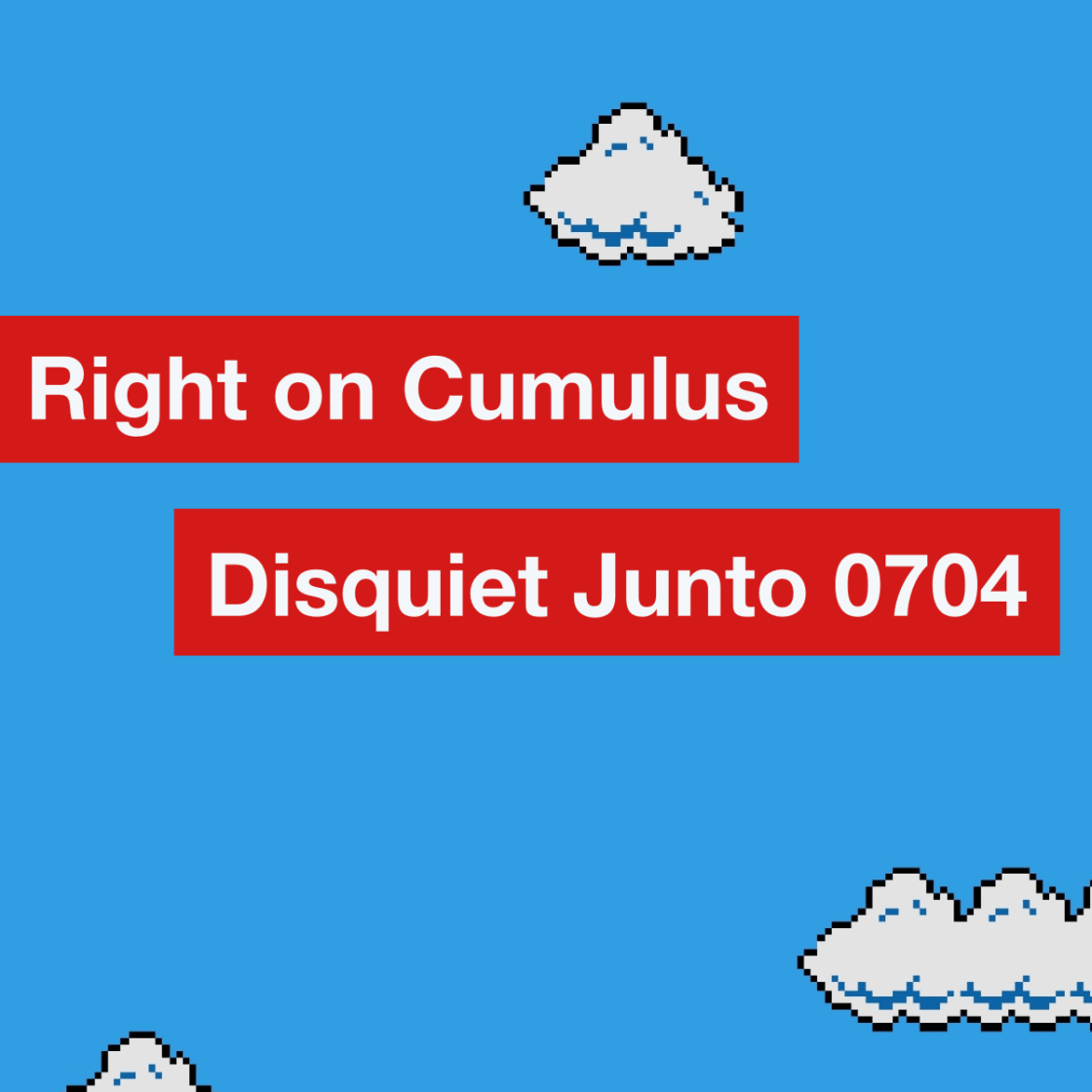
The Assignment: Compose 8-bit music inspired by a Cory Arcangel / Super Mario video.
/ By Marc Weidenbaum
Each Thursday in the Disquiet Junto music community, a new compositional challenge is set before the group’s members, who then have five days to record and upload a track in response to the project instructions.
Membership in the Junto is open: just join and participate. (A SoundCloud account is helpful but not required.) There’s no pressure to do every project. The Junto is weekly so that you know it’s there, every Thursday through Monday, when your time and interest align.
Disquiet Junto Project 0704: Right on Cumulus The Assignment: Compose 8-bit music inspired by a Cory Arcangel / Super Mario video.
Step 1: You’re going to record 8-bit music (or something approximately like it). If you’re not familiar with means by which to do so, read up a bit. Also, there may be some discussion on the Lines (llllllll.co) message board for those new to it.
Step 2: In 2002, the media artist Cory Arcangel created a work of art titled Super Mario Clouds, which removed everything from the 1985 Super Mario Bros. video game except the blue sky and passing clouds. This means that Arcangel’s video was silent, because also excluded was Koji Kondo’s classic score. Read up about the work, which is well-documented.
Step 3: Part of the reason that the original Super Mario Bros. music wasn’t included in Super Mario Clouds may have been to do with how it, naturally, wasn’t aligned with how sedate the Arcangel hack turned out to be. Please now record very sedate 8-bit music that does feel aligned with Super Mario Clouds.
Tasks Upon Completion:
Label: Include “disquiet0704” (no spaces/quotes) in the name of your track.
Upload: Post your track to a public account (SoundCloud preferred but by no means required). It’s best to focus on one track, but if you post more than one, clarify which is the “main” rendition.
License: It’s preferred (but not required) to set your track as downloadable and allowing for attributed remixing (i.e., an attribution Creative Commons license).
Please Include When Posting Your Track:
More on the 704th weekly Disquiet Junto project, Right on Cumulus — The Assignment: Compose 8-bit music inspired by a Cory Arcangel / Super Mario video — at https://disquiet.com/0704/
The Assignment: Revisit something that you just couldn't get to work last time.
/ By Marc Weidenbaum
Each Thursday in the Disquiet Junto music community, a new compositional challenge is set before the group’s members, who then have five days to record and upload a track in response to the project instructions.
Membership in the Junto is open: just join and participate. (A SoundCloud account is helpful but not required.) There’s no pressure to do every project. The Junto is weekly so that you know it’s there, every Thursday through Monday, when your time and interest align.
Tracks are added to the SoundCloud playlist for the duration of the project. Additional (non-SoundCloud) tracks also generally appear in the lllllll.co discussion thread.
Disquiet Junto Project 0703: That’s How You Got Killed Before The Assignment: Revisit something that you just couldn’t get to work last time.
Step 1: Think of something difficult you were trying to accomplish, something music-related that you just couldn’t get to work. It may be a piece of software, or a playing technique, or a part of a musical work-in-progress.
Step 2: Block out time and dedicate that time solely to putting a lot of effort into doing what you previously couldn’t. Even if you don’t solve the problem this time around, you will likely make some form of progress.
Step 3: Record something that reflects, expresses, or otherwise involves the effort you expended in Step 2 above.
Tasks Upon Completion:
Label: Include “disquiet0703” (no spaces/quotes) in the name of your track.
Upload: Post your track to a public account (SoundCloud preferred but by no means required). It’s best to focus on one track, but if you post more than one, clarify which is the “main” rendition.
License: It’s preferred (but not required) to set your track as downloadable and allowing for attributed remixing (i.e., an attribution Creative Commons license).
Please Include When Posting Your Track:
More on the 703rd weekly Disquiet Junto project, That’s How You Got Killed Before — The Assignment: Revisit something that you just couldn’t get to work last time — at https://disquiet.com/0703/
On Sundays I try to at least quickly note some of my favorite listening from the week prior — things I would later regret having not written about in more depth, so better to share here briefly than not at all.
▰ Amy Cimini has been recording since the early 2000s, and yet See You When I Get There — its title suggesting a certain amount of belatedness — is her first solo album, and it’s a solo viola record, to boot, exploring a range of timbre, textures, and techniques, with an emphasis on noise and and electronic mediation. Cimini is also the author of Wild Sound: Maryanne Amacher and the Tenses of Audible Life.
▰ I don’t focus enough on iPad music-making here, though I listen to a bunch, and many musicians I pay attention to include it prominently in their set-ups. This is Andrew Tasselmyer at work sampling and looping, as he puts it, in real time. Watch as it proceeds.
▰ This is a new-to-me (and newly uploaded) streaming bootleg of Bill Frisell playing solo at the Jazz Standard in Manhattan on November 21, 2019, just pre-pandemic:
The Assignment: Make music by misusing a piece of music software.
/ By Marc Weidenbaum
Each Thursday in the Disquiet Junto music community, a new compositional challenge is set before the group’s members, who then have five days to record and upload a track in response to the project instructions.
Membership in the Junto is open: just join and participate. (A SoundCloud account is helpful but not required.) There’s no pressure to do every project. The Junto is weekly so that you know it’s there, every Thursday through Monday, when your time and interest align.
Disquiet Junto Project 0702: Chain of Applications The Assignment: Make music by misusing a piece of music software.
This project is the second of three that are being done by the Disquiet Junto in collaboration with the 2025 Musikfestival Bern, which will be held in Switzerland from September 3 through 7. The festival topic this year is « Kette » — which translates, as the organization explains, to “Chain”: “Chains connect but they also bind. They create relationships but also restrictions. As a gift they look nice, feared when used in vice, and yet they can span bridges across fire and ice.” All three Junto projects will engage with the work of Svetlana Maraš, who is the Composer-in-Residence for the 2025 festival.
We are working again at the invitation of Tobias Reber, an early Junto participant, who is in charge of the educational activities of the festival. This is the seventh year in a row that the Junto has collaborated with Musikfestival Bern.
There is only one step in this project:
Select a piece of software, preferably one you use regularly, and misuse it in the service of recording a piece of music.
Note: If you don’t generally use software, then misuse something else you regularly use when making music.
Tasks Upon Completion:
Label: Include “disquiet0702” (no spaces/quotes) in the name of your track.
Upload: Post your track to a public account (SoundCloud preferred but by no means required). It’s best to focus on one track, but if you post more than one, clarify which is the “main” rendition.
License: It’s preferred (but not required) to set your track as downloadable and allowing for attributed remixing (i.e., an attribution Creative Commons license).
Please Include When Posting Your Track:
More on the 702nd weekly Disquiet Junto project, Chain of Applications — The Assignment: Make music by misusing a piece of music software — at https://disquiet.com/0702/