

If your regular café’s bathroom doesn’t look like this, I politely suggest you find another
News, essays, reviews, surveillance
If your regular café’s bathroom doesn’t look like this, I politely suggest you find another
When I was an editor at the magazines, primarily Pulse!, published by Tower Records, I occasionally sought out writers other than professional critics to write for us, in particular musicians and novelists. The list of novelists who did wasn’t a long one, but it was a respectable one, including as it did Jonathan Lethem, Richard Kadrey, Geoff Nicholson, and the late David Bowman, among others. One who declined was Paul Auster, and in some ways I’m glad he did. Had he said yes to my invitation, I’d only have had an article. But because Auster said no, back in October 1993, I have this letter, postmarked from Brooklyn:
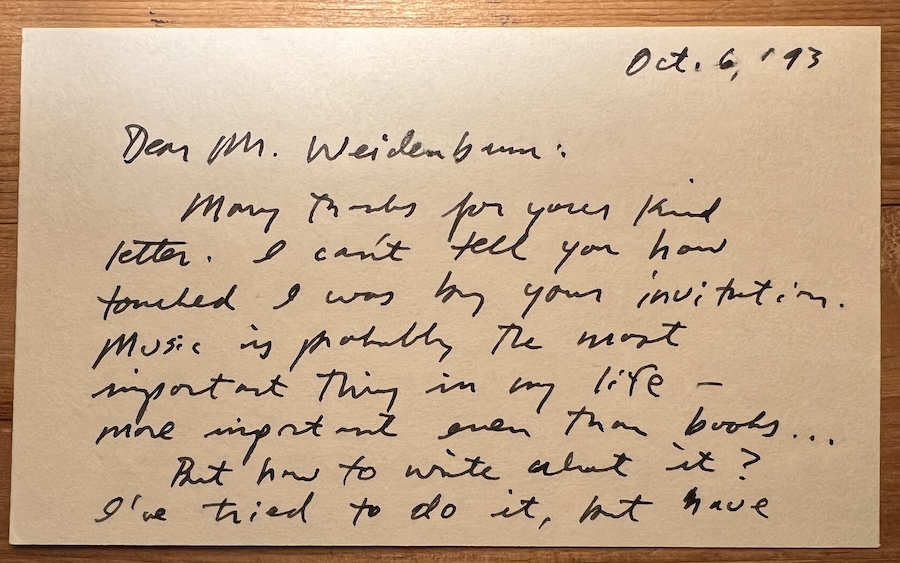
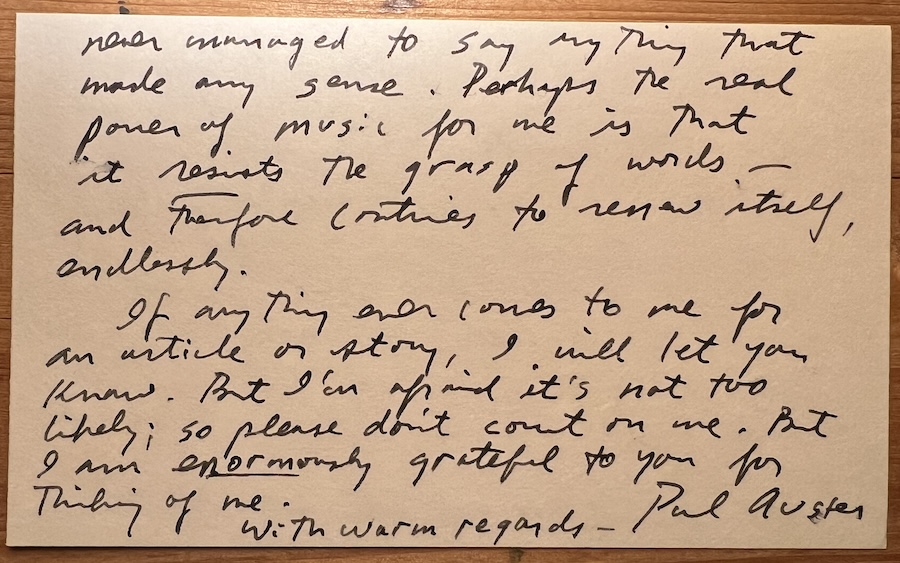
And if the script of his fountain pen is difficult to read, here is the text:
Oct. 6, ’93
Dear Mr. Weidenbaum:
Many thanks for your kind letter. I can’t tell you how touched I was by your invitation. Music is probably the most important thing in my life — more important even than books …
But how to write about it? I’ve tried to do it, but have never managed to say anything that made any sense. Perhaps the real power of music for me is that it resists the grasp of words — and therefore continues to renew itself, endlessly.
If anything ever comes to me for an article or story, I will let you know. But I’m afraid it’s not too likely; so, please don’t count on me. But I am enormously grateful to you for your thinking of me.
With warm regards —
Paul Auster
I have two very small office areas: one at home and one that I rent nearby. Neither has a proper stereo system.
The home office has a small modular synth setup next to my desk. For space-management reasons the speakers (monitors, actually, in music-equipment speak) sit perpendicular to my desk, above the synth. There I usually listen to music on my laptop speakers or headphones. My laptop, a MacBook Pro 14″ (the M1, which is somehow several generations behind but feels quite peppy and looks brand new), has fantastic built-in speakers, but when I really want to listen to something, I walk into the living room, which has proper speakers connected to what once was a proper stereo system and now inspires people point and stare and ask what the heck those big things are beneath the television and why don’t I just have a Bluetooth something or other. I have a Plex system running on a Mac Mini attached to the home stereo, so I can easily collate my digital music files (notably: inbound material I’m considering for review), listen to them in the living room, and access them elsewhere with my phone, iPad, or laptop.
The rental office is self-enclosed but in a shared building with an active hallway, so I only listen to music there on headphones and earbuds, so as not to bug anyone. My main extravagance is I bought a second guitar when I got the rental office, so I can be a terrible guitarist in two places rather than just one, and to avoid looking like an oddly clean-cut itinerant musician were I to walk back and forth with the guitar between home and office regularly.
That is where and how I listen.
I do this manually at the end of each week: collating (and sometimes lightly editing) most of the recent little comments I’ve made on social media, which I think of as my public scratch pad. Some end up on Disquiet.com earlier, sometimes in expanded form. These days I mostly hang out on Mastodon (at post.lurk.org/@disquiet), and I’m also trying out a few others. I take weekends and evenings off social media.
▰ The trope of a modern LA detective/PI who’s into throwback jazz (and/or the score is jazz-inflected) is widespread, epitomized lately by Bosch. I like how in Sugar, with Colin Farrell, the self-awareness connects to the PI’s love for classic films, and how snippets from such films are interspersed.
▰ If you have trouble keeping a journal, you might consider whether writing by hand or typing is best for you. I’m a typer, have been since far too young an age, thanks to my parents’ electric typewriter. I also like (i.e., depend on) the search-ability of text files. But that’s just one approach.
▰ I caught Bill Frisell & Hank Roberts (musicians I saw often around NYC in the late ’80s/early ’90s) as part of a sextet Frisell led at Berkeley’s Freight & Salvage, bonding the chamber-Americana of his 858 Quartet and his current jazz trio (Thomas Morgan, Rudy Royston).
▰ My Telecaster stays in tune like my Nintendo DSi holds a battery charge, just incredible staying power
▰ Guitar practice remains focused on the old Robin/Rainger tune “Easy Living,” which isn’t easy at all if you’re coming up to speed on 7th chords, so I’m just cycling through A+7 / D9 / G+7 / C9 (which involves muting strings on the augmented chords, and muting kinda eludes me) until it sounds natural
▰ Neal Stephenson’s newly announced novel, Polostan, due out October 15, is only 320 pages long, and it is apparently the first third of a trilogy called Bomb Light. Its relative brevity leads me to wonder if he turned in a 1,000-page book and was encouraged to subdivide it.
▰ Modern curses:
▰ I finished reading one novel and one graphic novel this week. First there’s Babel: Or the Necessity of Violence: An Arcane History of the Oxford Translators’ Revolution by R. F. Kuang: Can’t say I loved it. For a story founded on magic, there is little of it present here. For a book about the world, we spend little time outside of two cities. I will say, if an author notes Jonathan Swift as a guide, then readers should consider themselves warned about an impending meagerness of subtlety. And then Ultimate Invasion by writer Jonathan Hickman and illustrator Bryan Hitch. On the one hand — and I also read the first two issues of the new Ultimate Spider-Man, also written by Hickman, drawn by Marco Checchetto, which ties in with Ultimate Invasion — it’s a fun dissection and rearrangement of the Marvel pantheon. But on the other hand, it feels like it will end up reinforcing the pantheon by just building back up to the status quo. We’ll see. For now, I’m along for the ride.
Yes, I am enjoying, greatly, Rebecca West’s 1918 novel The Return of the Soldier. I don’t think I’ve read previously a contemporaneous account of what zeppelins sounded like to those for whom an appearance overhead was a not uncommon occurrence. (West is the pen name of the late Dame Cicily Isabel Fairfield. She and H.G. Wells were the parents of author Anthony West.)
