Some sounds and sound-related things I’ve been thinking about:
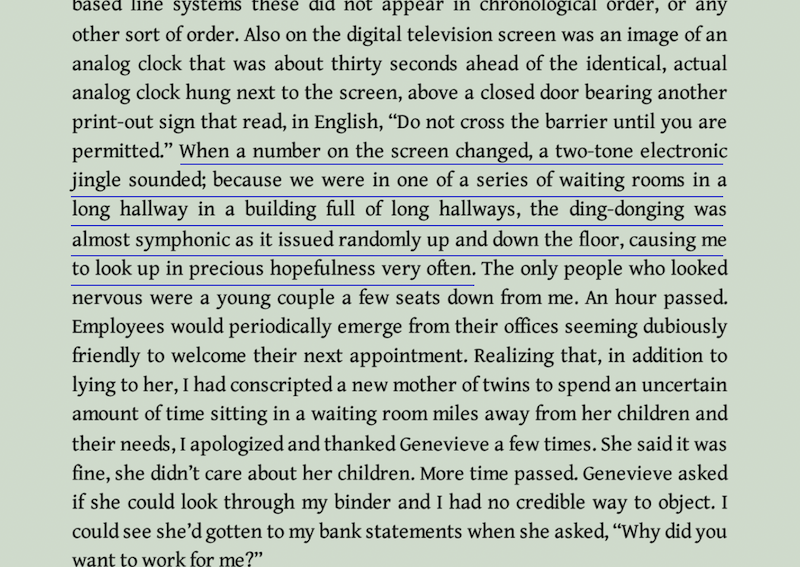
▰ When I open the refrigerator in the morning, it makes a sound like a Star Trek spaceship warp core cooling suddenly when coming out of hyperspace. That’s what it sounds like, though I don’t think that specific sound effect actually correlates with what my appliance sounds like. It’s more of an association.
▰ Elsewhere at home: the washing machine has, with the correct balance of preparation, a sudsy seesawing that can lull me to sleep any time of the day.
▰ When I listen to an audiobook while going for a walk, occasionally I miss a word, even just a syllable. The app will, with the push of a button, bounce back 15 seconds, but that’s a lot of words — as many as 30 or 40. If I hit it immediately, my being distracted due to having missed a word means I miss subsequent words, as well. So what I have to do is wait, listen some more, and then hit rewind, within the 15-second window. When I have this down, it’s as natural as my stride.
▰ I record audio notes for myself throughout the day, much as I jot down notes throughout the day. I have been trying out a variety of apps to transcribe my audio recordings, and one thing I’ve noticed is how much context matters. When I record a few words, the machine can’t always make them out suitably. It’s in my interest to make a full statement, so that the machine can form the correct words from the syllables.
▰ My phone (an iPhone) has too many options to mute sounds, including alerts and alarms. These variables have varying impacts that I can’t always keep track of: the little slider on the side, the volume, the “focus” level, the app-specific “notification” settings. It gets confusing. It’s like different committees control each of the options, and these committees haven’t met in a while.
▰ Speaking of my phone, I use the Background Sounds option quite a bit, to aid concentration, and a recent update to the software has made the tool oddly difficult to access: you have to swipe once and then hit four subsequent buttons simply to turn on the noise. It’s quite odd.