Disquiet Junto Project 0730: Calendar Advent

The Assignment: Create a sonic diary of the past year with a dozen (or more) super-brief segments.

Each Thursday in the Disquiet Junto music community, a new compositional challenge is set before the group’s members, who then have five days to record and upload a track in response to the project instructions.

Membership in the Junto is open: just join and participate. (A SoundCloud account is helpful but not required.) There’s no pressure to do every project. The Junto is weekly so that you know it’s there, every Thursday through Monday, when your time and interest align.

Tracks are added to the SoundCloud playlist for the duration of the project. Additional (non-SoundCloud) tracks also generally appear in the lllllll.co discussion thread.

Disquiet Junto Project 0730: Calendar Advent
The Assignment: Create a sonic diary of the past year with a dozen (or more) super-brief segments.

As has become the tradition at the end of each calendar year, this week’s Junto project is a sound journal: a selective audio history of your past 12 months.

Step 1: You will select a different audio element to represent each of the past 12 months of 2025 — or you might opt for even more elements, choosing a segment for each week, or each day, for example. These audio elements will most likely be of music that you have yourself composed and recorded, but they might also consist of phone messages, field recordings, or other source material. These items should be somehow personal in nature, suitable to the autobiographical intention of the project; they should be of your own making, your own devising, and not drawn from third-party sources.

Step 2: You will then select one segment from each of these (most likely) dozen audio elements. If you’re doing a dozen items, one for each month, then five-second segments are recommended, for a total of one minute. Ultimately, though, the length of the segments and of the overall finished track are up to you.

Step 3: Then you will stitch these segments together, equally weighted, in chronological order to form one single track. There should be no overlap or gap between segments; they should simply proceed from one to the next.

Step 4: In the notes field accompanying the track, identify each of the audio segments.

Tasks Upon Completion:

Label: Include “disquiet0730” (no spaces/quotes) in the name of your track.

Upload: A person participating in the Disquiet Junto should post only one track per weekly project (SoundCloud account preferred but not required). If on occasion you feel inspired to post more than one track (whether to a single account or across multiple accounts), you should clarify which is the “main” rendition for consideration by fellow members and (if on SoundCloud) for inclusion in the SoundCloud playlist.

Share: Post your track and a description/explanation at https://llllllll.co/t/disquiet-junto-project-0730-calendar-advent/

Discuss: Listen to and comment on the other tracks.

Additional Details:

Length: The length is up to you. How long did your year feel?

Deadline: Monday, December 29, 2025, 11:59pm (that is: just before midnight) wherever you are.

About: https://disquiet.com/junto/

Newsletter: https://juntoletter.disquiet.com/

License: It’s preferred (but not required) to set your track as downloadable and allowing for attributed remixing (i.e., an attribution Creative Commons license).

Please Include When Posting Your Track:

More on the 730th weekly Disquiet Junto project, Calendar Advent — The Assignment: Create a sonic diary of the past year with a dozen (or more) super-brief segments — at https://disquiet.com/0730/.
Blackout

New meaning to this tag

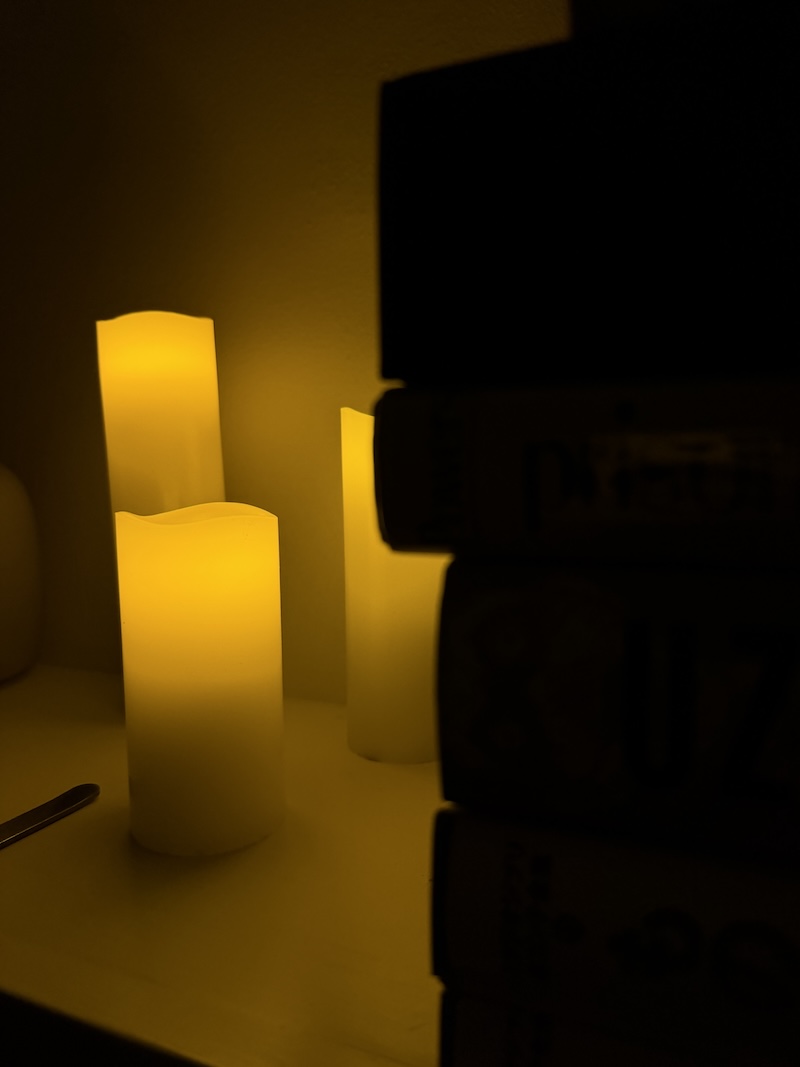
No post on Sunday, due to the blackout that swamped a lot of San Francisco, including the neighborhood where I live. Definitely gives new meaning to this site’s “current activities” tag.

Scratch Pad: 30s, Freesound, Fosse

From the past week

At the end of each week, I usually collate a lightly edited collection of recent comments I’ve made on social media, which I think of as my public scratch pad — and I tag on what books I may have finished reading. Knowing I’ll revisit my social media posts, I’ve found, serves as a positive and mellowing influence on my online activity. I mostly hang out on Mastodon (at post.lurk.org/@disquiet), and I’m also trying out a few others. And I generally take weekends off social media.

Right now, though, I’m on a more extended social media (and adjacent) break, through the start of January 2026. Which raises the question: when I’m on such a hiatus, what constitutes this site’s Scratch Pad, since this Saturday habit is, by definition, a collation of stuff I posted to social media throughout the given previous week? Apparently it’s random notes I make to myself that I would have posted online, plus bits I’ve sent to friends via email and other means. Just because I’ve stopped posting doesn’t mean my brain has stopped making posts. Anyhow, here’s this past week’s roundup:

▰ This week I started posting brief field recordings, each roughly 30 seconds in length, and writing about them. The series is now titled #30s. It’s funny, and informative in its own way, how this began. I went for a walk, which became an unexpected errand, which led to me hearing something (#30 Retail Phase, the sound of a retailer’s shoplifting alarm system), and recording it, and writing about it, and then doing the same three more times: (#30 Play Misty, the city waking to rain; #30 Block Chain, construction noise; and #30 Internal Monologue, the sound inside the household fridge). One chance alteration of a plan blossomed into an ongoing mini-series of interrelated reflective investigations.

▰ I’ve apparently been on freesound.org for over 20 years.

▰ Pondering trying again at Weekly Beats / “Jamuary,” which kick off in a few weeks

▰ On the Lines BBS (llllllll.co) there’s an annual discussion of the upcoming year’s goals, and I made some gestures in that direction.

▰ I just noticed the little waveforms that appear on my iPhone when I’m on a phone call with someone. There is a waveform at the top of the screen (iPhone 17 Pro), a tiny thing to the right of the “dynamic island,” and it shows different colors, on opposing sides of the waveform, depending on who is speaking.

▰ I spend a lot of time on video conference calls. Recently it’s seemed that people have had less difficulty with audio. I don’t know if the interfaces or the underlying technology are getting better, or we’ve just all been better trained at this point.

▰ A backpack remains a central organizing principal of my life. Getting a new one is a milestone of sorts, and requires some reorientation.

▰ Will there ever be another Don DeLillo novel? When will the next William Gibson book be published?

▰ I finished reading two novels this week: Jon Fosse’s Morning and Evening and Sarah Gailey’s Spread Me, respectively the 25th and 26th of the year (not counting a novel’s worth of books I started and didn’t finish). The strongest aspect of Morning and Evening, to me, is the fluidity with which Fosse paints these liminal existential/theological spaces. It was interesting to have completed it right after What We Can Know, by Ian McEwan (Atonement), because both novels have distinct parts one and two. In What We Can Know, there is a lot of part one before the jump; in Morning and Evening, there is precious little. Meanwhile, the “literary” What We Can Do and the “pulpy” Spread Me both take the future impact of climate change as their starting points, and both are lust-heavy. I’m almost done with Jinwoo Park’s Oxford Soju Club, and deep into several others, Middlemarch, House of Leaves, and Midnight’s Children among them. Yeah, too many at once, again. That’s one new year’s resolution deflated before the new year has even begun.

Stigmatic Ambient Music, Update 2

In which a negative is no longer misrepresented

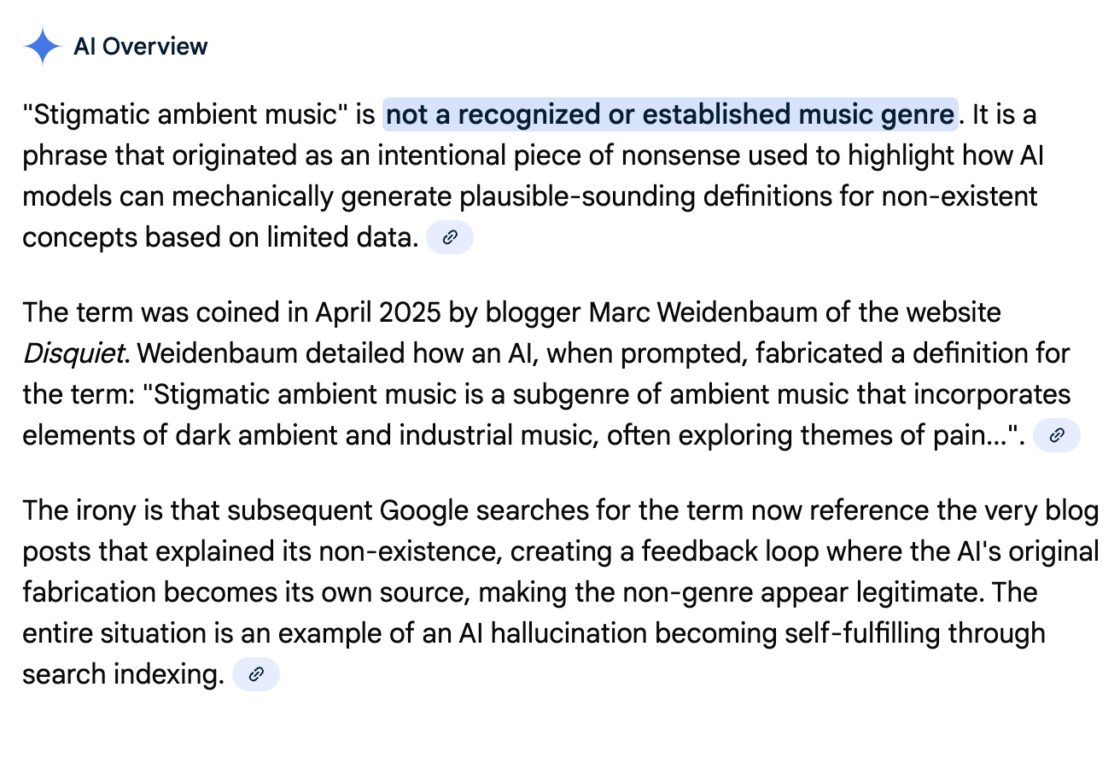
Back in April I wrote a post about a fake genre, which I had named “stigmatic ambient music.” For months afterward, a search for the name on Google would return statements as if the genre were real, which it wasn’t and still isn’t. This phenomenon was a classic AI feedback loop, in which a negative was misinterpreted as a positive. My original post was not an attempt at culture jamming. I hadn’t acted as if the genre was real. Quite the contrary, the post’s subhead stated clearly that stigmatic ambient music “doesn’t exist.”

Two months after that first post, I wrote an update that noted this ongoing issue with “stigmatic ambient music.” Google persisted in stating as fact that the genre not only existed but flourished sufficiently to deserve a detailed description of its characteristics:

“Stigmatic ambient music is a subgenre of ambient music that blends elements of dark ambient and industrial music to create a soundscape focused on pain, suffering, and psychological distress. It’s characterized by its use of dissonance, harsh textures, and a focus on unease or dread, often achieved through sound design rather than melody.

I bookmarked the Google search results for the non-genre, bounded by the preceding 24 hours, and I made a habit of clicking on the link each morning, and this remained the case day after day, month after month. Nothing of note changed.

And then today, December 19, for the first time, the search results reflected what had actually happened. This is the text of this morning’s automated summary attributed to Google Gemini:

The word “hallucination” gives me pause, because even if accepted as merely colloquial, it serves as an anthropomorphism that reinforces the problem (that is, the flattering presumption of cognition and awareness), but otherwise the description is, for once, factually accurate.

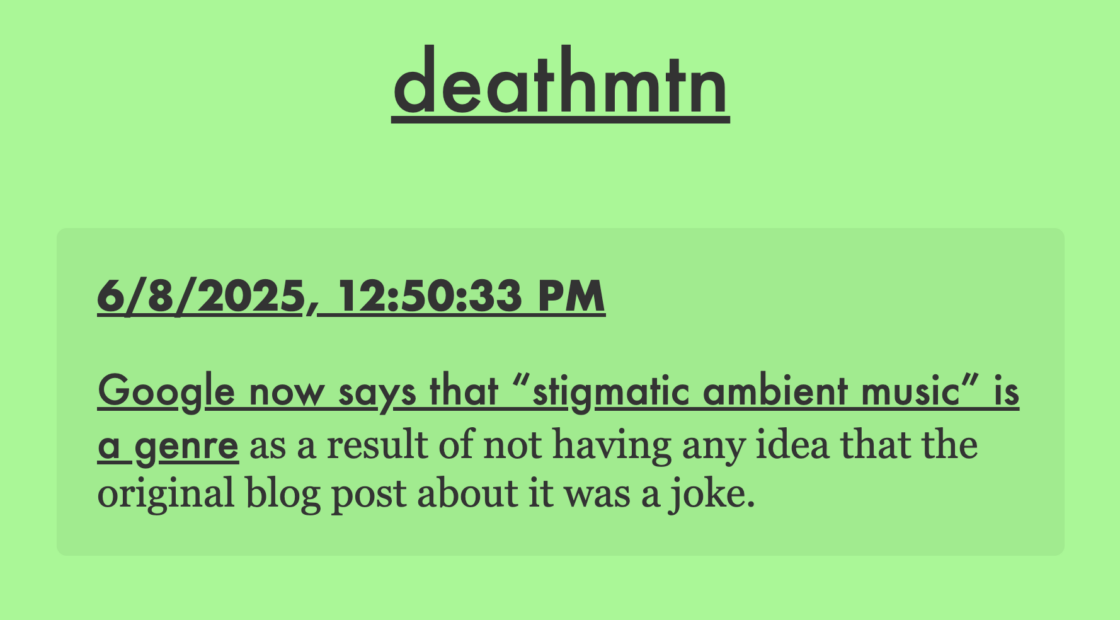
I suspect the change may relate in some way to Google having recently indexed a June 8, 2026, post by software engineer Jim Kang that briefly mentioned my exploration of AI’s response to the non-genre.

This development is good, because the correction has occurred, but less good, in that all it may have required was one sentence from a third party in order to entirely change Google’s AI mind (or “mind”) on the topic.

Scratch Pad: Lore, 1988, Obsidian

From the past week

At the end of each week, I usually collate a lightly edited collection of recent comments I’ve made on social media, which I think of as my public scratch pad — and I tag on what books I may have finished reading. Knowing I’ll revisit my social media posts, I’ve found, serves as a positive and mellowing influence on my online activity. I mostly hang out on Mastodon (at post.lurk.org/@disquiet), and I’m also trying out a few others. And I generally take weekends off social media.

Right now, though, I’m on a more extended social media (and adjacent) break, through the start of January 2026. Which raises the question: when I’m on such a hiatus, what constitutes this site’s Scratch Pad, since this Saturday habit is, by definition, a collation of stuff I posted to social media throughout the given previous week? Apparently it’s random notes I make to myself that I would have posted online, plus bits I’ve sent to friends via email and other means. Just because I’ve stopped posting doesn’t mean my brain has stopped making posts. Anyhow, here’s this past week’s roundup:

▰ Back early on when I was teaching a course on sound at a local art college, maybe 2013 or 2014, a student asked me, during discussion toward the end of a semester, what I though the normalized state of everyday being would become, given how fast things seemed, at the time, to be changing — and this is a decade-plus ago — and my response, in the moment, was “flux.”

I though “flux” might become an everyday sensibility. We might be concerned about flux but we would also adjust to and even take pleasure in flux. Flux was sort of the opposite of the supposed “end of history,” or an aslant corollary. Flux was change as a manic constant.

What I didn’t foresee was “lore,” which has clearly prevailed. Lore is the glue — whether fictional, or as a matter of heightened narrative-providing, dot-connecting facets of everyday life — that keeps things together. Lore’s prevalence in particular in the consumption (and collective contribution to) popular fiction feels like an expression of a desire for such continuity outside of fiction: lore as an antidote to flux. Lore is the anti-flux.

I still take pleasure in flux. To me, flux is riding the everyday, a bit like standing while on a public bus, or dodging fellow pedestrians while keeping up a good pace on a city sidewalk. I’ve never had great balance physically, but I can handle the cultural and technological flux okay. Keeping track of lore is not as much of a strength for me, come to think of it.

▰ I’m always keeping an eye on the Obsidian roadmap, Obsidian being my note-taking and writing cross-platform app of choice. Excited for a lot of what’s ahead, especially multiplayer, mobile widgets, and Bases support for Publish.

▰ It’s kind of funny to attend a concert in a church with a massive pipe organ, and the pipe organ just serves as a visual backdrop. No one plays it.

▰ I had an iPod but the vibration of the pre-SSD ones weirded me out. I think I used mostly rando Sandisk-type ones until the Touch came out.

▰ I have, based on recent evidence, found myself deeply in a phase of my life where I find concerts of songs that are all verse chorus verse, and during which there’s no musical improvisation, to be fully claustrophobia-inducing.

▰ When I got out of college, in 1988, I lived, for a spell, walking distance from the old Knitting Factory, the one on Houston Street. This year, 2025, here in San Francisco, I managed to walk from my home to concerts featuring Marc Ribot (in Golden Gate Park) and Fred Frith (at the 4 Star), both of whom I saw at the Knitting Factory way back when. More of this in 2026, please.

▰ I didn’t finish reading anything this week, but considering what I finished reading last week, I think that’s OK. I’m very close on Jon Fosse’s Morning and Evening and Sarah Gailey’s Spread Me.