At the end of each week, I usually collate a lightly edited collection of recent comments I’ve made on social media, which I think of as my public scratch pad. I find knowing I’ll revisit my posts to be a positive and mellowing influence on my social media activity. I mostly hang out on Mastodon (at post.lurk.org/@disquiet), and I’m also trying out a few others. And I generally take weekends off social media.
▰ The TV has a remote and the remote has a mic, so I queried it with “Pump Up the Volume” and, of course, this simply made the TV raise its volume level
▰ Going to see Elvis Costello this week. The tour is of the “early songs,” which apparently restricts itself to merely the first 11 albums (1977–1986).
▰ A friend mentioned having played a “url” show, which I initially figured to be a typo for an “irl” (in real life) show, but it turned out to have been a livestreaming show. I like clearly paralleled typology: There are URL shows and there are IRL shows (and, of course, hybrids).
▰ I had noticed that many shows on this current Elvis Costello tour had, thus far, opened with either “I Hope You’re Happy Now” or “Mystery Dance,” and most featured both, and I thought little of it, but when he sang them here in San Francisco, I realized the first was a sign that you weren’t quite getting what you thought you asked for, and the second includes the phrase “Don’t bury me ’cause I’m not dead yet.”
▰ Exploring some old Mario games, circa 2001-ish. It’s like going back to some summer camp I forgot I’d attended.
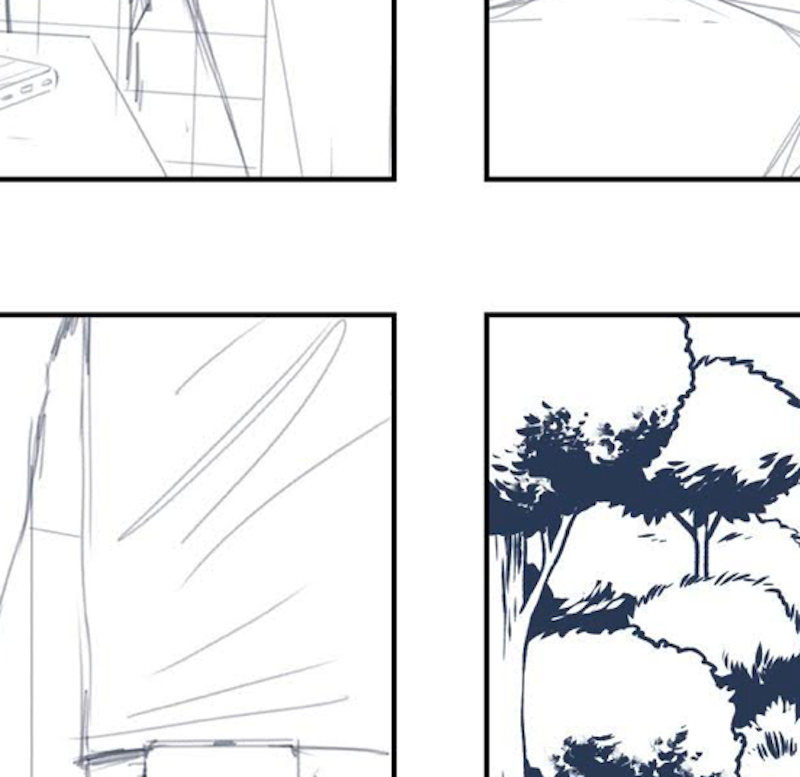
▰ A new installment of the Frame by Frame comic series I’ve been doing with illustrator Hannes Pasqualini should appear this coming week. Here’s a sneak peek. Meanwhile, the previous ones are at disquiet.com/fxf.
▰ The wind is prelude. When you hear it blowing, you step outside to confirm that, yes, the Golden Gate Bridge is again singing, and somehow the bridge’s song sounds the same (droning, unearthly) and different (today: steadier, thinner, more persistent, higher-pitched), and you can’t believe this remains a thing.
▰ Finished reading one book this week, Stephen King’s The Long Walk. I think it’s the only Stephen King novel I’ve finished reading, aside from The Green Mile, which I bought when it was first serialized as tiny little paperbacks — and I’m not entirely sure I finished that one.
▰ And this week in #dronescrolling — i.e., stuff other people posted: Matthew Wilcock has this ongoing series of sonified videos, on Instagram, of vehicular activity that are fantastic, turning streets and highways and even parking lots into piano rolls. And he’s also done table tennis and pedestrian intersections. (Thanks, Lowell Goss!) ▰ Bruce Levensteinsaid, on Bluesky, what many of us non-UK folks think: “it’s 2025. i want to pay for access to BBC iPlayer.” ▰ Mahlen Morris provided, on Mastodon, a run-through of resources for what the Golden Gate Bridge sounds like when it’s singing.
"Playing" Cory Arcangel's Nintendo remix on a modern handheld console
/ By Marc Weidenbaum
I spent all of my mornings this past week writing about sound in video games, and in the process, I kept coming back to the Nintendo GameCube, which led me to think in particular about gaming in the early 2000s, since the GameCube debuted in 2001.
My subject was, and remains currently, the contemplative aspects of video games and video game sound, notably when one is encouraged — or acts on the instinct — to pause without hitting pause, to situate oneself in a virtual space and observe, especially by listening, to the digital world in which one and one’s on-screen counterpart(s) are engaged. Think of this practice as gaming transcendentalism. In our time of highly popular long-form gaming videos that document digital environments, it’s a fascinating subject that brings media archiving into the realm of the somatic.
Throughout this writing I’ve been doing, an inevitable reference point, for me, has been Cory Arcangel’s classic media art piece, the deeply reflective Super Mario Clouds, which he created in 2002 (and which was featured two years later in the Whitney Biennial). This despite the fact that Super Mario Clouds is, in fact, entirely silent.
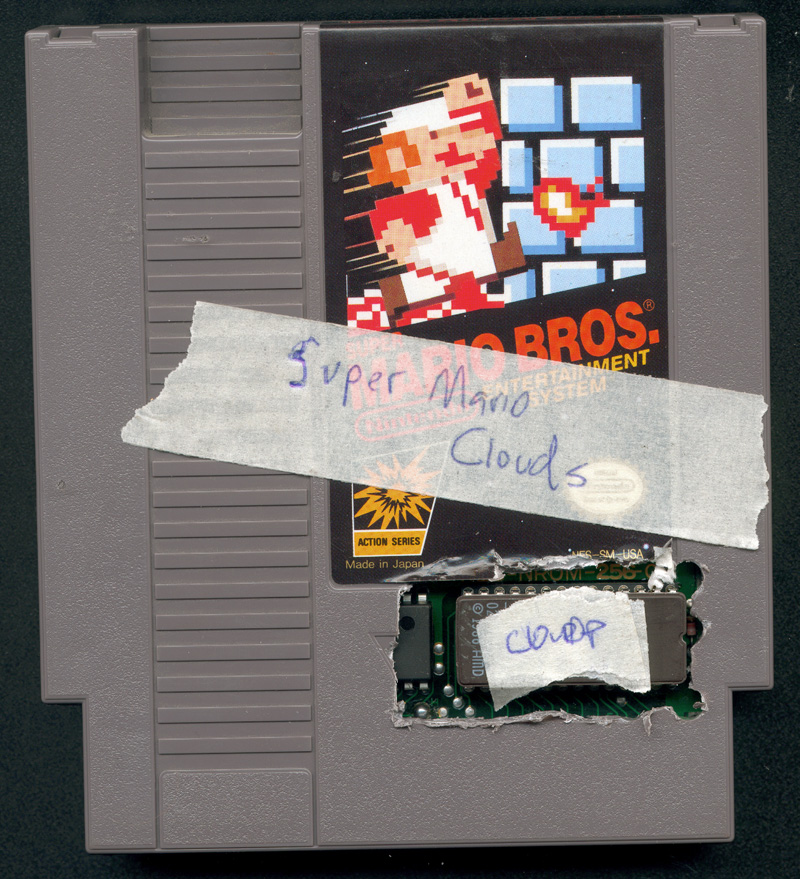
For the work, Arcangel took a cartridge of the game Super Mario Bros. and hacked it to remove everything but the blue sky and the cartoonish white clouds. Absent are Mario, and his various obstacles, and even Koji Kondo’s musical score. All that remains are a static sky and those passing clouds, which tellingly resemble thought balloons.
Super Mario Bros. ran on the Nintendo Entertainment System (NES), aka the Family Computer (Famicon), and was the very first Super Mario game. It came out in 1985, two years after the NES debuted. What may be useful to note is that Arcangel was born in May 1978, so he was about seven and a half years of age when Super Mario Bros. appeared. An impressionable phase of one’s life, to say the least.
“By tweaking the game’s code, the artist erased all of the sound and visual elements except the iconic scrolling clouds. On a formal level, the project is reminiscent of paintings that push representation toward abstraction: how many elements can be removed before the ability to discern the source is lost?“
And then I made my way to Arcangel’s own website, which has a page dedicated to Super Mario Clouds, displaying his hacked cartridge — and including a link to his own version/remix of the original Super Mario Bros. software.
I downloaded the Zip file, de-archived it, and recognized the file’s suffix, .nes, from the ROMs for old NES games. We live in the golden age of cheap small portable game consoles that allow one to play outdated video games, so on the chance it might work, I popped the microSD card out of my Anbernic RG35XXSP, a small, clamshell device that pointedly resembles a Game Boy Advance SP. I put the SD card into my laptop, dragged the .nes ROM (file name: arcangel-super-mario-clouds.nes) into the folder titled FC (for Famicon), safely ejected the microSD card, and slid it back into the slot on my SP.
On his website, Arcangel notes that Super Mario Clouds remains, to some degree, a work in progress: “I still need 2 get around 2 cleaning up all the different versions of this code.” So, I wasn’t even sure if his ROM would run, or if it might even freeze up my SP. I turned on the Anbernic, found my way through the menus to the arcangel-super-mario-clouds.nes file, and hit play — and it worked, immediately. The screen turned blue as the brightest day of summer, and the little white clouds began to pass by slowly from right to left.
The dimensions of the image, however, left wide black spaces on either side of the screen, and I recalled that Arcangel’s site had a note that read “Dims: Dimensions variable.” Taking that allowance as a cue, I went through the menus in the alternate firmware I’d installed on my Anbernic SP (in essence, I was running modded software on modded firmware), made a few changes to the arcane settings, and Super Mario Clouds proceeded to fill the screen from edge to edge.
This is when I had the urge to record a long, continuous segment, 10 minutes, to share online. Though Super Mario Clouds is, of course, itself silent — the absence of sound being one of myriad ways Arcangel chiseled his work from larger, more complex source material — that silence speaks to the contemplative opportunities inherent in video games.
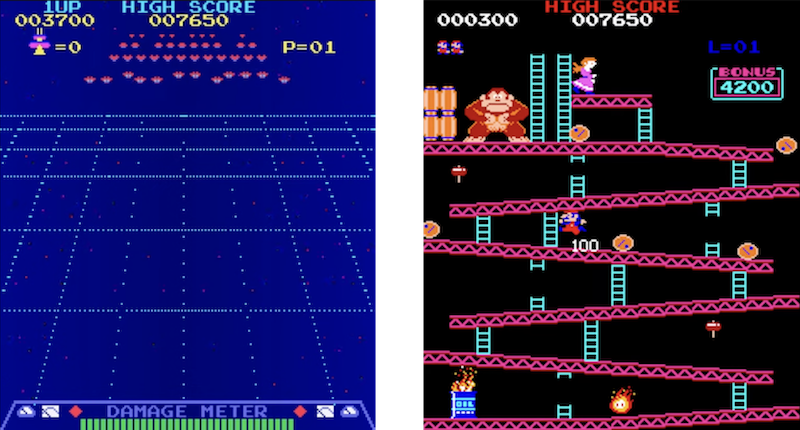
I also recalled that game designer Shigeru Miyamoto, creator of Super Mario, had, early on in his work at Nintendo, been tasked with finding a creative reuse of thousands of abandoned arcade consoles originally designed for a failed game called Radar Scope (1980). In Radar Scope, the screen shows an image that goes off toward a distant horizon, providing a sense of three-dimensional play. Miyamoto dispensed with 3D, and embraced the creative constraint of merely two dimensions. The result was Miyamoto’s first classic (of many), Donkey Kong (1981). There’s a connection to be drawn between Miyamoto’s reduction of the arcade game format to two dimensions, and Arcangel’s further reduction of Miyamoto’s original Mario game to merely its backdrop.
Now, on the one hand, my video of Super Mario Clouds on a modern handheld is, like Arcangel’s original work, entirely silent. On the other hand, the piece’s elegance and its (virtual) environmental focus make it part and parcel of the gaming transcendentalism that I happen to explore mostly through video game sound. To reinforce this point, I almost edited my video to a length of 4 minutes and 33 seconds, following John Cage’s template, but then I decided that 10 minutes allowed for a more immersive experience.
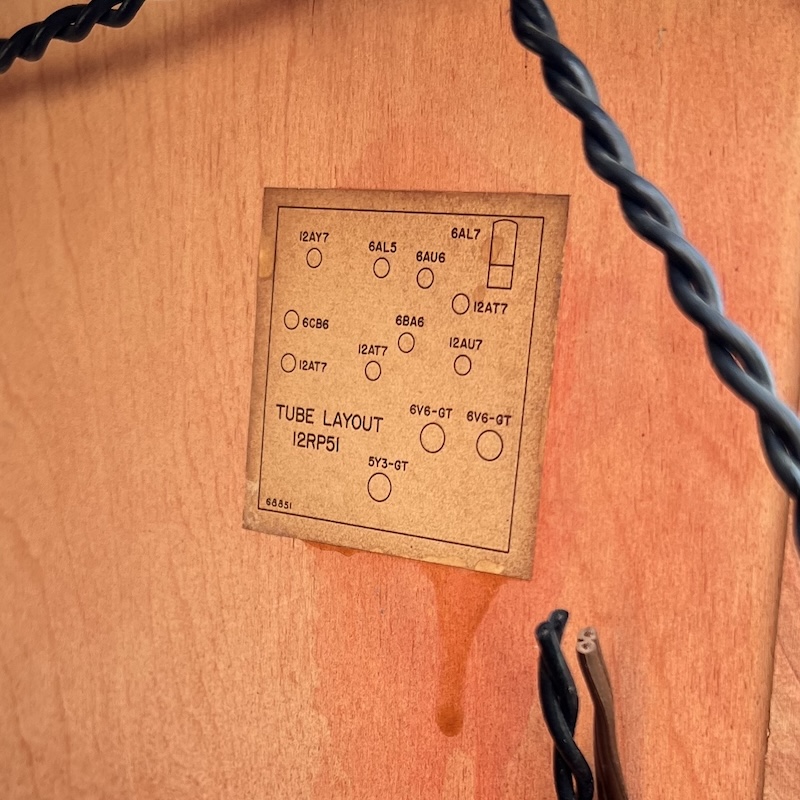
This is the “tube layout” for an ancient stereo console that someone left out on the street. The sticker, undated, was on an inside wall of the piece of furniture. When I complain about how absurd dealing with metadata of audio files continues to be, I like to remind myself that the past had its own difficulties and complexities.
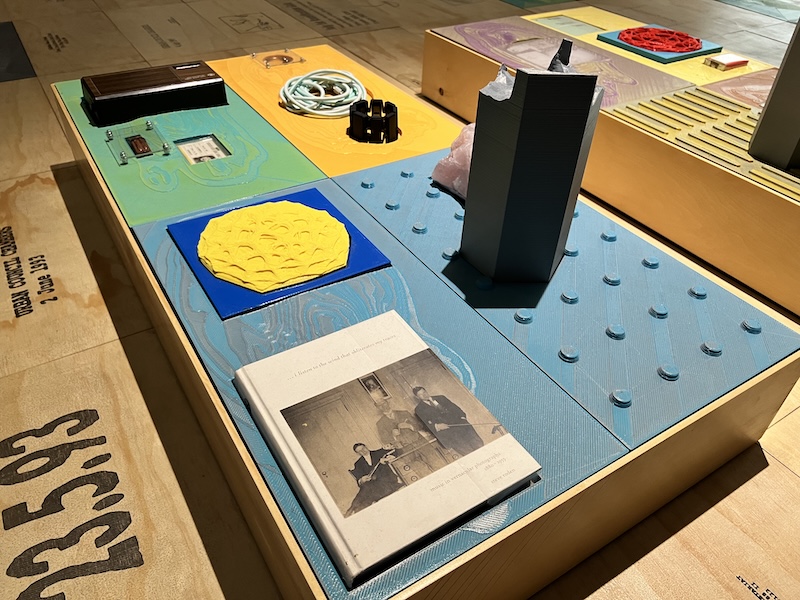
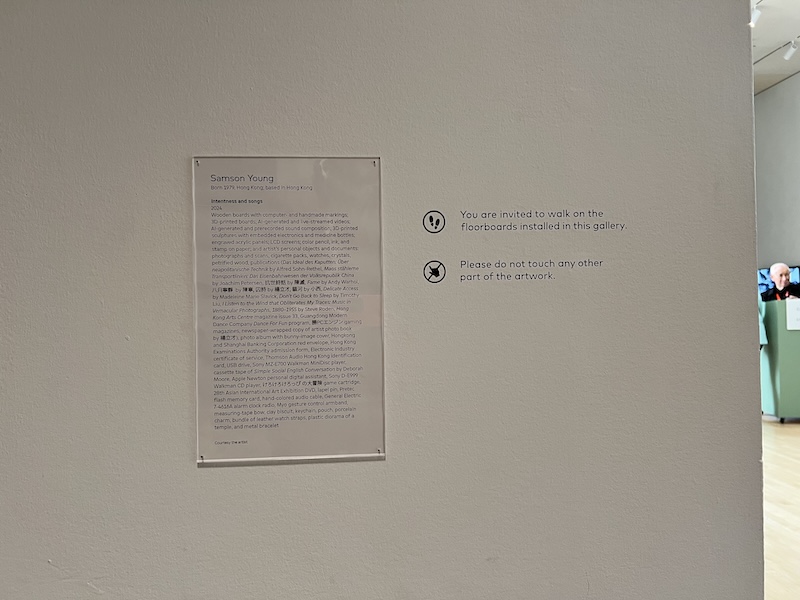
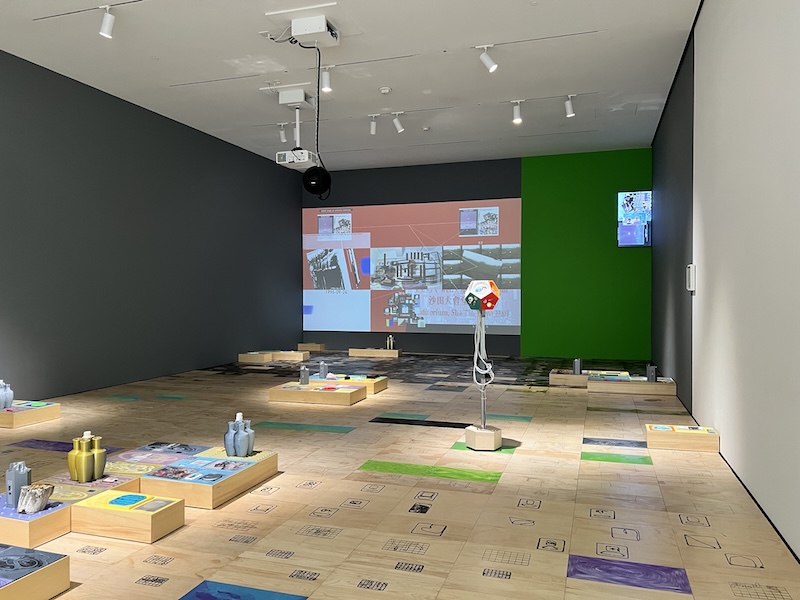
A friend some time back shared a photo of an object in the current installation by artist Samson Young, Intentness and song, that is on view at SFMOMA (December 21, 2024 – June 22, 2025). I first encountered Young’s work when I reviewed Seeing Sound, an exhibit curated by Barbara London at the Kadist gallery here in San Francisco back in mid-2021. This new Young exhibit is a sizable space filled with ephemera, notably small gadgets that emit little bits of light and sound, much of it on tight loops, all of which resists easy mental collation. I was touched to find old familiar gadgets, like an Apple Newton and a Sony MiniDisc player, in the mix, as well as this book by the late sound artist Steve Roden, i listen to the wind that obliterates my traces. Young seemed to have excavated his own memory palace and created a vaguely Lego-like zone of contemplation.
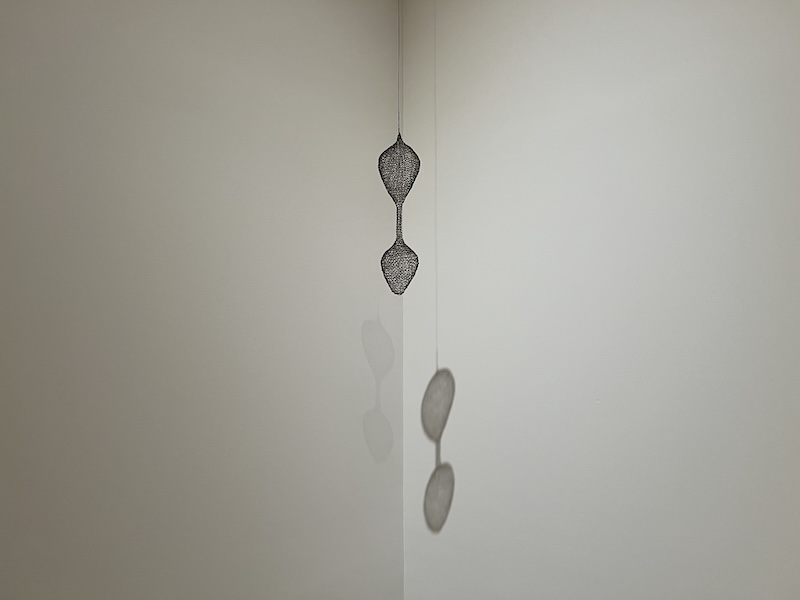
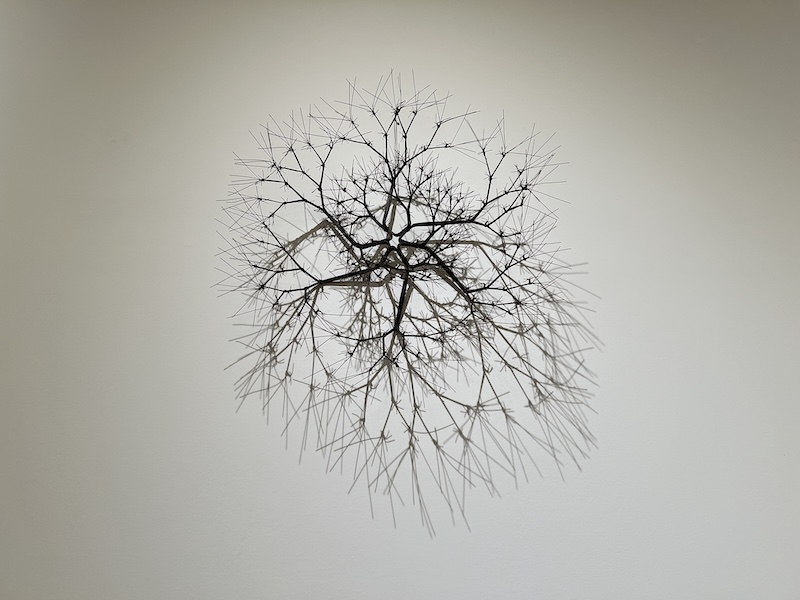
The Ruth Asawa retrospective at SFMOMA is a dozen shades of fantastic. I fear it’s becoming cliché to note it, but with the sculptures, the physical objects are only part of the story. The shadows carry a lot of the weight, so to speak. And it’s really the interplay where things happen. It’s like the sculptures are the guitar solo, and the shadows are the result of delay and reverb pedals.