My ongoing Listening Diary of the newly released dozen Autechre live sets from 2023 and 2024 has passed the 2,000 words milestone, with no signs of slowing down, and thus far I’ve still only touched on half the latest AE_2022- recordings. Today I focused on the Melbourne date for the first time, with side trips to Turin, and to Japan, and to William Gibson’s early fiction (speaking of which, Neuromancer turned 40 this year). In the process of keeping this diary, I’ve also been building up a much larger collection of “Other Notes” at the bottom of the post than I had expected to, most recently to share some examples of the software Autechre utilizes (live and in the studio), as well as to strike an accidental contrast between these new sets and one of the ones from the seven that were released in 2023.
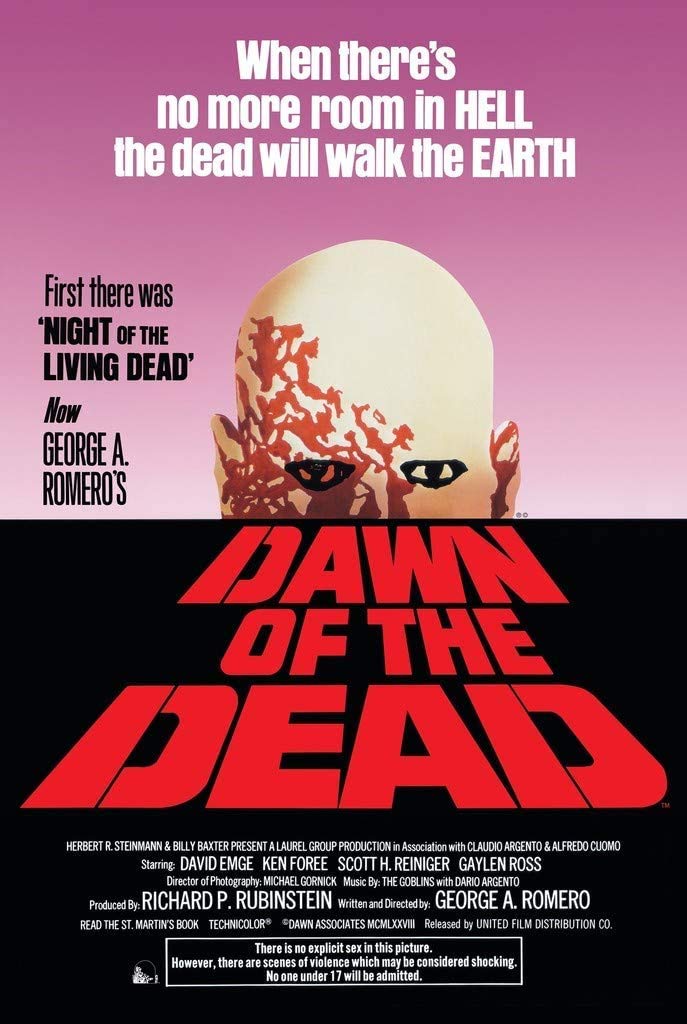
Anti-eroticism. Architectural literacy. Consumerism finger-poking. And zombies, lots of zombies. I wrote about the original Dawn of the Dead (1978), one of my favorite movies of all time, for Hilobrow’s ongoing horror series. The 25-part collection, titled Scream Your Enthusiasm, has some great contributors, including comic book artist and playwright Dean Haspiel, film editor Crockett Doob, author Lynn Peril, and series editor Heather Quinlan, just to name a few. I didn’t have space to get into the music, but of course the film’s classic score was the result of a team-up between the band Goblin (“the Goblins” on the poster) and Dario Argento. I dedicated the short essay (as I did an earlier Hilobrow piece on Celtic Frost) to my late friend Eric Engelhardt.
I’ve been doing a lot of research these past few years into field recordings, those of both the natural environment and the built environment. Bridging, in a manner of speaking, the gap between the two respective realms are the environmental sounds that fill video games, virtual reality, and the like. They are artificially created yet intended to give the impact of something real, something heightened or extrapolated, something — to use the ubiquitous term — immersive. Many of these high-definition sonic studio concoctions are derived from actual field recordings, while others are produced more synthetically. Such recordings are, of course, intended to be experienced in a given context.
However, as with the one heard (and seen) below, in which a driver navigates the nighttime streets of the 2013 game Grand Theft Auto V, there is a large and growing audience for prerecorded video game experiences, and though they are, inherently, audio-visual, many of these fan recordings are couched in sonic terms, like “ASMR” and as “sleep aids.” There is something lulling, indeed, to this city drive, which the title informs us has “NO LOOPS” — which is to say, it is a constant, non-repeating stream of different journeys around the open world of the video game, courtesy of the channel named Video Game Weather ASMR. It is also, per the functional title, eight hours long. The primary things I found myself listening to are the car engines and the rain, and I found myself listening for variations therein. Your mileage may vary. I recommend starting at the beginning and then checking out the different scenarios, each from the point of view of a different driver/character in the game. There is a clickable table of contents to the video, helping situate you should you want to know where you are — or more to the point, who you are — at a given moment.
The British duo Autechre traffic in abstract music that veers between abstract sound design and challenging club music, which is to say they record what is known as IDM, and this past week they did what they seem to do every few years, which is to unleash an ungodly amount of their music out of the blue all at once. For background: There was the four-hour-plus elseq 1-5 in 2016, and the eight-hour NTS Sessions 1–4 two years after that. And of course, way back in 2015, there were the 28 hours of music comprised by AE_LIVE. Oh, and the nearly eight-hour AE_LIVE 2016/2018 in 2018. Bringing us up to the present: In 2023 Autechre released 7 full sets, packaged as AE_LIVE 2022–, from a tour that occurred mostly the year preceding, and then this week, rather than create a new catch-all title, they simply added another dozen sets from 2023 and 2024, bringing AE_LIVE 2022– (the hyphen still open, no end in sight) to a total of 19 sets, or nearly 23 hours of music. It’s a lot. Like, a lot, even on its own, and especially in the broader context of these 2001-ish monoliths, not to mention their studio recordings and other work. As I’ve done in the past, I’m going to try to tackle — and almost certainly fail — this motherlode by doing so in plain sight, keeping a listening diary rolling in public. It’s at disquiet.com/autechre_live_2024. Now, the point of this Listening Post series is to help pick out items in the vast miasma (sorry, I’m in the midst of reading Neal Stephenson’s new novel, Polostan) of modern music. I’d suggest starting off with AE_MADRID_100424. (I can’t embed it here, but you can check it out at autechre.warp.net.)
I do this manually at the end of each week: collating recent comments I’ve made on social media, which I think of as my public scratch pad. I find knowing I’ll revisit my posts to be a positive and mellowing influence on my social media activity. I mostly hang out on Mastodon (at post.lurk.org/@disquiet), and I’m also trying out a few others. And I generally take weekends off social media.
▰ Went to the symphony. The orchestra tuned up. My friend: “This is your favorite part, isn’t it?” Me: “Yeah.”
▰ Me earlier this morning: it’d be a good week to catch up on some recent and upcoming album releases.
▰ Definitely a first for me: I saw a pair of great used speakers on Craigslist. The guy selling them was 30 miles away. Arranging a meet-up was difficult. He was like “How about I mail them?” I was like “I trust you. Let’s do it.” They arrived today, well-packed. It’s the little things.
▰ Every morning I pick an Oblique Strategies card at random. Today’s? “Just carry on.”
▰ I pull up Brian Eno’s Thursday Afternoon (which it is, I notice after the fact), and my streaming service is like, “Oh, it’s you again. You paused at 16:46 last time. Wanna start from the beginning, or pick up where you left off? Ha, doesn’t matter. We know you’re just gonna let it loop for hours.”
▰ The odd comfort of a siren screaming by, a reminder there is a world outside my home office
▰ I know how to turn off auto-play. I don’t know how to turn off the thing that turns auto-play back on.
▰ I did make a top 10 albums list this year — top 25, actually. I’ll post it in a bit. Still reconciling it with my general disinclination to do such a thing. The main benefit, for me, was how it’s helped me think about tracking my listening slightly differently. Maybe something good will come of that.
▰ Readers: “You never write negative reviews anymore.” Me: “I do. I just only send them to the publicists.”
▰ The hard part about there being so much music is that there is so much music that sounds nearly the same. In 1996, a record of birdsong and ambient tones stood out; now there’s like 10 a week. Ditto arpeggio-heavy synths. And jazzy breakbeats. And laptop-baked “avant-pop.” And so forth. The overload isn’t about numbers; it’s about a handful of siloed monocultures within which the differences between albums has become somewhat minimal.
While I’m at it: I think from a certain perspective, avant-pop is where something might shine through by combining elements toward a unique artistic point of view. But in the end, a lot just sounds like it’s using such elements as window dressing for what is, in effect, a fairly standard song.
▰ Turning up the white noise like a morphine drip
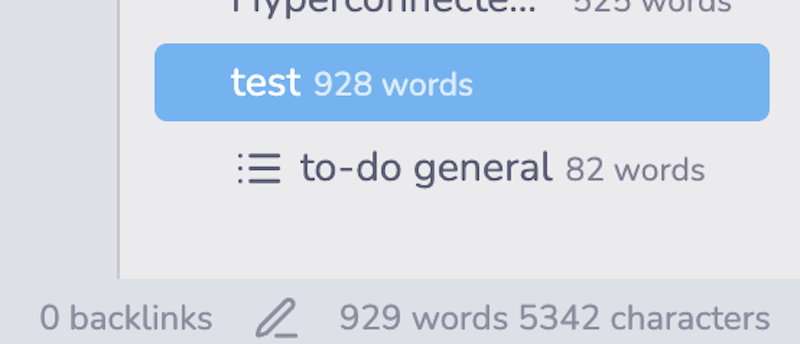
▰ You’d think if computers could do one thing, it’d be to count consistently. I love Obsidian as a text editor (among other features), but it persistently has these slight deviations between word counts. This file registers as both 928 words and 929. Call it Schrödinger’s calculator.
▰ Funny thing about the excellent desktop speakers I got on Craigslist (iLoud Micro Monitor) is only one has an “on” light. I find I tilt my head to the right, wondering if that one’s on. (It is. Fantastic separation.) Love my M1 MacBook Pro speakers but this levels up my desk-time listening big time.
▰ Been reading a lot but not finishing much. I finally finished reading not one but two novels: First, Charles Portis’ widely celebrated True Grit. I’ve never seen either movie (the John Wayne one or the Coen Brothers one), but I will see them now. It’s quite thick with vernacular, and the narrator’s voice is interesting, in that it is that of both the teenage girl who is driving the events of the book, and of the same person a half century later thinking back to her youthful adventure. So, the dialog is her when she was young, and yet the framing narrative is her elder self. And it’s a good story, and the depiction of the late-1800s American west makes me very glad to live in the modern world, even with all its own tensions and shortcomings.
And I finished Neal Stephenson’s brand new and refreshingly brief and breezy (some violence and horrific incidents excepted) novel, Polostan, which is the first third of a novel or, as it’s being packaged, the first book of a trilogy. Like True Grit, it focuses on a young woman who ends up teaming up with men committed to a hard life. It’s written in the third person, but the woman, who goes by several names, Russian and American, is on almost every page, to the extent that it almost feels first-person. I think the main reason it’s in the third person is that, strong as she is, she only has so much control over her life. The third person narration boxes her in, and the manner that suits the story. And, in any case, Stephenson uses — unless I am forgetting something — the third person very rarely in any of his fiction. Polostan is structured as an interrogation, and then the interview ceases and the remainder of the story proceeds. It works well, though a lot of the drama for the first two thirds involves the narrator simply not telling us what happens because, conveniently, we have to flash back to the story being told, such that the answer to whatever question spurred the given reminiscence doesn’t arrive until the end of the segment, if not later still.
And I should finish Kate Atkinson’s Case Histories shortly.