Scratch Pad: Lore Was Always Ahead of Mythos

From the past week

I  do this manually at the end of each week: collating most of the recent little comments I’ve made on social media, which I think of as my public scratch pad. I also find knowing I will revisit my posts to be a positive and mellowing influence on my social media activity. I mostly hang out on Mastodon (at post.lurk.org/@disquiet), and I’m also trying out a few others. And I generally take weekends off social media.

▰ gluten-free breadboarding

▰ Still not sure why audiobook players don’t let you also listen to music

▰ Been doing this thing with TV ads lately where I unmute for the last second or, at most, two seconds (the now normalized ad countdown makes this easy), and seeing — that is, hearing — what makes the final sonic impression, and then trying gauge the extent to which advertisers are doing anything in that final moment to catch the ear of and appeal to vigilant ad-muters

▰ Friday morning hold-music dancing-in-place

▰ In the middle of reading too many books. As matters of gluttony go, it’s a lesser of numerous evils. I did finish reading a short graphic novel, Old Dog: Operations, an anthology by various writers and artists building out the world and lore introduced a year ago in Declan Shalvey’s Old Dog [Redact One]. I was going to type “mythos,” and then sorted “lore” as the more common word these days, and then wondered when lore overtook mythos, but according to the data in Google Books Ngram, lore was always ahead of mythos.
The Science of Oz

And fun with time zones

Every week, when I send out the Disquiet Junto project, I don’t actually send it out directly. I set it up in various digital publishing tools, primarily my disquiet.com website and an email list service, and then I set them both on timers. I am almost always deep asleep when they actually go out, shortly after midnight. I do all this knowing that some of the first Junto members to see each week’s project instructions are in Australia, and in fact it’s not uncommon for an Australian track to pop up on the llllllll.co discussion thread before I wake up. (I’m looking at you, Bassling* — aka Jason Richardson.) So it seems particularly appropriate that this week’s project has as its basis the research of four scientists from an Australian University. I first became aware of it as part of the process of putting together my This Week in Sound email newsletter.

*And indeed, he had recorded and posted before I was up.

Slightly adapted from the note that appeared in the October 24, 2024, issue of the Disquiet Junto project announcement newsletter.

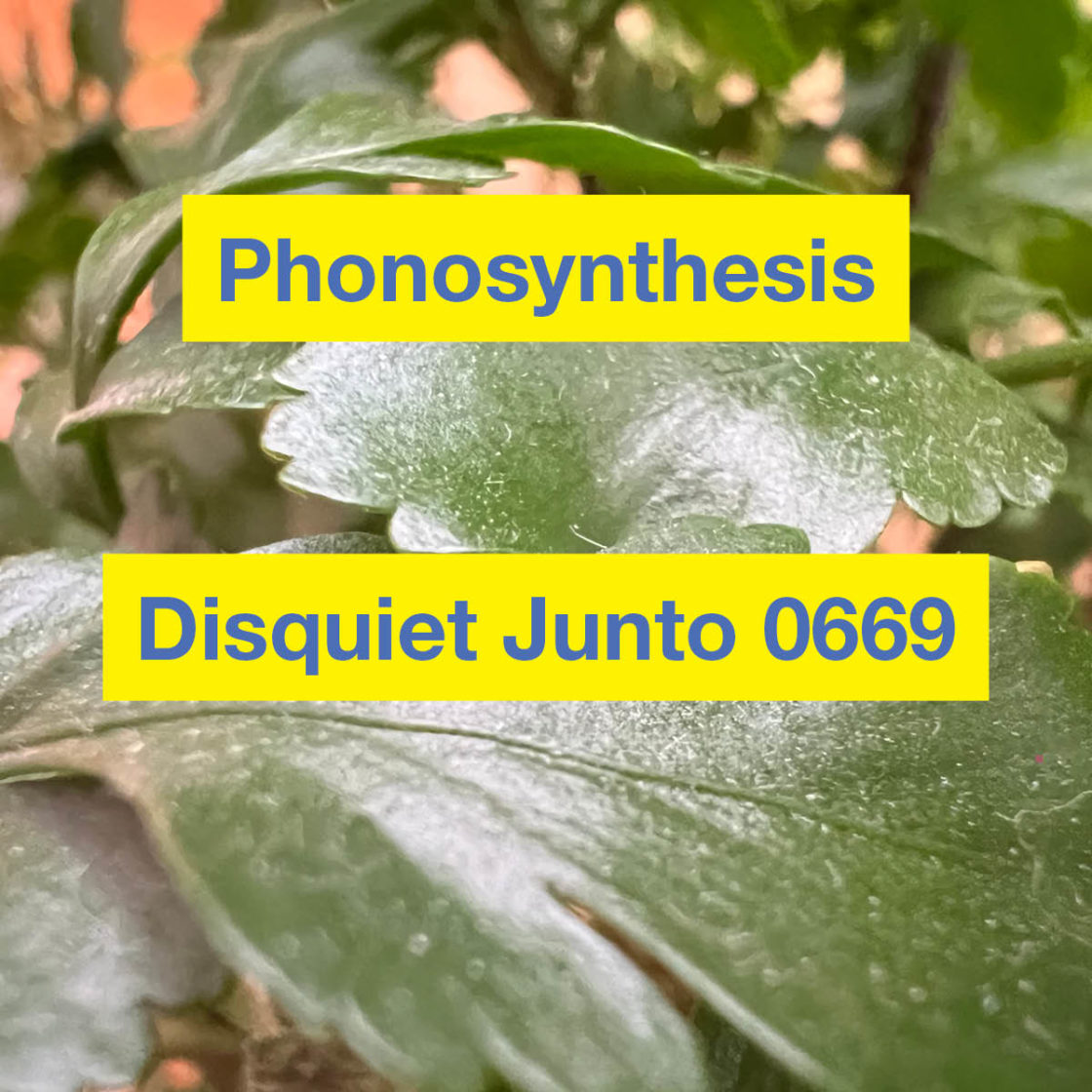
Disquiet Junto Project 0669: Phonosynthesis

The Assignment: Make music to help a forest regenerate.

Each Thursday in the Disquiet Junto music community, a new compositional challenge is set before the group’s members, who then have five days to record and upload a track in response to the project instructions.

Membership in the Junto is open: just join and participate. (A SoundCloud account is helpful but not required.) There’s no pressure to do every project. The Junto is weekly so that you know it’s there, every Thursday through Monday, when your time and interest align.

Tracks are added to the SoundCloud playlist for the duration of the project. Additional (non-SoundCloud) tracks also generally appear in the lllllll.co discussion thread.

Disquiet Junto Project 0669: Phonosynthesis
The Assignment: Make music to help a forest regenerate.

A scientific research paper this month documented evidence that sound can help fungus grow. The conclusion: “Demonstrating a tangible impact on fungal activity, our findings suggest that carefully tuned acoustic parameters might be able to enhance ecological processes.”

Record music to help a forest grow. Imagine an array of solar-powered speakers is spread through a forest-in-need. Or come up with another deployment scenario of your own imagining. What sort of music would you play for the forest to encourage its regeneration?

The research paper: https://royalsocietypublishing.org/doi/10.1098/rsbl.2024.0295.

Coverage in the New York Times: https://www.nytimes.com/2024/10/04/science/fungus-sounds-growth.html

The paper is the work of four people from the College of Science and Engineering, Flinders University, in Australia.

Thanks to Michael Rhode for having shared with me the research coverage.

Tasks Upon Completion:

Label: Include “disquiet0669” (no spaces/quotes) in the name of your track.

Upload: Post your track to a public account (SoundCloud preferred but by no means required). It’s best to focus on one track, but if you post more than one, clarify which is the “main” rendition.

Share: Post your track and a description/explanation at https://llllllll.co/t/disquiet-junto-project-0669-phonosynthesis/

Discuss: Listen to and comment on the other tracks.

Additional Details:

Length: The length is up to you. How hard do you need to work to keep your secret?

Deadline: Monday, October 28, 2024, 11:59pm (that is: just before midnight) wherever you are.

About: https://disquiet.com/junto/

Newsletter: https://juntoletter.disquiet.com/

License: It’s preferred (but not required) to set your track as downloadable and allowing for attributed remixing (i.e., an attribution Creative Commons license).

Please Include When Posting Your Track:

More on the 669th weekly Disquiet Junto project, Phonosynthesis — The Assignment: Make music to help a forest regenerate — at https://disquiet.com/0669/

More This Week in Sound: Phonosynthesis, Farts

A lightly annotated clipping service

▰ ROOTS MUSIC: Call it “phonosynthesis,” as scientists confirm that sounds can improve the growth of fungus, per the New York Times: “Playing sound to Trichoderma harzianum, a green microscopic fungus that defends tree roots from pathogens, led to growth rates seven times as fast as those of fungus grown in the sound of silence. If the laboratory findings can be replicated in nature, then sound could be an unexpected new tool for improving the health of forests, encouraging beneficial microbes to take root and thrive.” (Thanks, Mike Rhode!)

▰ SCREEN OFF: One thing I love about the Diary section of the London Review of Books is it often doesn’t announce its topic. It’ll just say “Diary” at the top, along with the entry’s author’s name, and unless you read the piece, you might not know what it’s about, and when you begin to read, you don’t necessarily know what’s ahead. A Diary by Dani Garavelli earlier this month waits until its second paragraph to introduce the topic at hand, movie theaters, and while you might guess it’s about their decline, it doesn’t get around to that for a spell. Eventually we do get around to the introduction of sound in the 1920s and ‘30s, and eventually to the unfortunate results of haphazard cost-cutting decades later. With one theater, by way of example: “They simply dropped a wall from the circle downwards and then divided what they had behind that into two more cinemas. There was no soundproofing: you could quite often hear the film in the neighbouring auditorium.”

▰ BOTTOMS UP: Noni Hazlehurst was a presenter on the longrunning Australian TV series Play School from 1978 to 2011. I hadn’t heard about the show until she was interviewed by the Guardian. Here she describes an inflatable raft that caused what she says was the most chaotic thing to ever happen on the show’s set: “Now, the thing is, it’s meant to inflate in 30 seconds into a two-person rubber dinghy, which it did – but it made the most extraordinary farting sound that you’ve ever heard in your life. For a full 30 seconds. It exploded and just about knocked the whole set over. We were in absolute hysterics, to the point where someone wrote in and said we were obviously drunk. You couldn’t have written it. It was just so funny.”

▰ 21ST CENTURY FX: “I’ve never really used sound effects in comics much. I don’t like them. As a kid, they fascinated me, but after a certain age they started to take me out of the storytelling, so I’ve tried to avoid them. I was part of the generations that helped kill the sound effect and the thought balloon, I guess.” That’s the opening of a great consideration the sound effects (and related topics) of comics in the latest issue of Warren Ellis’ newsletter, Orbital Operations. There was also a heap of inventive sound in his recent audio drama, The Department of Midnight, which I need to get around to unpacking. 

▰ GRACE NOTES: Listen Up: Paranoia about whether or not smart devices are listening to us got a nudge when 404 Media shared a leak of an “active listening plan” that proposed to use “‘real-time intent data’ from smart device microphones to deliver ads to consumers.” ▰ No Fooling Around: A multimedia feature in the Guardian on life — especially sonic nocturnal life — during wartime: “people can see almost nothing in the darkness and so strain their ears to hear the noises that haunt them afterwards.” ▰ Punctured: Inconsistency is cited in research on the use of breath sounds in respiratory evaluations. ▰ Battle Bots: Robot vacuums across the country were hacked in the space of several days, [allowing] the attackers to not only control the robovacs, but use their speakers to hurl racial slurs and abusive comments at anyone nearby.” ▰ Just Browsing: A Chrome extension keeps alert for audio deep fakes.