Restaurants are getting noisier, and the noise gets harder for people to deal with as they age. Both those things are true, and they combine to make the situation even worse. Fortunately, in the wake of revised FDA regulations back in 2022, over-the-counter (OTC) hearing aids are becoming available, dropping the price significantly (from the thousands of dollars to the hundreds), and increasing innovation in the marketplace.
The new hearing health tools in Apple’s AirPods became the FDA’s first authorized OTC hearing aid software device, as announced last month. Without that regulation change, the situation would not have improved as quickly as it has.
As Chris Welch reports in the Verge, the initial trio of Apple featues includes “clinical-grade hearing aid functionality, a hearing test, and more robust hearing protection.”
Rebecca Hamilton at Slate reports on the scale of need: “[J]ust 16 percent of Americans between the ages of 20 and 69 years who would benefit from hearing aids ever use them. Some 20 million go without.”
Pete Wells in the New York Times notes a particular use case that predates the hearing health additions: “What you may not know is that the AirPods Pro 2 already come with a setting that can turn up the volume on the voices of people you’re talking to and another one that tamps down background noise. Other earbud makers, including Sony, Samsung, Beyerdynamic and Soundcore, also offer functions meant to make conversation easier in noisy places.” Wells was a long time restaurant critic, so if anyone knows something about noisy rooms, it’s him.
Technology will help, but a major next step is going to require changes to cultural norms. Right now, AirPods and earbuds in general send a visual signal of isolation, that someone is paying attention to something other than the world around them. We’ll need to get comfortable sitting across from someone and not take the presence of their earbuds as a physical indication that they aren’t paying attention to us. No one sees a traditional hearing aid in someone’s ear and thinks they’ve checked out of the conversation, quite the contrary.
Related stories on the topic of things we put in our ears:
▰ Up to 11: For some with extreme hearing loss, the answer in the future may be an SCBI, or “spinal computer–brain interface,” which can “effectively convert sound into interpretable spinal cord stimulation patterns, offering a novel approach to sensory substitution for individuals with hearing loss.”
▰ Fungus Among Us: Mycelium is a fungus with manufacturing utility and reported antibiotic properties. Also, the fungus is the sole ingredient in a brand of earplugs made by Gob (gob.earth), a company based in San Francisco. “The result is a hypoallergenic earplug with a secure fit that moulds to the ear with a similar action as memory foam,” writes Ellen Eberhardt in Dezeen. The makers claim certain unique qualities: “Unlike traditional foam earplugs, which can muffle certain frequencies, our mycelium-based earplugs provide superior sound absorption while maintaining clarity and comfort.”
▰ Ear Ache: A conservative political commentator was involved in a recent humorous kerfuffle. He reportedly attended a sports event wearing earplugs, and later was accused of editing the plug out of a selfie. Reminder: the year is 2024, and everything is political, including the perceived manliness of hearing protection.
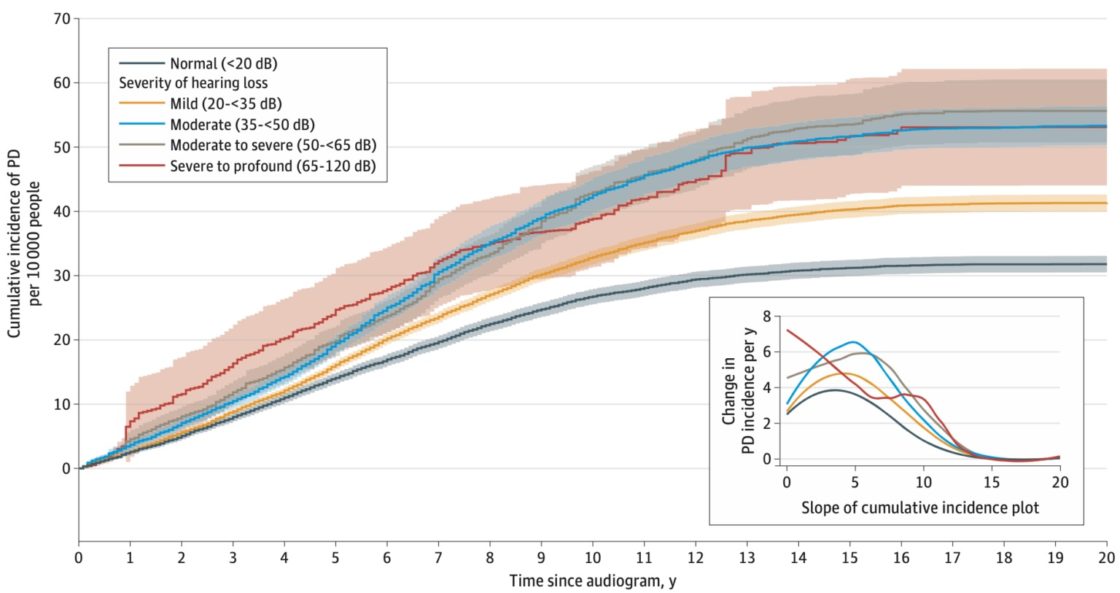
▰ Say What?: “[Researchers] have found those who experience hearing loss are more likely to be diagnosed with Parkinson’s disease later on. … But if hearing aids are prescribed right off the bat, the risk of diagnosis appears significantly dampened.” The chart below is from the latest issue of JAMA Neurology, published by the American Medical Association.