Cellular Automata MP3s for the People

The Automaton audio software tool applies the classic rules-based, artificial intelligence Game of Life to sound. It was released this past weekend by Audio Damage, and on Sunday shots of the interface served as images of the week here (disquiet.com).

Now, much like the pixelated patterns in the Game of Life, Automaton is propagating across the Internet in unexpected but not unforeseen ways, largely as initial demos by curious early adapters.

On the software’s Audio Damage homepage (audiodamage.com) there are two samples, one rhythmic (MP3) and one melodic (MP3), that show how the controlled randomness of Automaton can affect music over time.

In the always active comments at createdigitalmusic.com, participants were posting the results of their initial experiments. Kent Williams (aka Chaircrusher, founder of the cornwarning.com label — based in Iowa, naturally) took Julie Andrews‘s take on “The Sound of Music” and put it through the Automaton grinder, showing how it can automate glitchy remixes (MP3, createdigitalmusic.com). And one Fall a Star (fallsastar.com) posted a multiple-instance application of Automaton on a dubby, rhythmic original material (MP3, createdigitalmusic.com).

Also, thanks go out to Disquiet.com reader Davis who pointed out an earlier, Nintendo DS hack called glitchDS that uses the Game of Life as an audio manipulator. Video evidence at youtube.com and youtube.com. More details at glitchds.com. Here’s a screenshot from one of the youtube.com videos:

Solo Guitar MP3 from Matthew Mullane

The single of the week from the luvsound.org label is a three-and-a-half-minute solo guitar piece by Matthew Mullane, who intersperses lulling strums with spitfire arpeggios and intricate runs. The strums bring everything to a momentary halt, with a bluesy air that has a kind of swagger to its sway — imagine Chet Baker with an electric six-string. There is even, to borrow Jelly Roll Morton’s gift to music theory, a Spanish tinge. And between those gentle moments come rapid little note-packed moments that pierce the recording room’s echo like shrapnel tearing through silk (MP3). But it’s that silky air, not the finger-picking calisthenics, that’s the thing, an exquisite aural space that Mullane treats with respect. Titled “A-7” the track begs the question if someone is ever truly playing solo when every note reverberates for several seconds before it even begins to fade from recognition, and several more before it fades from memory. Mullane’s lovely effort feeds on the simple truth that feedback keeps the recent past present.

Digiki Mashup/Crashup Meta-Mix MP3

A year or so ago, I found myself in a small, downstairs club in Tokyo named Soft (soft-tokyo.com), where among the performers was Digiki (aka Antonin “LV”Gaultier, maudevintage.com/diginikki), who seemed to be breaking down familiar pop beats with little more than a mixer and an iPod or two. What fascinates about Digiki’s sound isn’t just his facility with producing complex mixes live using familiar, everyday technology. It’s that while he builds his music from that of others, it’s less a mashup than it is a car crash, and the distinction is intended entirely as a compliment to the latter. That Digiki show at Soft wasn’t just a matter of mixing from one track to the next, or of adding in whimsical tidbits and emphasizing transitions with pointed musical parallels between tracks. He was truly mixing it up, stretching segments, looping portions, jump-cutting, and adding a healthy amount of glitch to the proceedings. Often the original material was held at a tantalizing distance, rather than appearing as a brief and focused cameo, as is often the case with more common mashups.

Digiki now has a new full-length out, appropriately titled Dense Music, and he’s posted a five-minute mix of its contents (a meta-mix?) that artfully confounds as much as it pleases (MP3). The patchwork-as-identity aesthetic is evident right on the cover (seen to the left). On a website dedicated to the new record, densemusic.com, he’s posted lengthy liner notes, which look back at the material from that Soft performance, which he describes as “non-danceable dance music for its use of beats and elements from the dance music genre but which are fragmented and structured in ways that belong more to contemporary music than to house music.” Dense Music collects remixes of earlier Digiki tracks (largely from his Beat Vacation album), by the likes of Carl Stone, Kraftpunk, and Toshiyuki Yasuda (aka Fantastic Plastic Machine). For the meta-mix MP3, Digiki has added yet another, tantalizing layer of mediation by taking their mixes of his music, itself built from other people’s music, and crunched it into something entirely new — everything from disco horns to early-music chanting, squelched into a taut, often bracing five minutes.

The Anthems of Anathem (MP3)

At this rate, Neal Stephenson may be the first science fiction author since L. Ron Hubbard to found a self-propagating religion — he already has the ritual music completed. As mentioned on Saturday here (disquiet.com), not only does Stephenson’s new book, Anathem — a science-fictional, nearly 1,000-page riff on the Clock of the Long Now — take music as its frequent subject, but the book has a companion CD of the mathematically informed, quasi-liturgical chanting that is inherent to Stephenson’s intricate story.

If Anathem often reads like a delirious mashup of Douglas Hofstadter’s Gödel, Escher, Bach, Umberto Eco’s The Name of the Rose, and Isaac Asimov’s Foundation, then the music (composed by David Stutz), doesn’t so much underscore Hofstadter’s Bach as it reaches further back, to the origins of polyphony, when the magic of two near but separate voices — separate just to the point of beading — was, like any sufficiently advanced science, still something close to magic.

The Stutz album is titled Iolet: Music from the World of Anathem, and there’s a sample of the singing (MP3) at his webpage, synthesist.net. The sound is quite pure, with rarified tonal color, and compositional attention to very small shifts in notes. But the point of the composition isn’t so much the notes themselves, but how they overlap when sung by multiple voices. (The singers are Linda Strandberg, Melissa Plagemann, and Rebekah Gilmore.) The piece is titled “Mascheroni’s Circles” after the (real-world, non-Anathemic) mathematician on whose geometrical studies it is based, Lorenzo Mascheroni. Below is the piece’s opening sequence, from Stutz’s score, which he has posted online (PDF):

The score includes what amount to stage directions regarding how multiple singers are intended to enact the piece:

Circles: Each line of music represents a circle. The first note in the line is the circle’s center.

Centers: The starting note on a line is the circle’s center. When beginning a new circle, always sing the center first. There are two different representations: the double whole note or the diamond tremolo note. To sing a double whole note center, simply hold the note a long time. To sing the diamond tremolo, repeat the note in a moderate staccato, using the basic tactus as your tempo.

Scales: The repeated scales represent sung circles. Scales that have brackets above them are sung faster or slower than the basic tactus. (The different rhythmic patterns represent different diameters.) You may repeat a circle as many times as you like (circles are endless, right?), but you should try to sing it the same way on every repeat, with the exception that on some repetitions, you may elect to sing some or all of the “points” that exist on your current circle (see below). You do not have to sing any points at all on a given repetition, nor do you have to sing the same points on subsequent repetitions. The singing of points should be somewhat random.

Points: The whole notes and triangle tremolo notes represent marked points on the circle. To sing a whole note point, simply hold that note longer than the normal pulse for your current circle. To sing a tremolo triangle point, repeat the note in a staccato fashion using the pulse for the current circle. “Points” should be held long enough for other singers to hear and act upon. them

To begin a circle, listen for someone else singing the point that coincides with the center of the circle that you wish to start. (Circles may only be drawn from a point that matches their center.) Obviously, a circle can only be started when another active circle contains the point that represents the center of the new circle. To sing this piece as a solo, sung points become centers – the long note or staccato pattern is elided with the center of the next circle sung. (Long notes match long notes, stacatto notes match staccato notes.)

Stutz, a former programmer with Microsoft, writes further, on synthesist.net, about the geometry and game-play at the heart of the music:

I chose to represent musical circles as symmetric scales or patterns that revolve around a central pitch, repeating themselves over and over. More importantly, one don’t need no stinking straightedges or lines or triangles in a world of circles and points! As a result, I was able to draw the points needed for the Bride’s Chair Proof by starting with a single point and a single circle. (I’ve embedded the diagram below in this post.)
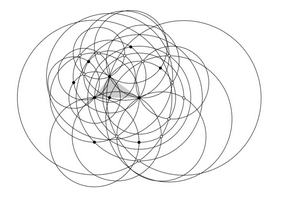
Armed with the construction, I then prepared to turn it into music by doing an analysis of the centers, radii, and incidences involved. In this particular construction, there were 22 circles and 22 important points. Some of the points were shared by many circles, some not. Some of the points were meetings between circles, some acted only as centers, and some fulfilled both functions. I created a chart based on this information, and started fitting musical patterns to the elements of the chart. And lo, after a few iterations, I had musical elements that were very pleasing to my own ear! As a final nod to the avout, I then turned these musical elements into a game that might be played by fids learning the Adrakhonic Proof. In this game, the musical circles are provided on the page, along with the points within them that are important. Finding the path through them, however, is left as a cooperative exercise to the performers. (See the score for details.)

The words “avout,” “fid,” and “Adrakhonic” are from the novel, which is thick with referential wordplay. Just as an aside, Stutz’s detailing of Mascheroni’s work includes a reference to how Mascheroni (1750 ”“ 1800) was, in fact, re-discovering what Georg Mohr (1640 ”“ 1697) had done more than a century prior — a recycling of innovation that is also part of the broader Anathem narrative. The following conversation appears on page 101 of the novel:

“It’s frustrating, talking to you. Every idea my little mind can come up with has already been come up with by some Saunt two thousand years ago, and talked to death.”

“I really don’t mean to be a smarty pants,” I said, “but that is Saunt Lora’s Proposition and it dates to the Sixteenth Century.”

Seven additional samples of Stutz’s score, some of which have a Tuvan throat-singing quality, appear on the Anathem page on Stephenson’s site, nealstephenson.com. There is also video (fora.tv) and a downloadable file (MP3) of Stephenson reading from Anathem (in it he name-checks the Tallis Scholars), followed in each by a performance of Stutz’s music, recorded last week in San Francisco. Revenue from sales of the Iolet CD will go to the Clock of the Long Now.

Images of the Week: Cellular Phonics

The following is a screenshot from Automaton, a new software-based sequencer from the company Audio Damage and an excellent mainstream example of generative music, in which sound is produced a series of mutating changes:

And this one is from the software’s user manual, which is available for free download (PDF):

The software, based on John Horton Conway‘s Game of Life, which dates back to 1970, allows user-programmed effects to alter sonic material according to the rules of cellular automata (by some small coincidence, also a concern of the Neal Stephenson novel, Anathem, mentioned here yesterday [disquiet.com]). The white-filled boxes shown above are the sequencer (that is, the pattern of the music visualized in realtime), while the other colors refer to four effects implemented on the music: blue is Stutter, red is Modulate, orange is Bitcrush, and green is Replicate.

“Yes, this effectively makes it ancient history as far as computers are concerned,” a footnote in the user manual for Automaton states, in reference to the 1970 article in Scientific American by Martin Gardener that introduced Life to the general public. “The article suggested using checkers and a checkerboard to iterate generations by hand. No, the author wasn’t kidding.” (The massive shift in presumptions regarding computational power in the past 40 years again brings to mind matters that are at the heart of Stephenson’s Anathem — and, for that matter, Charles Stross’s earlier science fiction novel of humanity’s adaptation to change, Accelerando.)

Below, borrowed from a wikipedia.org entry on Conway’s game, is an image (an animated GIF gile) depicting a looping example of how through a turn-based rule system, the cellular automata in Automaton might flow in two dimensions. The genius of this particular application of Life, the Glider Gun designed by mathemetician Bill Gosper, isn’t just that the little triangular doodles make their way off the screen in an orderly fashion (that is, without splintering, which is what so many Game of Life objects end up doing), but that the “gun” at the top of the screen keeps pumping out new gliders, as the triangular bits are refered to.

Automaton is just the latest in a series of software-based tools from Audio Damage, which has a tendency of making them look, online, for fun, like the physical effects boxes from which they are derived. The image accompanying Automaton appears to imagine an iPod-like (or iPhone-like) tool that runs Audio Damage, a tantalizing idea indeed:

More info on Automaton, including video, at audiodamage.com. The software programming is by Adam Schabtach (studionebula.com), user interface by Chris Randall (analogindustries.com).