These sound-studies highlights of the week originally appeared in the June 25, 2024, issue of the Disquiet.com weekly email newsletter, This Week in Sound. This Week in Sound is the best way I’ve found to process material I come across. Your support provides resources and encouragement. Most issues are free. A weekly annotated ambient-music mixtape is for paid subscribers. Thanks.
▰ LISTENING TO DRY PAINT: Or perhaps the opposite. Can sound damage art? That is the question on the cover of the June-July 2024 issue of the journal News in Conservation: “Although this issue is not new, it has perhaps become more urgent with the more frequent use of amplification and electronically generated music near artworks. Does exposure to sound pose an immediate or cumulative risk? And are there ways to mitigate or reduce any risk, for example, by avoiding certain types of music, setting limits on the sound or vibration levels experienced by artworks or introducing measures to reduce transfer from source to object?” While the article makes it clear there is much further research to be done, initial findings are worrisome: “Our pilot study provided clear evidence that airborne sound can have a direct impact on canvas paintings, causing not only the canvas but also the stretcher and frame (if present) to vibrate; as such, airborne transmission routes must be considered alongside structure-borne routes when assessing the impact of sound on artworks. As has been observed before, the vibration levels measured within the canvases were higher than those measured in the stretchers or frames. These observations are important, both in trying to define criteria for sound levels in the vicinity of artworks, along with its character (time and/or frequency specific), and in thinking about how to approach sound-induced vibration mitigation.” The article’s main authors are Catherine Higgitt, principal scientist at the National Gallery in London, and Tomasz Galikowski and David Trew, of the firm Bickerdike Allen Partners.
▰ SEOUL MUSIC: South Korea recently restarted a sonic weapon project aimed at North Korea. The program was banned back in 2018 as the result of an agreement between the two countries. However, the revived program is already beset with problems: “The loudspeakers deployed by South Korea to wage psychological warfare against North Korea faced audits and legal battles claiming they are too quiet, raising questions over how far into the reclusive North their propaganda messages can blast.” The program’s 40 speakers “were designed to blare pop music and political messages as far as 10 kilometres (6.21 miles), enough to reach the city of Kaesong and its nearly 200,000 residents.” Meanwhile, “North Korea’s own loudspeakers in the area further diminish the reach of South Korea’s psychological warfare.” (Via Warren Ellis)
▰ CAR GUISE: Bringing heavy hitters in to make sounds for electric vehicles may have been overkill: “The two top-ranking sounds [in a recent survey of consumers] were both non-tonal and could best be described as white noise with slightly different pitches. The survey’s respondents preferred the non-tonal sounds over the tonal ones, which they perceived as being ‘alarming,’ ‘ugly,’ and ‘unappealing.’ In contrast, people liked the non-tonal sounds because they sound more like white noise or ‘nature-derived.’ Indeed, some respondents said they wanted sounds that most closely resembled a conventional car noise.”
▰ MOVIE MAGIC: The British Film Institute explains how it preserves and restores the sound of old films: “Optical soundtracks could be on cellulose triacetate, polyester or the exceedingly combustible pre-1951 nitrate cellulose base. With exceptional safety and care, optical soundtracks are digitised using white-light LED and photocell replay machines, red-light LED scanners with Sondor Resonances which offers digital image processing technology to digitise directly from a positive copy or an original negative, and a multitude of magnetic replay options.” The full article isn’t that technical, and it provides a solid overview of early film sound history, including an 1898 — you read that right, as in back when Victoria was still queen (I had this wrong when I first sent out the newsletter, and mistakenly thought Edward VII had already ascended) — wax cylinder. And from even earlier: an 1894 experiment by Thomas Edison and W. K-L. Dickson, inspired by none other than Eadweard Muybridge. Fun fact: “A 90-minute feature film soundtrack can typically take up to 100 hours or more to completely restore or remaster.”
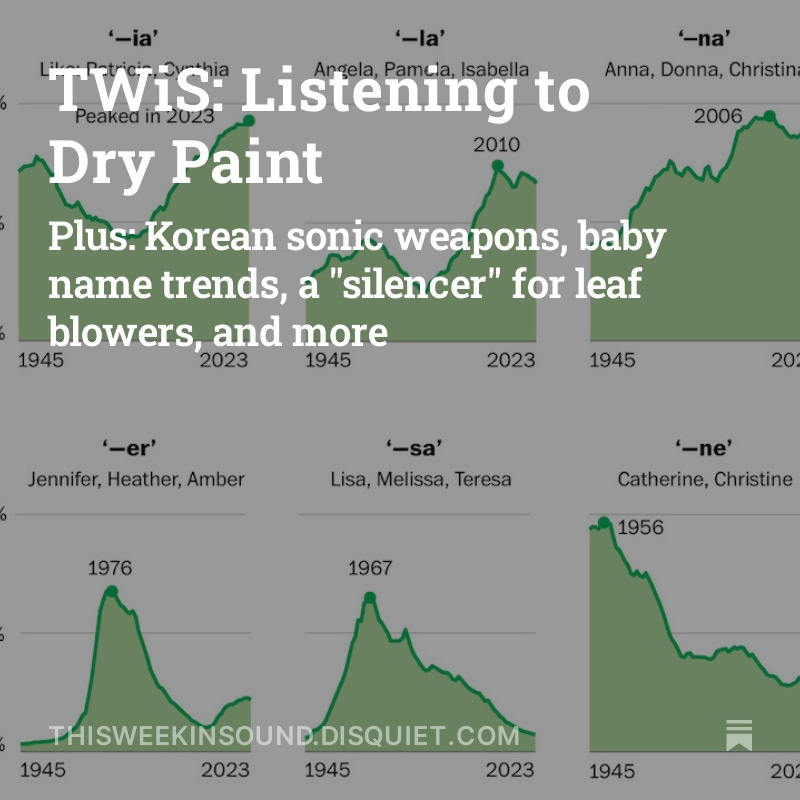
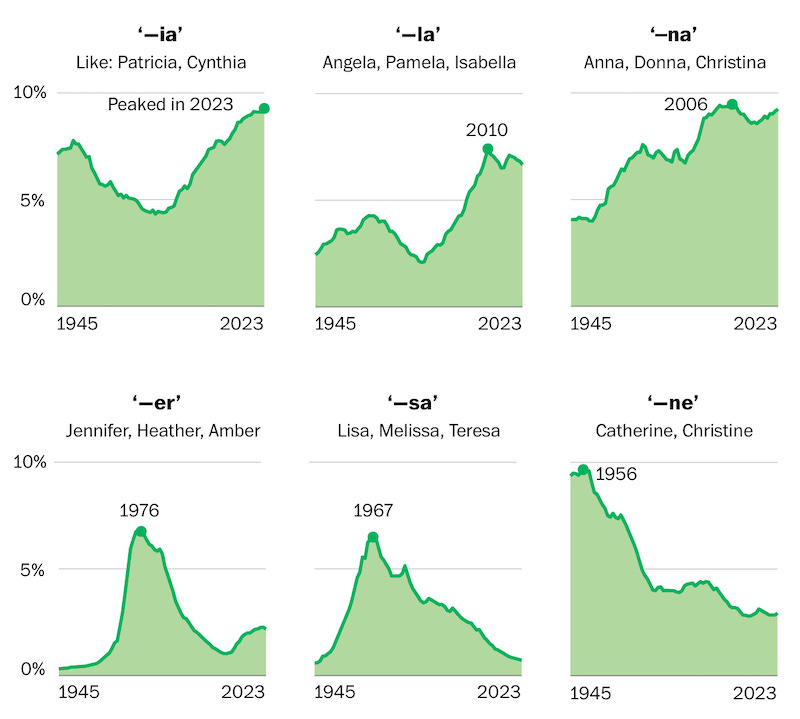
▰ ALL’S WELL THAT ENDS WELL: When it comes to naming one’s child, that is. The data hounds at the Washington Post (full article via gift link) did a deep dive into popular names for children in the US, building on observations by Laura Wattenberg, an expert on baby-naming. This is a particularly valuable story, because the insights manage to talk about language in the context not so much of meaning or etymology, but in terms of sound. The patterns in naming being tracked here are about how certain phonemes, specifically the ones that end names, are the crux of naming trends.
▰ A NEW LEAF: “The challenge before Johns Hopkins University engineering students: Take a leaf blower, but make it quiet. Make it work as powerfully as ever, but do not allow it to emit the ear-piercing caterwaul that has gotten leaf blowers banned in some communities and cursed in many others.” The students have made a “silencer” for leaf blowers. “Their improved leaf blower drops the overall noise level by nearly 40% while almost entirely erasing the most obnoxious frequencies. The design is patent-pending and Stanley Black & Decker expects to be selling them in two years.”
▰ SOUND BITES: Chants Operations: Why music Ph.D. candidate Katherine Scahill talks about sound and voice, rather than music, when discussing Thai Buddhist chanting (“one of the ethical precepts that monks undertake is not to sing or play musical instruments” — “They wouldn’t call it music, and it might give the wrong impression”). ▰ Water Log: The New Yorker visited a lifestyle-brand sound bath, led by Sara Auster, whom I first learned about via her work with turntablist Maria Chavez; about two years ago she “sonified” a line of paintsfrom Sherwin-Williams. ▰ Talk Central: Pocket FM partners with ElevenLabs to turn “writing into audio.” ▰ Order Up: While McDonald’s may have hit pause on its AI-voice program for drive-thru orders, SoundHound has bought Allset, a “food-ordering platform.” ▰ Switched On: The Criterion Collection has a set of movies up currently related to their synth scores (e.g., Manhunter, Liquid Sky, Merry Christmas Mr. Lawrence, and Danz CM breaks down the history of the synth in movies. ▰ On the Clock: The bells of Westminster move from the pages of Virginia Woolf’s Mrs. Dalloway to the ballet, courtesy of a field recording, as guided by choreographer Wayne McGregor. ▰ Green Day: Lonely planet recommends quiet parks around the world. ▰ Tune Out: The New Yorker had a fun cicada cartoon on June 24th. ▰ Copy Cats: If record labels win this AI lawsuit, the payment could reach $150,000 per song. ▰ Over Load: How “irrelevant speech”in the form of background noise increases the perception of workload, due to “disturbed concentration, impaired performance, and hampered efficient working” (research: sciencedirect.com). ▰ Going Deep: A bill in the works to make non-consensual deepfakes illegal. ▰ Dusk to Dawn: It’s probably OK to have that white noise machine going all night. ▰ Pressed to Play: At press time, OpenAI reported “it would delay the launch of voice and emotion-reading features for its ChatGPT chatbot because more time was needed for safety testing.”