On the Line: Voice, Flower, Bird

Some favorite recent phrases

▰ MOUTH OFF:

“The sound of our voices is born of our anatomy, the way we’re shaped inside — not just a skill but part of the physical self. The prospect of not being able to sing anymore felt like contemplating an amputation.”

The singer Dessa contemplates the loss of her voice in a New York Times essay. (Thanks, Rich Pettus!)

. . .

▰ FLORA AURA:

"Primroses may respond to sound — but that doesn’t mean that they 'hear' the way that we do. As Schlanger writes, they have a version of 'earless' hearing: 'Sound, to them, is pure vibration.'"

The Schlanger mentioned above is Zoë Schlanger, author of The Light Eaters: How the Unseen World of Plant Intelligence Offers a New Understanding of Life on Earth, the subject of Rachel Riederer’s review in The New Yorker.

. . .

▰ BIRD BRAIN:

“The simple song of the cirl bunting is reminiscent of a sewing machine, or a hand-held scanning device from Star Trek.”

That’s the description of the Shriek of the Week this week. Crystal clear, as always.
Sound Ledger: Fast Food and Podcasts

Audio culture by the numbers

100: Number of McDonald’s locations that had a (now canceled) AI ordering system for drive-through customers.

6: Hours per weekday when take-out orders are prohibited in parts of Milan to decrease noise pollution.

200,000: Estimated average cost of production, in $U.S, for an eight-to-ten–episode podcast.

Sources: McDonald’s: qz.com; Milan: msn.com; podcast: bloomberg.com.

2 New Aphex Twin Tracks

Aren't exactly new

It looks like you can listen to the two newly announced Aphex Twin songs right now. In fact, they appear to have been available for almost a decade. Warp Records has announced a set of new pressings of Aphex Twin’s classic Selected Ambient Works Volume II, originally released 30 years ago, in 1994 (my 33 1/3 book on it came out 10 years ago, in 2014).

The new Warp editions contain 27 tracks each, including the original 24 tracks, and the formerly vinyl-only “Stone in Focus,” and two that appear at the end of the new release: “th1 [evnslower],” which is glacially slow, and “Rhubarb Orc. 19.53 Rev,” which features operatic vocal elements and qualities that suggest parts of it, if not the entirety of it, are being played in reverse (hence the “Rev” in the title). By the way, “Stone in Focus” wasn’t vinyl only, per se, as it was also on the 1994 Astralwerks CD compilation Excursions in Ambience (The Third Dimension), which also had tracks from Seefeel, Spacetime Continuum, Future Sound of London, and Air, among others.

Both of those tracks appeared previously on Aphex Twin’s own SoundCloud accounts. The first is on his famed @user18081971, on which he posted heaps of tracks when he reemerged (culminating in the album Syro) from a long period of relative silence, and the other at his eponymous @aphextwin/@richarddjames account. Judging by the time codes for those tracks on Warp website and on the individual track pages (11:07/11:08 for “th1 [evnslower]” and 6:41 for “Rhubarb Orc. 19.53 Rev”), these are the same pieces of music.

And several enterprising people have, of course, reversed the “Rev” track so we can hear it before it was flipped. Here it is:

Lou Reed’s Purpose-Built Music

A long way from Metal Machine Music

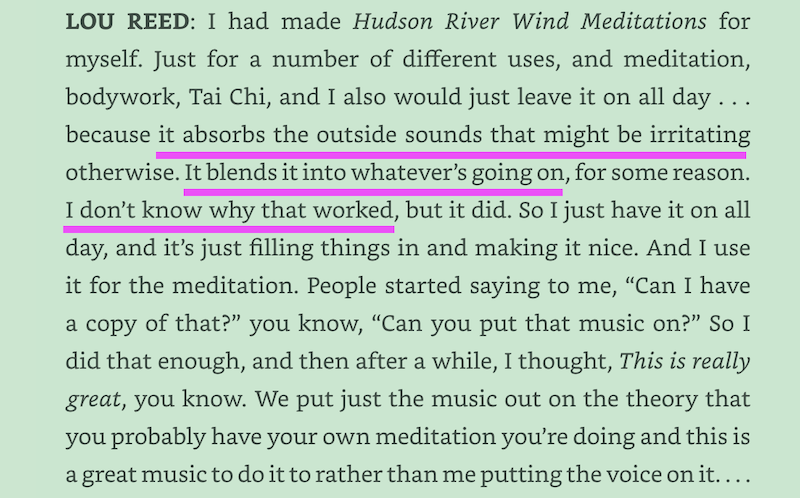
I’ve been enjoying the book The Art of the Straight Line: My Tai Chi, which is credited on its cover to Lou Red, but is more accurately a posthumous book, assembled by Laurie Anderson, from materials he wrote, interview materials with Reed, and the reminiscences of numerous people in his orbit. Here he talks about the 2007 album, produced by Reed and Hal Willner, he released of music he recorded for use during his tai chi sessions. I love that he, in essence, re-created ambient music, and came to understand it deeply, in the process.

Pronouncing “Junto”

As Benjamin Franklin might have

I updated the Disquiet Junto F.A.Q with for the first time since late last year. There’s a new item about how to pronounce “junto.” For the Disquiet Junto, the use of the word in the first place relates to Benjamin Franklin’s Junto club, which he started in 1727. Let’s work from the assumption that Franklin’s use of “junto” was based on the Spanish word “junta,” and so pronounce “junto” the same way, with “jun” like “hoon.”