
Record Label Name Available
An ongoing series cross-posted from instagram.com/dsqt

I have a white noise app on my Mac laptop that helps me focus. I noticed it doesn’t have “on” and “off” modes. It has “play” and “pause” modes. Apparently it’s never “off.” You will always listen again. If you’re not listening, you are simply preparing to listen.
As of this writing, these are the available sounds:
Airplane
Beach
City
Crickets
Fan
Fan 2
Fan 3
Fire
Ocean
Pier
Rain – Light
Rain – Heavy
Rainforest
River
Shower
Thunderstorm
Wind
Wind Chimes
Blue Noise
Brown Noise
Pink Noise
Violet Noise
White Noise
I use the “airplane” noise mode, myself. I’ve become so accustomed to its tonality that I’ve been known to use it while on airplanes, which is ironic given that I usually use noise cancelling headphones on planes to block out the actual airplane noise. This is to say, I both eliminate the sound of the plane and then pipe in the artificial sound of the plane. The action is, from one perspective, the sonic equivalent of tearing out your backyard and laying down astroturf. Though of course, it’s nothing like that.
As for the other options, I appreciate the cicadas, but it mostly makes me think of camping, which is not on my personal list of ideal situations. I’ll take a non-reclining coach seat on an airplane over camping.
Of the “color” noises, I occasionally opt for brown, which is essentially airplane noise reduced to a mathematical formula. Brown noise is the airplane noise of a low-polygon simulation of flight.
One thing the app lacks is café chatter — better yet, café chatter in a language I don’t understand (which would be any language other than English, though I’m coming up on a year-long streak in Duolingo German, so who knows). Perhaps chatter will come with a future upgrade.

For better or worse, my ideal aesthetic
I do this manually at the end of each week: collating (and sometimes lightly editing) most of the recent little comments I’ve made on social media, which I think of as my public scratch pad. Some end up on Disquiet.com earlier, sometimes in expanded form. These days I mostly hang out on Mastodon (at post.lurk.org/@disquiet), and I’m also trying out a few others. I take weekends and evenings off social media.
▰ I’m trying to look at art at museums before I read the wall text. Trying. Certainly spending more time on art than text. Speaking of which, the Day Jobs group show at Cantor/Stanford is excellent, all about how work and art interacted for various people: Warhol, LeWitt, Kruger, Kilgallen, Pindell, etc.
▰ Safari has been slow as molasses so I’m giving the Brave browser another go
▰ I’m back in the “single text file” phase of the to-do list carousel, which cycles through Apple Notes -> spreadsheet -> various dedicated apps -> single text file -> Apple Notes -> etc.
▰ Email these days is like tribbles performing The Sorcerer’s Apprentice. My inbox was well over 1,300. A stupid use of time, but I winnowed to 80 these past few days. Those 80 will take time. (And this doesn’t count promotional emails filtered automatically to folders and, thus, bypassing my inbox.)
▰ “Old timer, tell me again about the olden times when you got so much email spam over night that by the time you were done deleting your first batch in the morning more had arrived? And how sometimes it took a third round before your workday could really begin?”
▰ Stoked for any signs of an RSS resurgence: 404media.co.
▰ I appreciate a synthesizer module that can set the BPM as low as .5 — that is, one beat every two minutes. Kudos, also, to this device for granting new life and purpose to old MIDI controllers (notably the Novation Launchpad and the APC Mini). It’s the Crosspatch Triggerpad.
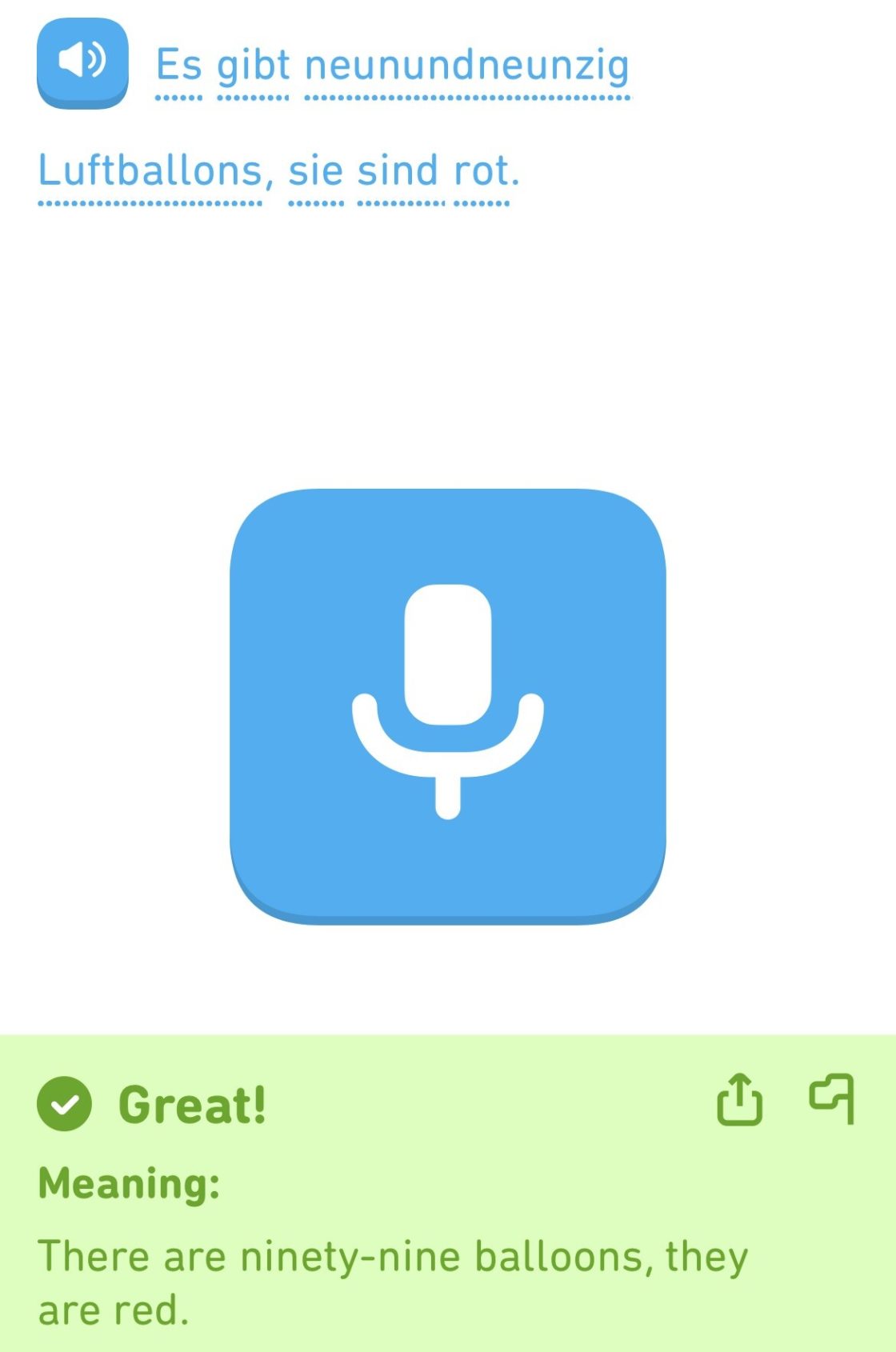
▰ The second we learned the German word for balloons in Duolingo, I knew a question along these lines would eventually be asked.
▰ I’d say my studies of 7th chords have taken a step back but that’d be a half diminished chord which is the most confusing to me of them all and that’s me trying (and probably failing) to make a music theory joke and I’ll be here all week
▰ I find myself sitting in an electric car, currently turned off, listening to exactly the sort* of music that might make a passerby think the car is running
*slowmo granular synthesis
▰ Heaven is a place

▰ Interesting to see the New York Times add the “Listen” option to the main nav within its mobile app. Not sure what this means for the standalone NYT Audio app. Seems like these don’t use AI/machine voices, which may explain why there’s a lag between breaking news and what’s available to listen to.

After I posted this online, an interlocutor on Mastodon provided another publication’s example:
“The swiss online magazine Republik (republik.ch) has a interesting approach. All texts are immediately available for listening via text to speech, but they also follow up with a version recorded with professional voice artists. You can set a notification for when that version is available. Like this (I assume) they manage to establish listening to their articles as a “standard service” and at the same time maintain and value the premium experience of a professional voice.”
And, continuing on this theme, New Scientist has its own approach to audio, which seems mobile-only (or perhaps mobile-first). I’m still sorting it out. For the time being, publications are exploring audio, but there is no industry standard.
▰ I’m testing out a friend’s work-in-progress VCV Rack modules (they are very cool), and there’s a humorously complicated workaround to get unofficial modules into one’s laptop software without Rack overwriting them. I wonder if there’s a more efficient process for testing that we’ve got going.
▰ The March 29 New York Times Strands puzzle (“Pardon my French!”) was especially fun
▰ It’s a likely sign a new service isn’t going all so well when you get a “You’re off the waitlist” alert regarding a list you never signed up for in the first place
▰ I finished two graphic novels and a sorta-comic this week. I very much enjoyed Travis Dandro’s Hummingbird Heart, a memoir about the adolescent experience of cascading loss after death ruptures a family, in turn rupturing friendships, all right on the cusp of adulthood, the arrival of which is its own source of loss, as well. I read the first volume of Radiant Black, a fairly standard superhero origin story. Not sure I’ll continue with the series but we’ll see. And my friend Gene Kannenberg, Jr., has produced a remarkable thing, a pop-up book, Here Comes Charlie Brown!, that takes the four panels of the very first Peanuts book and turns them into three dimensions. The volume, published by Abrams, with a cover by Chip Kidd and packaging (including a wonderful spine) by Shawn Dahl, both cherishes the source material and investigates its literal and emotional depth. Gene is credited with “paper engineering,” the best job title no one told us about in grade school. And while the physicality of the book is tremendous, I especially appreciate Gene pointing out the unique qualities of the colors he elected to employ: “I have taken the liberty of adding color,” he writes, “but with digital equivalents of coloring techniques used in comic books and Sunday comics supplements in the mid-twentieth century.” It’s a fantastic object, this book.