On the Line

Some favorite recent sentences

"I hear the board release, like a sigh. Still can't hear the footfall, but now I can hear the shape of a body in the hall just outside, the shadow in the room tone."

That is Nick Harkaway from his science fiction novel Titanium Noir (2023). I’ve wanted to read something by Harkaway for some time, and news that he’s writing a character based on his father’s most famous character (his dad was John le Carré, the character being George Smiley) led me to finally do so. It may be worth noting that a central figure in Titanium Noir is a literally towering giant of a post-human (it is science fiction) who draws family members close and into the broadly defined business. Perhaps there’s, I dunno, some subtext. In any case, this is one of several sonically expressive moments in the novel. Another key one is when a giant (called Titans) attacks the protagonist with the power of a laugh. 

. . .

"Talking this way is formal, in both senses of the word: formalizing conversation, rendering it visible and tangible, can sometimes make it feel strangely serious."

That is Max Norman writing in The New Yorker about the experience, when interviewing the artist Joseph Grigely, who is deaf, of doing so by writing things down, and thus taking greater pains than were they merely communicating with spoken words. “I found myself weighing my words,” he continues, “choosing not to ask a question that wasn’t perfectly phrased.”

. . .

"As I write this now at my flat in Edinburgh, I can hear the single toll of the tram bell as it heads along Leith Walk. (The ‘ding’ is singular but not resonant. It is a recording of a bell, and there is no tintinnabulation, as Edgar Allan Poe named it, no lingering sound, because the recording cuts it off. The tram bell is like a bad music hall singer, always in the middle of a note.)"

That is Andrew O’Hagan from his recent essay, “Stevenson in Edinburgh,” in the London Review of Books. (The Stevenson is, naturally, Robert Louis Stevenson.)

Sound Ledger (Freesound.org Edition)

Audio culture by the numbers

40,940: The number of sounds newly added to freesound.org in 2023

237: The number of hours of sound uploaded by the Freesound contributor (username: Philip_Goddard) who added the longest total amount of recordings in 2023

2,961: The number of individual sound files uploaded by the Freesound contributor (username: Hewn.Marrow) who added the most sound files in 2023

Source: blog.freesound.org

Other Minds 2023 Review (Preview)

In The Wire

My review of the last two nights of the 2023 Other Minds festival is in the brand new issue (the one with the Haxan Cloak on the cover) of The Wire. I’ll post the full article online when the next issue of the magazine is published.

The final two nights of the annual Other Minds festival were split between two quite different venues: the tony Taube Atrium Theater, which is secluded deep inside the stately War Memorial building across from gleaming City Hall, and Gray Area, a revivified, hollowed-out, long-defunct movie theater on a commercial stretch of Mission Street. It’s a half hour walk between them, but they are worlds apart. 

Other Minds ran for six nights total, its opening evening dedicated to a screening of a Morton Subotnick documentary, Subotnick: Portrait of an Electronic Music Pioneer. This all occurred in mid-November, from the 14th through the 19th, those dates placing it in neatly between the Recombinant Festival the month prior and the Tape Music Festival, which fleshed out the first week of 2024. The rapid-fire collection of multiple multi-night, international series gave lie to the monotonous death knell that media outside San Francisco keep ringing, whether lasciviously or with rehearsed concern. A testament to longevity and fortitude, the November events marked the 27th festival for Other Minds, which remains overseen by Charles Amirkhanian, who co-founded it back in 1993.

The Taube show featured works by composers Neil Rolnick, Bora Yoon, and Eivind Buene performed respectively by pianist Geoffrey Burleson (with support from Rolnick), Yoon herself (with visuals by Joshue Ott — whose Thicket app I wrote about a lot back in 2010, including an interview with his collaborator on it, Morgan Packard), and the Friction Quartet. The Gray Area show featured Carl Stone in collaboration with Japanese vocalist Akaihirume.

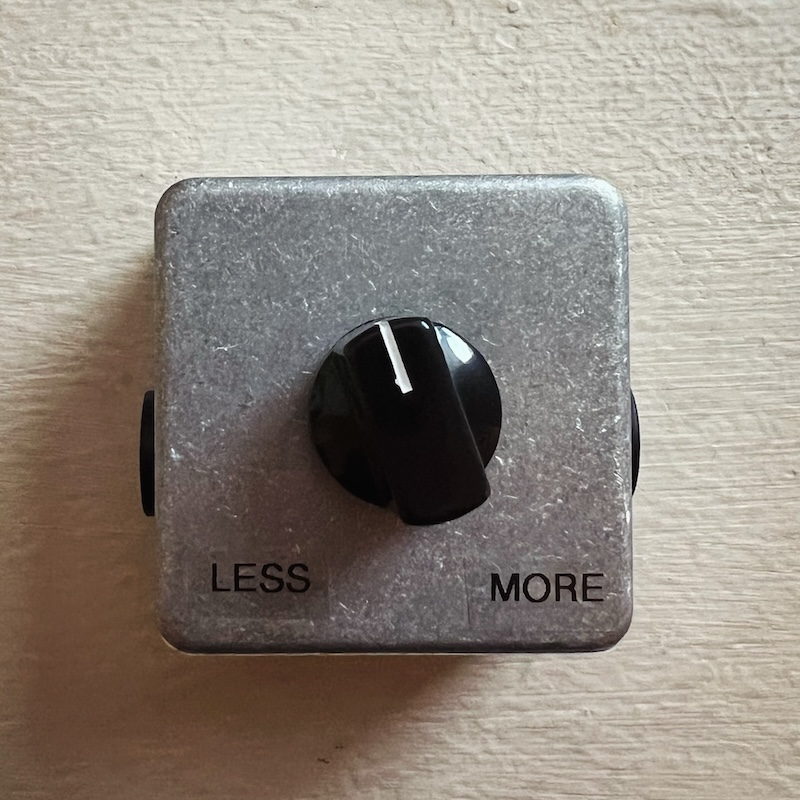
Less < — > More

Though as several people joked, what if less is more?

Excellence in interface design. I should mention: this is a real guitar pedal (it’s the Dead Bat from Audio Alchemy). You place this device between a power source and an analog pedal and it simulates a drained battery. Well, that’s how it is described. What it does is steadily reduce the power that is sent to the analog pedal — to “choke” or “strangle” or “starve” it, just to mention a few of the less than tasteful metaphors I’ve encountered. I’d guess there are fluctuations inherent in an actually dying battery, especially as it nears the end, that are more random/interesting/chaotic. I’m just getting started with this one. I’ll report back. So far I’ve tried it with an analog tremolo pedal, and it worked quite nicely. Which is to say, it sounded horrible — in a good way. I want to try it on a delay pedal. I’m wondering what the most complicated / sensitive analog pedals there are that I might apply this to.