On the Line

Some favorite recent sentences

"Her own sound was singular, in life as in print. If you called her, as I often did while working with her as a fact checker, a decade ago, and then as an editor’s assistant, you got used to waiting out a dozen rings and the answering-machine greeting — she screened the old-fashioned way — followed by the sudden burst of that rich, deliberate voice picking the conversation up midstream.

That is Alexandra Schwartz memorializing the late critic Joan Acocella, who died on Sunday, in The New Yorker.

. . .

"He cut the tape, built a loop, excised the guitar, slowed it all to a narcotized pace, and played along, augmenting the phrases where he saw fit."

That is Grayson Haver Currin writing about the process behind Brian Eno’s album Ambient 1: Music for Airports for Pitchfork’s Sunday review

. . .

"Now came an auditory impression. It must have been there all along, but I was only now processing it. Low voices, coming from the other side of the door. Footsteps, doors opening and closing. Beeps and electronic tones. Telephone sounds, hospital noises. The ordinary, busy clamour of a large institution. It could be a school, a government building, our own project. It didn't sound like the past."

That is from Permafrost, the first novel I’ve read by Alastair Reynolds. I’m currently 79% of the way through, according to my Kindle. It’ll likely be the first novel I finish reading in 2024, unless Shards of Earth by Adrian Tchaikovsky comes to a close sooner. It’s a fantastic story of time travel, especially in terms of how it depicts perception, as shown here, when the protagonist is transported several decades into the past (more to the point, this being time travel, into “a” past). I’m a big fan of heavy in medias res storytelling — “hard science fiction” being a recognized subgenre, I kinda wish “hard in medias res science fiction” was a subgenre — and it’s an approach that is particularly useful in Permafrostbecause we experience the book with the same initial bewilderment that several characters experience in the scenarios they find themselves facing.
New Year, New Blogs

From Taylor Deupree and Marcus Fischer

I’m under no illusion that a practice initiated at the turn of the year will extend long enough to become a habit, whether diet, exercise, meditation, or phone-use diligence. Nonetheless, the green shoots of resolution-adjacent blogging are always a pleasure in early January — and by “blogging” I don’t solely mean writing posts on standalone websites, though I do prioritize them. A certain breed of email newsletter counts, as well, when the issues double as URL-specific posts, and — and this is key — there is an RSS feed to access them. I remain convinced that an RSS feed is an essential component of a blog — that, alternately, to require people to repeatedly visit your website of their own volition, and in the process for them to recall precisely where they left off reading the last time they were there, is simply too much to ask of a reader. It was too much to ask in the late 1990s, and in our cellphone-mediated, notification-riddled present, it is all the more so. RSS brings the writing to the reader, and in some ways isn’t that distinct from email. How different is the interface of my email application (Mimestream currently, in large part because it matches the keyboard shortcuts of the browser-based Gmail app) from that of an RSS reader (Feedly for me at the moment, though I am looking at options)?

And while writing is the core of blogging, there are other forms of self-expression. Blogs that are mostly pictures or math or music are still blogs. The key thing is that blogging is not about final drafts. Blogging is as much a public notepad as social media is at its best (to be clear, most of social media is social media at its worst). It’s not a magazine; it’s a journal.

Which is why I am happy to see several musicians take up newsletters recently, and to do so with sketches, rather than finished work, on their minds.

Taylor Deupree has started up The Imperfect, a series of studio journal entries, a recent issue of which includes a reflection on the whole notion of works-in-progress, especially the earliest stages: “notebooks. portable synths. voice memos,” he writes — all lower case. “we’ve got tools to capture and remember these ideas while they strike far away from or studios… but remembering to have those with you while on the go, or beside the bed, or in the car, is another challenge.” That issue includes a brief bit of gossamer ambience to listen to while you read it.

Likewise, Marcus Fischer, who records for Deupree’s record label, 12k, has launched Dust Breeding, porting over to it the vast archive of posts he made to a blog of that name a decade-plus ago. True to blogging, he isn’t quite sure where the revived Dust Breeding will lead: “This latest incarnation will be something different once again,” he writes. “What that will be, only time will tell. I thought of naming it something else but I’ve kind of grown attached to it.”

If you’ve recently started a blog related to sound or music, please let me know. Thanks.

. . .

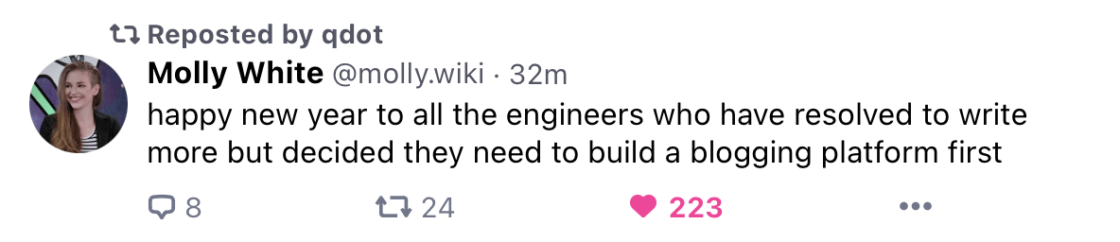
Related: I loved this post from Molly White, highlighting a syndrome/tendency I have witnessed countless times — and reminded me of when I tried to sketch out a rudimentary publishing system in Perl, many years ago pre-WordPress (an exercise that did, indeed, negatively impact my output).

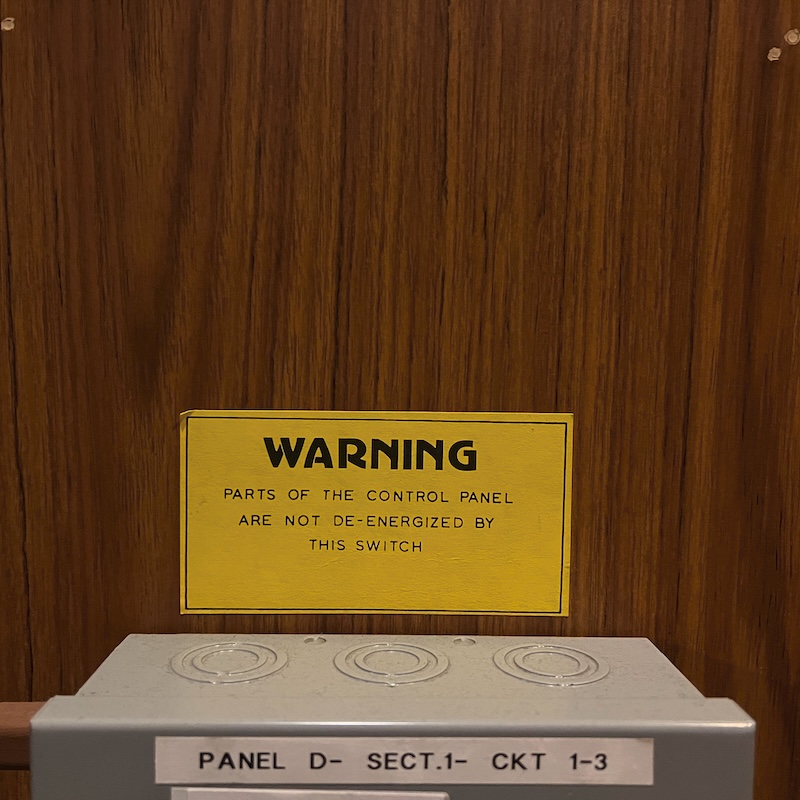
Warning

An ongoing series cross-posted from instagram.com/dsqt

I’m not sure if this is the most David Lynch photo I’ve ever taken, the most Wes Anderson, or the most Stanley Kubrick, or simply some antiseptic Venn diagram of them all.

Scratch Pad: Social Media Detritus

From the past week

I do this manually at the end of each week: collating (and sometimes lightly editing) most of the recent little comments I’ve made on social media, which I think of as my public scratch pad. Some end up on Disquiet.com earlier, sometimes in expanded form. These days I mostly hang out on Mastodon (at post.lurk.org/@disquiet), and I’m also trying out a few others. I take weekends and evenings off social media.

▰ My kingdom for Boxhead Ensemble to cover Ragnar Kjartansson’s The Visitors

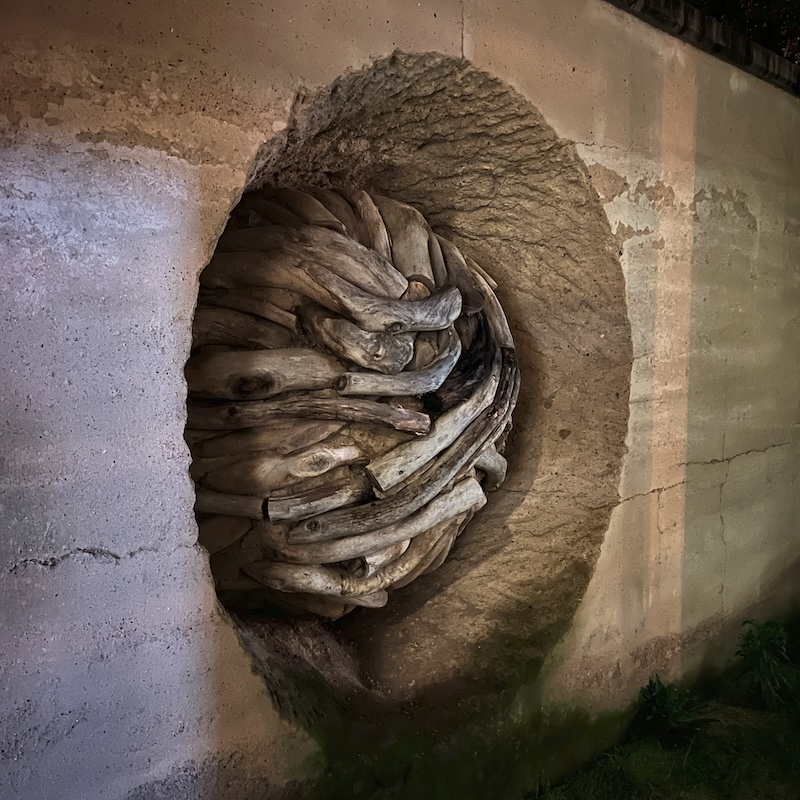
▰ I  never miss the opportunity to check out the Earth Wall installation by Andy Goldsworthy when I’m nearby in the Presidio. If I’m not mistaken, 2024 marks the 10th anniversary of its installation.

▰ I went to bed well before midnight on December 31, 2023, and I wasn’t woken by fireworks at midnight, so either it was an especially quiet New Year’s Eve here in my little swath of San Francisco, or I was even more deep asleep than usual

A Criterion Blooper

And a formal request

The Criterion Collection and its streaming service, the Criterion Channel, are synonymous with excellent taste in film, and so it’s all the more confusing that the company’s year-end “Room Tone” roundup from 2023 fails to actually deliver any substantial room tone. The otherwise cute supercut collects brief snippets of Criterion interviewees — among them Laura Dern and Martin Scorsese — sitting quietly and self-consciously as film crews record room tone for whatever video production was underway. In what is essentially a purposeful blooper reel, we hear the subjects occasionally joke about the discomfort inherent in staying still and we witness the unease on some of their faces and in their posture. Room tone serves the editing process: it provides background sound that can later be used to fill gaps during the assemblage of a film (or video — and it’s a necessity for audio-only projects, too, such as podcasts). Room tone is unique to a given place and moment — the physicality of the space, including what time of day it is, who’s in the room, even what they’re wearing. However, instead of getting to listen to the various room tones, we hear instead what appears to be a bit of a Nino Rota score. This seems like a missed opportunity on the part of Criterion. More to the point, it seems “off brand” for Criterion to employ a proper film term and to not make good on it (then again, Letterboxd has its “Rushes” and “Call Sheet,” which are neither). As one commenter on YouTube put the Criterion situation, “This was not the ASMR feast I was expecting… but I enjoyed it nevertheless.” Same here — and I hereby request a director’s cut that removes the repurposed background music entirely.