In the work of Janet Cardiff and George Bures Miller
/ By Marc Weidenbaum
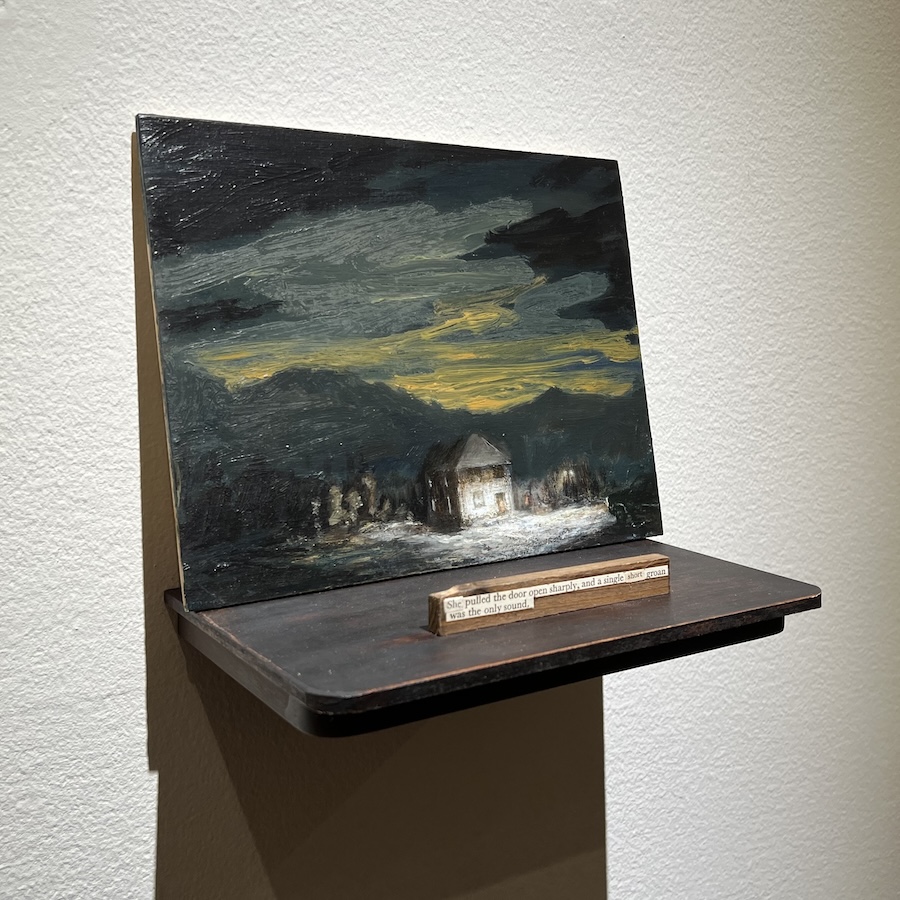
This is just one of the many works currently on display at the show from artists Janet Cardiff and George Bures Miller open through March 9 at the Fraenkel Gallery in San Francisco. Essentially all the works in the show engage with sound, two pieces filling entire rooms, others triggered by tiny red buttons the size of a bug bite. This one makes no sound, except perhaps in the viewer’s imagination.
Titled simply White House Night and dating from last year, it’s a fragile little painting of a little building against a murky backdrop, picturesque in a macabre sort of way, the piece’s delicacy emphasized by how it is not hung on the wall, but left to lean atop a small shelf. In front, on a piece of wood the odd shape of which suggests it’s been repurposed, are a couple lines of text, an assemblage, two words superimposed, or interjected, into what was either a pre-existing sentence, or two separate ones now joined together.
The combination of painting and rejiggered typography functions like a reverse of a piece by the late artist Tom Phillips: the words remote from the image and formed into a whole, even one with its seams showing, rather than the image serving to reorient a written sequence that preceded the art-making. It shares with Phillips the sense of making the most of limited resources, one of which is language.
There’s something almost accusatory about the edits, the “She” like a later clarification and the “short” carrying meaning the viewer can only guess at. We’re left with the image, so to speak, of a “short groan,” and the lingering presence otherwise of the deep silence that the structure, seemingly illuminated by a car’s headlights, contains.
And what we talk about when we talk about software
/ By Marc Weidenbaum
Martin Yam Møller asks people more or less the same nine questions about music equipment for a running series of informative interviews on his website. These have included the musicians Sofie Birch, Emily Hopkins, Colleen, and Takeyuki Hakozaki, among many others. Møller asked me to participate back at the start of 2020, and I finally completed the Q&A this past week. To be very clear, I don’t remotely have the musical talent of the other people interviewed by Møller; as I mention in one of my answers, regarding my engagement with music-making: “using instruments has helped me understand more deeply the music I write about, and playing has informed the collaborations I do with musicians, as well as the occasions when I interview musicians and other people who work in sound.” That said, I really enjoyed chewing on his questions, things like which “knob/fader/switch” is my favorite, and what’s “the most annoying piece of gear you have, that you just can’t live without.” Below is the second half of the answer to one of the questions, just by way of example of how the interview plays out. His question in this case was: “What software do you wish was hardware and vice versa?” I easily came up with several answers for the first half of the question. The other half was much more difficult to answer, and now having looked over the responses from other participants in the series, I recognize I’m not alone. It seems like an obvious reverse, but the more I thought about it, the more I realized not only that I couldn’t really come up with a specific answer, but that the question itself reveals something about the limits of what we talk about when we talk about software. Here’s what I wrote:.
[A] lot of my favorite software, such as the Borderlands app, isn’t purely software; these are tools that work because of the physical interface on which they run. An app like Borderlands already is hardware, in a manner of speaking, because it runs on an iPad. However, a distinction can be made between a piece of software-driven hardware that will work until the thing breaks, like a guitar pedal with firmware, versus a piece of software that is dependent on a separate operating system, such as iPadOS in the case of Borderlands, that may break the software when the OS updates and the old hardware on which it ran is sunsetted. Any number of iOS apps fall into the latter category.
In addition some software, like the Koala app, already have physical parallels in hardware: if I want Koala in standalone hardware form, I could just get an Roland SP-404 (I do want to try the MK II, which does a bunch of stuff the Teenage Engineering EP-133 K.O. II doesn’t). I love Samplr, which also falls into the Borderlands category of being iPad-specific. I love SuperCollider, but it requires a computer keyboard and a screen — I wonder what “hardware SuperCollider” might even mean, right? In many ways, SuperCollider is as tied to a keyboard as Koala, Samplr, and Borderlands are tied to iPadOS. So, no, there isn’t really a piece of software that I wish was hardware.
I do this manually at the end of each week: collating (and sometimes lightly editing) most of the recent little comments I’ve made on social media, which I think of as my public scratch pad. Some end up on Disquiet.com earlier, sometimes in expanded form. These days I mostly hang out on Mastodon (at post.lurk.org/@disquiet), and I’m also trying out a few others. I take weekends and evenings off social media.
▰ SoundCloud is reportedly for sale for one billion dollars (US). If the roughly 2,000 subscribers to the Disquiet Junto email announcement list each ponies up a half million, we could buy SoundCloud and make it a Junto-only playground. Let’s get on that.
▰ Remembering that tour of Sun Studio I took 20-plus years ago where the guide explained that some of the beloved echo in the recordings was the result of being in the hall just outside the bathroom
▰ The calendar is confusing. Firmwarebruary should precede Jamuary.
▰ It is quite possible I have gone 48 hours without misplacing my AirPods
▰ I got an extra copy of Eli Fieldsteel’s excellent new book, SuperCollider for the Creative Musician. I’ll be giving it away to a lucky reader at random in an issue of my This Week in Sound email newsletter sometime between today’s issue and next Tuesday’s. Subscribe at thisweekinsound.substack.com.
▰ I don’t track my activity closely, but I do look back each morning at how many miles my phone, an iPhone 13, has inferred that I walked the day prior. It’s weird I have to pull this up on my phone because I can’t do so on my laptop, since so many other apps are cross-platform.
▰ Made it to 2024 without ’em, but I finally am picking up some USB-C cables that have USB Type B, USB Mini, and USB Micro ends. Using adapters has gotten ridiculously complex.
▰ Only way the final episode of Monarch’s first season coulda been better is if everyone who met the team upon their return was an ape
▰ The birds have gone bonkers this evening. It’s like corvid Gwar karaoke up and down the block.
Again, my current social media locations are listed here.
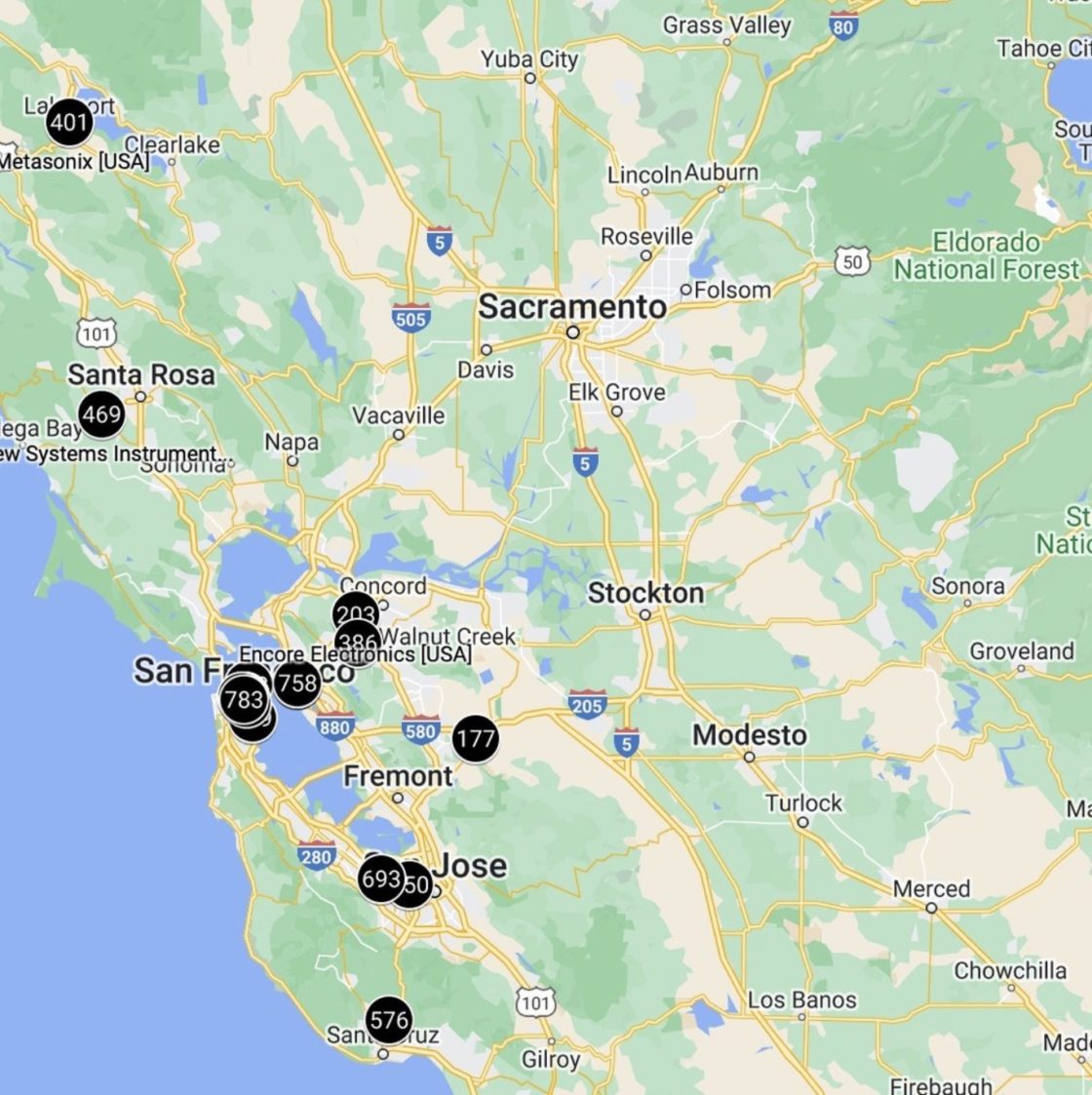
Are there really no Eurorack synthesizer makers further inland in California than this? (Locations courtesy of the map of Eurorack Module Manufacturers.)
The Assignment: Explore an aspect of the ancient occult science using music.
/ By Marc Weidenbaum
Each Thursday in the Disquiet Junto music community, a new compositional challenge is set before the group’s members, who then have just under five days to upload a track in response to the assignment. Membership in the Junto is open: just join and participate. (A SoundCloud account is helpful but not required.) There’s no pressure to do every project. It’s weekly so that you know it’s there, every Thursday through Monday, when you have the time and interest.
Deadline: This project’s deadline is the end of the day Monday, January 15, 2024, at 11:59pm (that is, just before midnight) wherever you are. It was posted on Thursday, January 11, 2024.
These following instructions went out to the group’s email list (at tinyletter.com/disquiet-junto). Note that this service will change shortly, likely to Buttondown, due to Tinyletter shutting down.
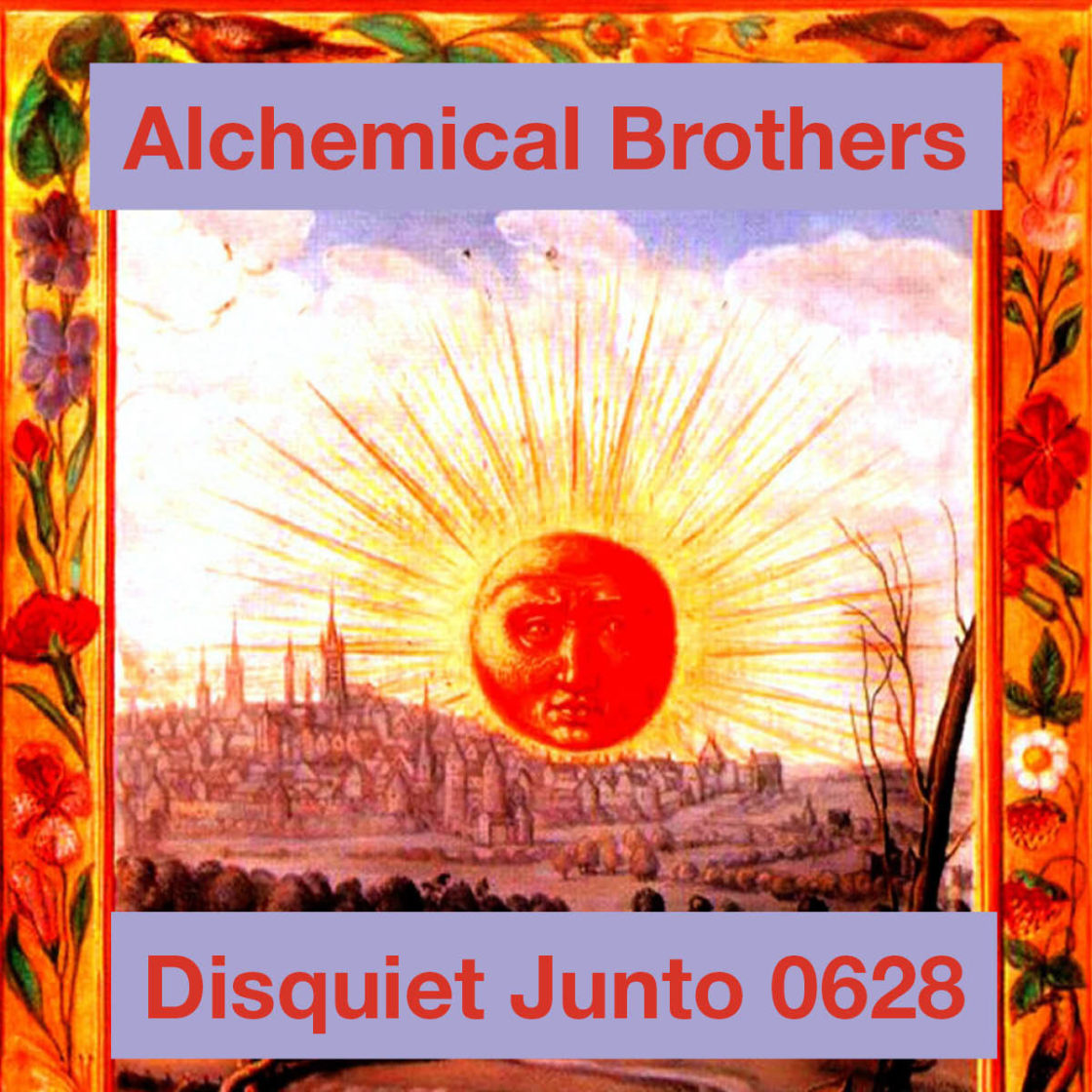
Disquiet Junto Project 0628: Alchemical Brothers The Assignment: Explore an aspect of the ancient occult science using music.
Step 1: There are, we’re told, seven stages of alchemy, the ancient occult science concerned with the transformation of matter. The third of these stages is “Separation,” which is symbolized by the element of air. Since air is closely associated with the transmission of sound, Separation suggests itself as a stage of alchemy that might be explored through music. Read up a bit on alchemy.
Step 2: Produce a piece of alchemy-inspired music that explores the concepts of “transformation” and “separation” as you interpret them.
Seven Important Steps When Your Track Is Done:
Step 1: Include “disquiet0628” (no spaces or quotation marks) in the name of your tracks.
Step 2: If your audio-hosting platform allows for tags, be sure to also include the project tag “disquiet0628” (no spaces or quotation marks). If you’re posting on SoundCloud in particular, this is essential to subsequent location of tracks for the creation of a project playlist.
Step 3: Upload your tracks. It is helpful but not essential that you use SoundCloud to host your tracks.
Step 4: Post your track in the following discussion thread at llllllll.co:
Step 5: Annotate your track with a brief explanation of your approach and process.
Step 6: If posting on social media, please consider using the hashtag #DisquietJunto so fellow participants are more likely to locate your communication.
Step 7: Then listen to and comment on tracks uploaded by your fellow Disquiet Junto participants.
Note: Please post one track for this weekly Junto project. If you choose to post more than one, and do so on SoundCloud, please let me know which you’d like added to the playlist. Thanks.
Additional Details:
Length: The length is up to you. Consider the opportunity to explore numerology as well.
Deadline: This project’s deadline is the end of the day Monday, January 15, 2024, at 11:59pm (that is, just before midnight) wherever you are. It was posted on Thursday, January 11, 2024.
Upload: When participating in this project, be sure to include a description of your process in planning, composing, and recording it. This description is an essential element of the communicative process inherent in the Disquiet Junto. Photos, video, and lists of equipment are always appreciated.
Download: It is always best to set your track as downloadable and allowing for attributed remixing (i.e., a Creative Commons license permitting non-commercial sharing with attribution, allowing for derivatives).
For context, when posting the track online, please be sure to include this following information:
More on this 628th weekly Disquiet Junto project, Alchemical Brothers — The Assignment: Explore an aspect of the ancient occult science using music — at: https://disquiet.com/0628/