Sound Ledger: Meta’s Language Model

Audio culture by the numbers

6,500: estimated number of spoken and written forms of communication used by humans

100: number of languages that Meta’s SeamlessM4T can translate and transcribe 

4,000,000: number of hours of (publicly available) speech mined to achieve the result

Source: engadget.com.

On the Line: Ulitskaya, McBride, Tools

Some favorite recent sentences

“At the age of ten he made himself a reed pipe. He kept blowing into it, and tender sounds poured out.”

That is from “The Autopsy,” a short story by Russian writer Lyudmila Ulitskaya, translated by by Richard Pevear and Larissa Volokhonsky (it’s in the August 28, 2023, issue of The New Yorker, and in Ulitskaya’s collection The Body of the Soul: Stories, due out at the end of October.)

. . .

"Though they never availed themselves of anything as obvious as a drumbeat, they tended to shape even their most abstract pieces around a tidal ebb and flow." 

That is Philip Sherburne, writing at Pitchfork about the great ambient musician Brian McBride (half of the duo Stars of the Lid), who recently died at age 53.

. . .

“I thought how differently different people react and use the same tools, and it might be a great way of finding out the range of this small synthesiser.”

That is the musician Grant Wilkinson, writing about how he put together a synthesizer and then released an album of different musicians using the same equipment (himself, Darren Hayman, and three musicians sharing the name Phil: Maguire, Julian, and Bilsby). 

Kronos at 50

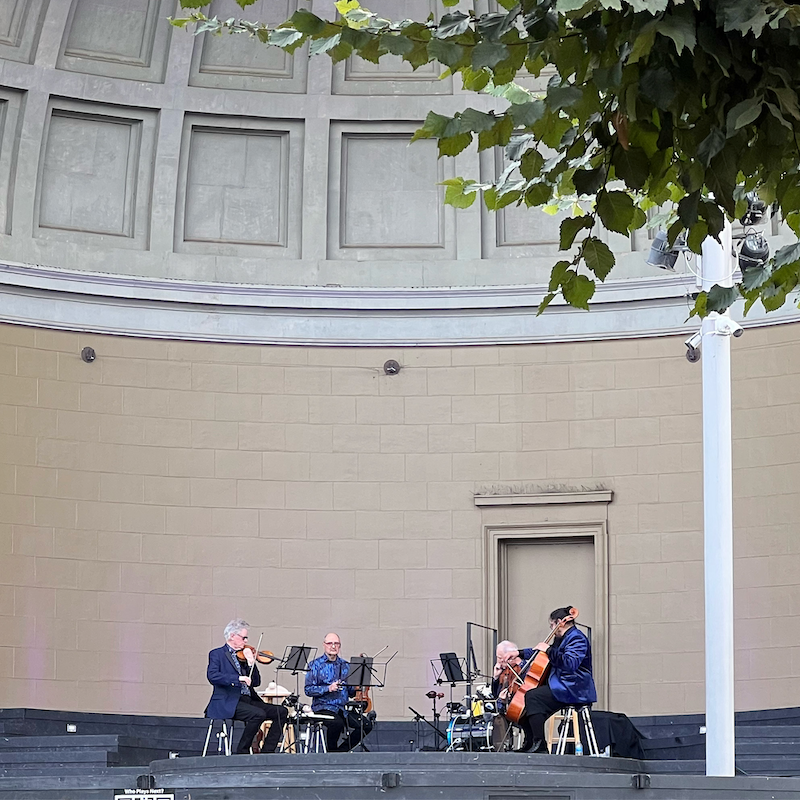
Kronos Quartet is shown here, celebrating its 50th anniversary with a free concert in Golden Gate Park on Saturday, August 26, 2023. When I took this photo, they had just begun a humorous piece by John Oswald. Earlier they had done works by Angelique Kidjo, Michael Gordon, Clint Mansell (one each from Requiem for a Dream and, later, The Fountain), and Sigur Rós, among others. Still to come were a “Summertime” that eerily channeled Janis Joplin’s ragged vocals, and an “All Along the Watchtower” that was indelibly Jimi Hendrix’s — and much more. We even got an encore. Fantastic afternoon.

That’s cellist Paul Wiancko, who joined Kronos this year (filling the seat vacated by Sunny Yang, who had been with the quartet for a decade), on the right, along with, from left to right, David Harrington, Hank Dutt, and John Sherba. Those three are on, respectively, violin, violin, and viola, but they all played other instruments over the course of the concert, including drums, voice, and additional percussion, and they employed some unusual bows for one theatrical piece. Born in 1983, Wiancko drew his first breath the year Kronos itself turned 10. Harrington noted that the group had lived in San Francisco for 46 years, and over the course of the afternoon mentioned numerous collaborators from the city — and also how he’d first heard one of the composers they later worked with thanks to the retail resource that is nearby Amoeba Records.

Scratch Pad: [ambient], Practice, Sound Art

From the past week

I do this manually at the end of each week: collating most of the recent little comments I’ve made on social media, which I think of as my public scratch pad. I mostly hang out on Mastodon (at post.lurk.org/@disquiet), and I’m also trying out a few others

▰ [ambient noise] [ambient noise] [indistinct chatter] [indistinct chatter] [background noise] [indistinct chatter] [ambient noise]

^ verbatim how a speech-to-text app “transcribed” a brief field recording I submitted (I’d intended to submit a different audio recording)

▰ After practicing guitar in the morning, you recognize that the hum of your amp is sorta soothing, so you just leave it on as you return to work

▰ Timed my walk to the supermarket to late afternoon in part because, on a day as clear and warm as this one, I expected to hear music students practicing through open windows. There’s usually a smattering of trumpets, pianos, and violins. But not a peep.

▰ There are a lot of sounds I love in urban life, key in recent years being the skateboard. I’m not sure if skateboarding’s more popular than it used to be here in San Francisco, or if wheels got louder, but I hear it more, pay attention to it more, and have come to cherish it.

▰ I’ve got a concert review, a book review, and a fun short piece about Ornette Coleman due out soon(ish)

▰ I’ve been practicing the basic* “spider walk” (plus some variations) on guitar every day. Something about it sounded familiar. Then I recognized that the first two lines are the first two bars of “Blue Monk” by Thelonious Monk.

*four frets in a row, then the next string higher

▰ I think often of a sound art exhibit I visited in London in 2019. I walked around the location and then went to the desk where the gallery-requisite woman in a black dress sat. I asked, trying not to seem stupid, where the sound was. She plugged something in. The sound started.

▰ What kind of a Friday is it? I found myself staring for a while at half of a “U” in a document on the left of my screen, and wondering why it was cut off. Turns out it was a “J”.

▰ Going through my inbox and slurping down /yum codes on Bandcamp. Forgive me if you sent me something and I’m only just getting around to it. The sheer amount of music is sort of insane. I’m not complaining. I’m down for the insanity, but that doesn’t make it any less insane.

After I posted the /yum comment, a friend — a composer, no less — asked what it is, and I replied: On Bandcamp.com, which is the main way many musicians sell their recordings, they can provide a free download to press (and other interested parties), and it is called a “yum” code. When you receive such a code, you then go to bandcamp.com/yum and enter the code. Then you can download the files, or access via your bandcamp library. If you write about music and/or record music for sale as downloads, a lot of time can involve /yum codes.