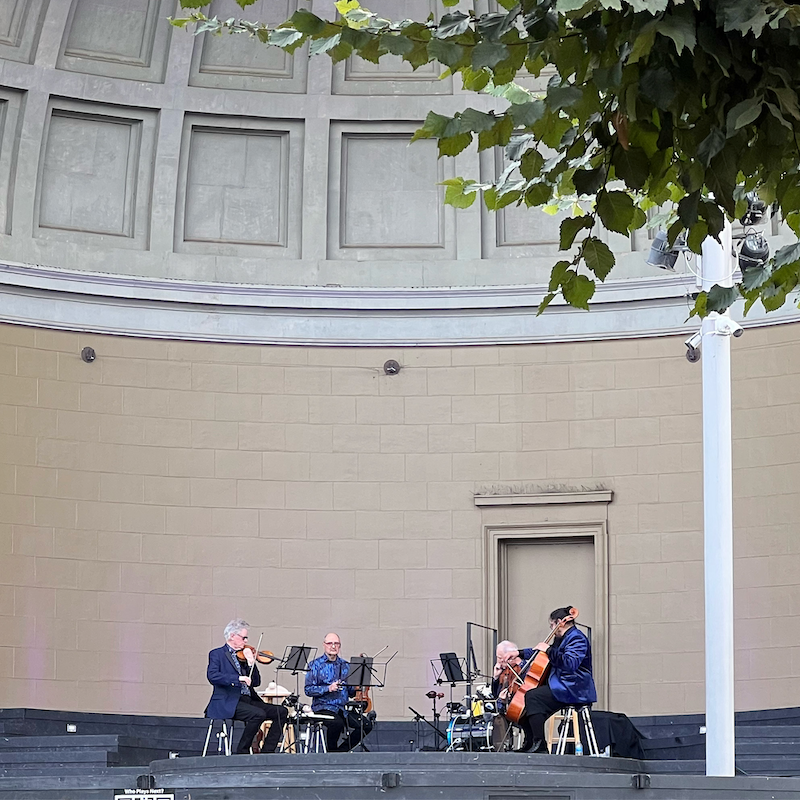
Kronos Quartet is shown here, celebrating its 50th anniversary with a free concert in Golden Gate Park on Saturday, August 26, 2023. When I took this photo, they had just begun a humorous piece by John Oswald. Earlier they had done works by Angelique Kidjo, Michael Gordon, Clint Mansell (one each from Requiem for a Dream and, later, The Fountain), and Sigur Rós, among others. Still to come were a “Summertime” that eerily channeled Janis Joplin’s ragged vocals, and an “All Along the Watchtower” that was indelibly Jimi Hendrix’s — and much more. We even got an encore. Fantastic afternoon.
That’s cellist Paul Wiancko, who joined Kronos this year (filling the seat vacated by Sunny Yang, who had been with the quartet for a decade), on the right, along with, from left to right, David Harrington, Hank Dutt, and John Sherba. Those three are on, respectively, violin, violin, and viola, but they all played other instruments over the course of the concert, including drums, voice, and additional percussion, and they employed some unusual bows for one theatrical piece. Born in 1983, Wiancko drew his first breath the year Kronos itself turned 10. Harrington noted that the group had lived in San Francisco for 46 years, and over the course of the afternoon mentioned numerous collaborators from the city — and also how he’d first heard one of the composers they later worked with thanks to the retail resource that is nearby Amoeba Records.
I do this manually at the end of each week: collating most of the recent little comments I’ve made on social media, which I think of as my public scratch pad. I mostly hang out on Mastodon (at post.lurk.org/@disquiet), and I’m also trying out a few others.
^ verbatim how a speech-to-text app “transcribed” a brief field recording I submitted (I’d intended to submit a different audio recording)
▰ After practicing guitar in the morning, you recognize that the hum of your amp is sorta soothing, so you just leave it on as you return to work
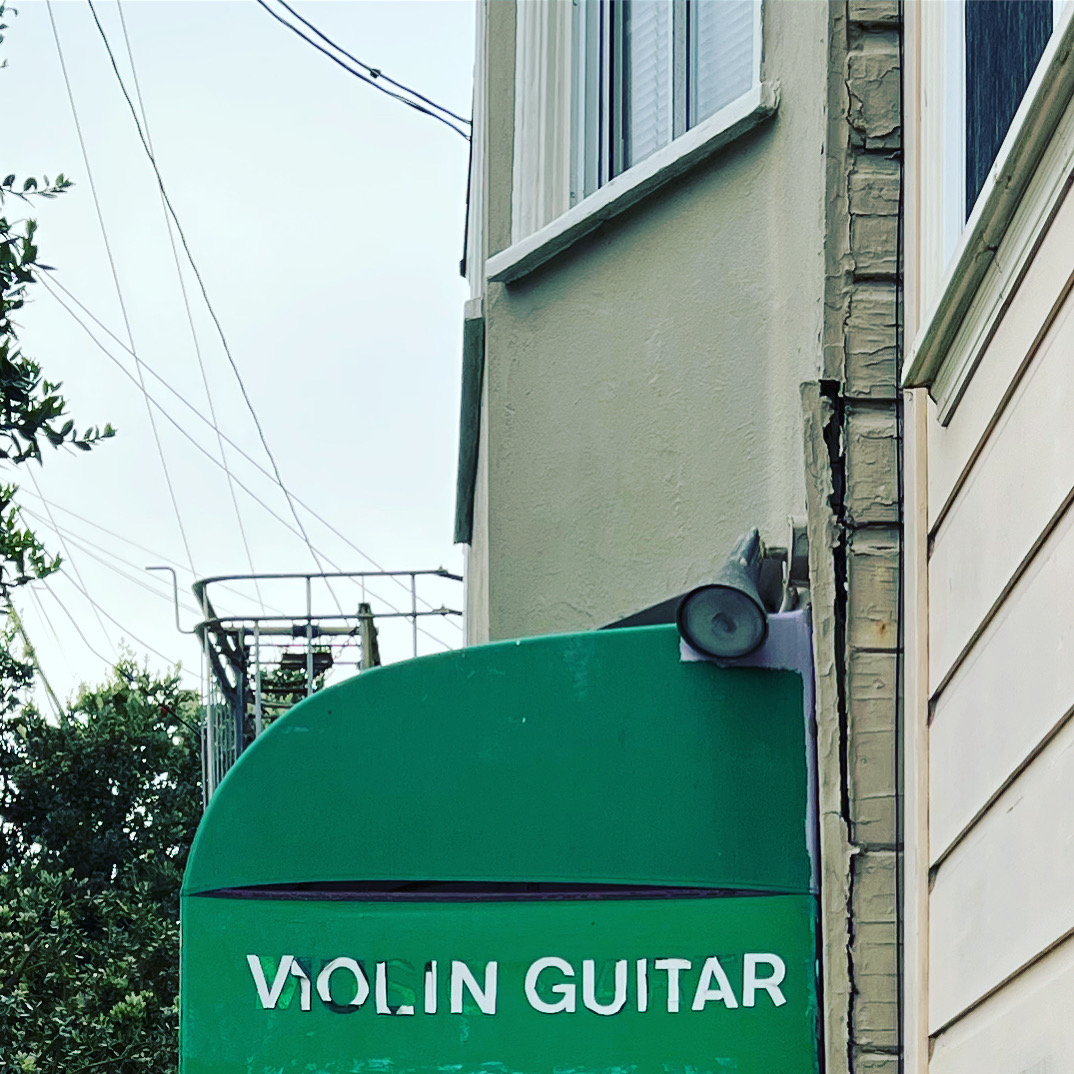
▰ Timed my walk to the supermarket to late afternoon in part because, on a day as clear and warm as this one, I expected to hear music students practicing through open windows. There’s usually a smattering of trumpets, pianos, and violins. But not a peep.
▰ There are a lot of sounds I love in urban life, key in recent years being the skateboard. I’m not sure if skateboarding’s more popular than it used to be here in San Francisco, or if wheels got louder, but I hear it more, pay attention to it more, and have come to cherish it.
▰ I’ve got a concert review, a book review, and a fun short piece about Ornette Coleman due out soon(ish)
▰ I’ve been practicing the basic* “spider walk” (plus some variations) on guitar every day. Something about it sounded familiar. Then I recognized that the first two lines are the first two bars of “Blue Monk” by Thelonious Monk.
*four frets in a row, then the next string higher
▰ I think often of a sound art exhibit I visited in London in 2019. I walked around the location and then went to the desk where the gallery-requisite woman in a black dress sat. I asked, trying not to seem stupid, where the sound was. She plugged something in. The sound started.
▰ What kind of a Friday is it? I found myself staring for a while at half of a “U” in a document on the left of my screen, and wondering why it was cut off. Turns out it was a “J”.
▰ Going through my inbox and slurping down /yum codes on Bandcamp. Forgive me if you sent me something and I’m only just getting around to it. The sheer amount of music is sort of insane. I’m not complaining. I’m down for the insanity, but that doesn’t make it any less insane.
After I posted the /yum comment, a friend — a composer, no less — asked what it is, and I replied: On Bandcamp.com, which is the main way many musicians sell their recordings, they can provide a free download to press (and other interested parties), and it is called a “yum” code. When you receive such a code, you then go to bandcamp.com/yum and enter the code. Then you can download the files, or access via your bandcamp library. If you write about music and/or record music for sale as downloads, a lot of time can involve /yum codes.
This went out yesterday as a weekly bonus — a thank-you to people who financially support This Week in Sound. It supplements the free Tuesday and Friday issues, which feature a broader array of material from the field of sound studies. It contained an annotated playlist of recommended music. I wrote about (1) a video from FM3, best known for their Buddha Machines, posted by member Christiaan Virant, (2) a single from electronically mediated cellist Henrik Meierkord, and (3) a highlight, by Ina Kacz, from a recent compilation album.
The Assignment: Using a speech-to-text tool, turn a field recording into instructions for a composition.
/ By Marc Weidenbaum
Each Thursday in the Disquiet Junto music community, a new compositional challenge is set before the group’s members, who then have just over four days to upload a track in response to the assignment. Membership in the Junto is open: just join and participate. (A SoundCloud account is helpful but not required.) There’s no pressure to do every project. It’s weekly so that you know it’s there, every Thursday through Monday, when you have the time and interest.
Deadline: This project’s deadline is the end of the day Monday, August 28, 2023, at 11:59pm (that is, just before midnight) wherever you are. It was posted on Thursday, August 24, 2023.
Tracks are added to the SoundCloud playlist for the duration of the project. Additional (non-SoundCloud) tracks appear in the lllllll.co discussion thread.
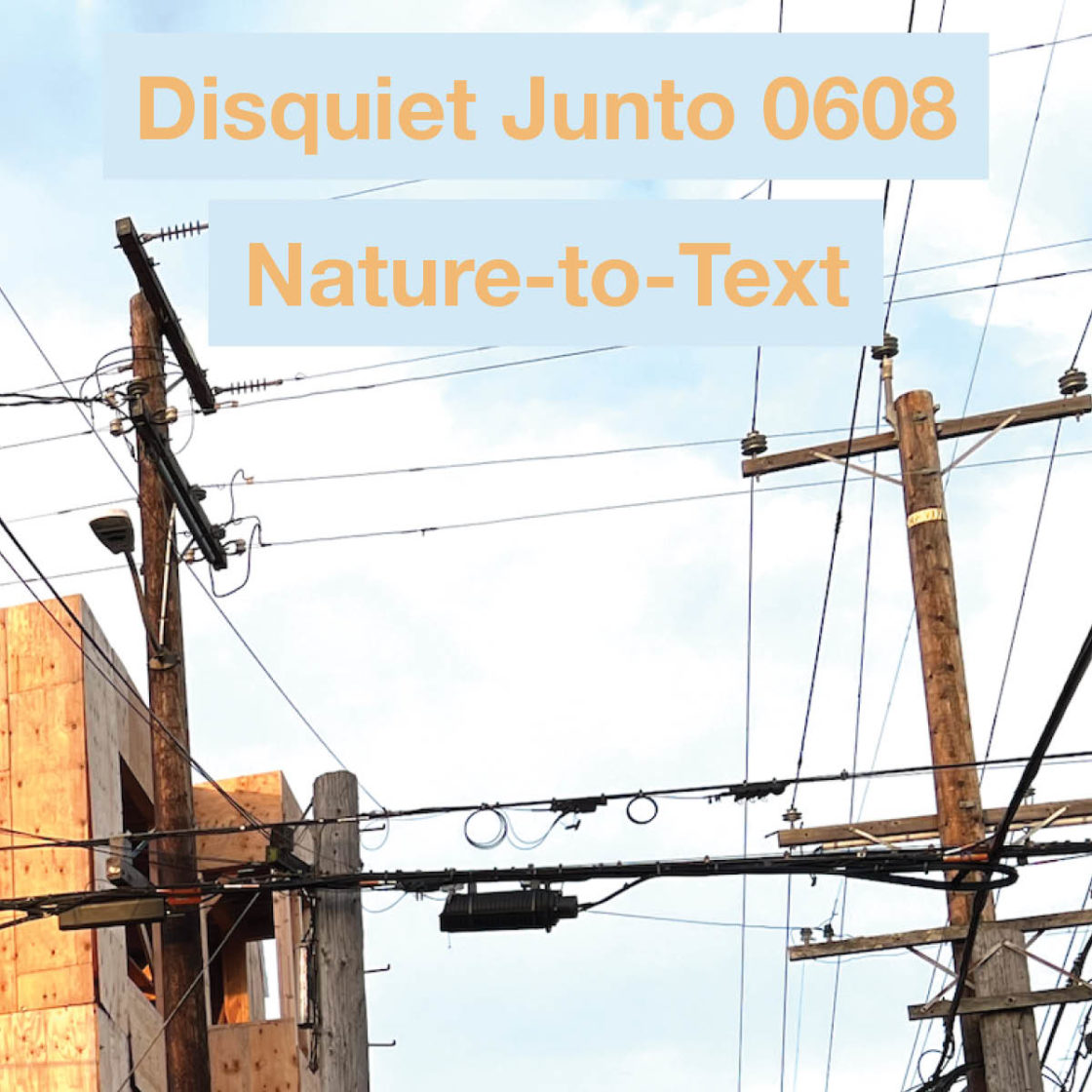
Disquiet Junto Project 0608: Nature-to-Text The Assignment: Using a speech-to-text tool, turn a field recording into instructions for a composition.
This project is perhaps more experimental than ordinary, simply because it may not work for everyone. Apologies in advance. As someone, I think Brian Eno, once said, “It’s only experimental music if there’s a chance it can fail.”
Step 1: When one uses speech-to-text tools, such as those now commonly included in word processing software, often those tools will mistakenly interpret ordinary, non-verbal sound as garbled words, or otherwise try to characterize the sound, such as with bracketed phrases like “[deep breath]” or “[background chatter].” One potential way to achieve the result is to upload the audio to YouTube and then apply automated captions. Check out your options. There is likely to be discussion of this topic on places where the Junto occurs, such as the llllllll.co BBS and the Junto Slack.
Step 2: Record some non-verbal audio, perhaps a field recording of the sound on the street, or down a hallway. It’s recommended to do the recording somewhere where there is likely to be variation.
Step 3: Submit a segment of the audio to a speech-to-text tool. Or perhaps multiple tools, to see the results.
Step 4: Assuming Step 3 yields a series of descriptions, then compose a piece of music that treats that sequence as a kind of score. That is, make music that achieves the result described by the speech-to-text tool’s results. Perhaps you could use someone else’s. Here, for example, is a sequence that I ended up with recently: “[ambient noise] [ambient noise] [indistinct chatter] [indistinct chatter] [background noise] [indistinct chatter] [ambient noise].”
Eight Important Steps When Your Track Is Done:
Step 1: Include “disquiet0608” (no spaces or quotation marks) in the name of your tracks.
Step 2: If your audio-hosting platform allows for tags, be sure to also include the project tag “disquiet0608” (no spaces or quotation marks). If you’re posting on SoundCloud in particular, this is essential to subsequent location of tracks for the creation of a project playlist.
Step 3: Upload your tracks. It is helpful but not essential that you use SoundCloud to host your tracks.
Step 4: Post your track in the following discussion thread at llllllll.co:
Step 5: Annotate your track with a brief explanation of your approach and process.
Step 6: If posting on social media, please consider using the hashtag #DisquietJunto so fellow participants are more likely to locate your communication.
Step 7: Then listen to and comment on tracks uploaded by your fellow Disquiet Junto participants.
Step 8: Also join in the discussion on the Disquiet Junto Slack. Send your email address to [email protected] for Slack inclusion.
Note: Please post one track for this weekly Junto project. If you choose to post more than one, and do so on SoundCloud, please let me know which you’d like added to the playlist. Thanks.
Additional Details:
Length: The length is up to you.
Deadline: This project’s deadline is the end of the day Monday, August 28, 2023, at 11:59pm (that is, just before midnight) wherever you are. It was posted on Thursday, August 24, 2023.
Upload: When participating in this project, be sure to include a description of your process in planning, composing, and recording it. This description is an essential element of the communicative process inherent in the Disquiet Junto. Photos, video, and lists of equipment are always appreciated.
Download: It is always best to set your track as downloadable and allowing for attributed remixing (i.e., a Creative Commons license permitting non-commercial sharing with attribution, allowing for derivatives).
For context, when posting the track online, please be sure to include this following information:
More on this 608th weekly Disquiet Junto project, Nature-to-Text (The Assignment: Using a speech-to-text tool, turn a field recording into instructions for a composition), at: https://disquiet.com/0608/