I do this manually each Saturday, usually in the morning over coffee: collating most of the little comments I’ve made on social media, which I think of as my public scratch pad, during the preceding week. These days that mostly means post.lurk.org (Mastodon).
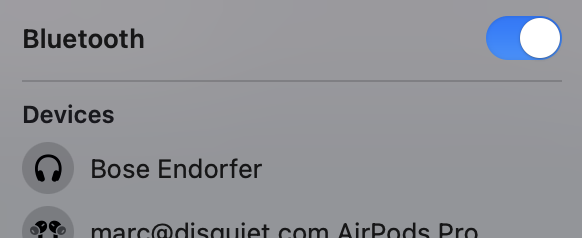
▰ Fun with bluetooth headphone naming
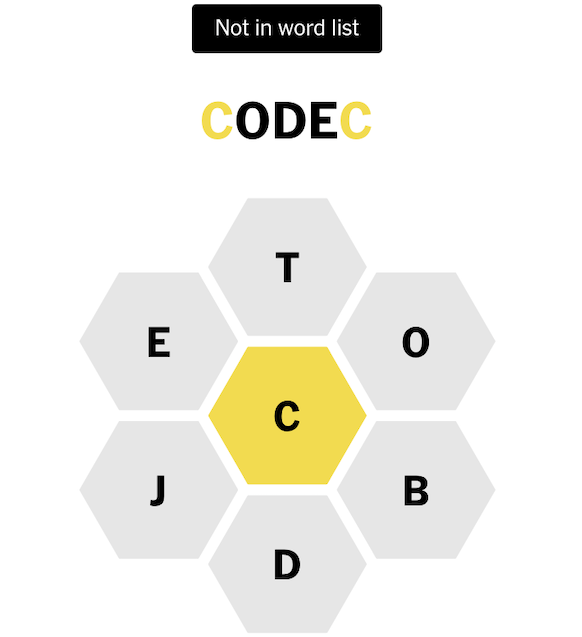
▰ How is “codec” not an option in Monday’s New York Times Spelling Bee?
▰ The Moon Baboon level of the video game It Takes Two took a lot out of me
▰ Almost a month into Duolingo and I still don’t know the German word for “labeled a bunch of music files and then realized I hadn’t converted them yet from WAV to ALAC”
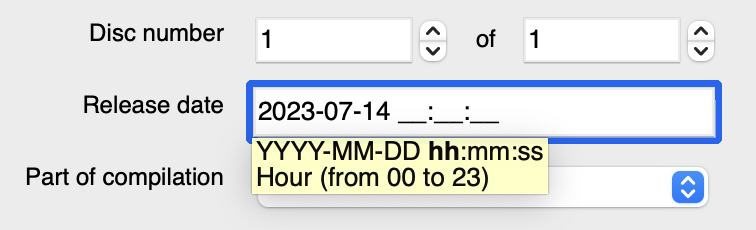
▰ Album metadata achieves new heights in trainspotting
▰ Best language I’ve seen in a security process (CAPTCHA/login) in some time: “Do not challenge me on this device again”
▰ Not sure why I find both Goodreads and StoryGraph so dissatisfying. They seem overly complicated for what they’re for (entering dates on Goodreads in particular is peculiar and often doesn’t seem to work). If you have a recommendation for an alternative (I tried the Mastodon-based one and didn’t get it) that’d be great.
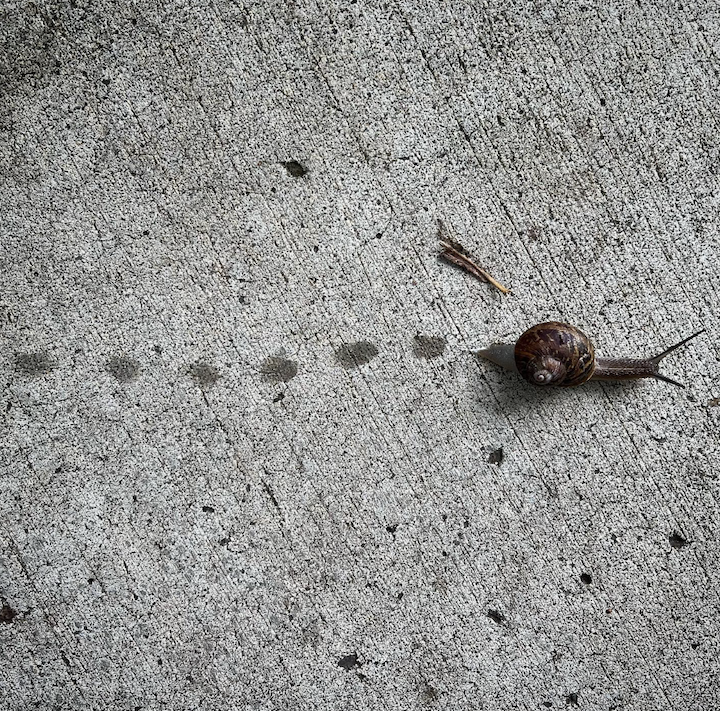
▰ Nature marks where to cut
▰ Morning sounds: birdsong, chatter, air conditioning exhaust
A Wired magazine reporter, Amos Barshad, got in touch with me recently when he was writing a story, “AI Could Usher in a New Era of Music. Will It Suck?” published earlier this week, about the intersection of artificial intelligence and popular music. The article’s focus, per its title, is “Heart on My Sleeve,” a song enabled by AI that mimicked Canadian rapper Drake and got a lot of attention in the process (from audiences, from the press, and from the record label that administrates Drake’s commercial interests).
Barshad and I talked on the phone when he was researching the piece. As he quotes in the article, I think that the “hand-wringing [around AI music], it’s a strange thing to me. … We’ve been concerned with creating artificial life at least since the Golem.” The rise in anxiety about AI makes me think about issues raised when the cloning of Dolly the sheep was announced in 1997; I kept coming across people saying how “now” was the time to start debating the impact of cloning, as if cloning hadn’t been on the horizon for a long time. It was at that moment I realized how few people must read (or absorb and reflect on) science fiction, which I’ve found has routinely provided me with tools to navigate daily modern life. Sci-fi may not successfully predict the future (arguably, it is always about the present), but it can sure instigate thought experiments in advance of the future’s eventual — and in the case of Drake Prime, mundane if worrisome — arrival. I appreciate the economic and existential anxieties that come along with the current slate of AI techniques. I think the Writers Guild of America, for example, is correct is using this moment to put initial rules in place. I also think a lot of writing about “AI” treats it as a singular instance — as a known, identifiable, and nameable thing. Which it is not. In many cases, today’s writing opposed to AI reads about as sophisticated as arguments that regularly situate a nameless “they” as the source of any given problem. (As for writing that’s strongly in favor of AI, by contrast it often reads like it was written by an AI, which is a whole other problem.)
In some ways, I’m the worst person to talk with about the impact of AI on pop music because I don’t really pay a lot of attention to pop music. While on occasion a song will catch my fancy, I barely listen to anything with a singer, and haven’t for a long time. It’s not that I dislike pop music these days so much as it disinterests me. I listen to music continuously, and the patterns of adoption and mimesis in pop music strike me as slow and routine, compared with the ingenuity and invention in experimental music.
A key thing for me that Barshad touches on in his Wired article is the cybernetic history of both artificial intelligence and electronic music. The development of cybernetics is key to the development of artificial intelligence and, as I note in the article, of generative systems. The Drake AI song is, as Barshad quotes me, boring, plain and simple. It’s the end result of rote cause and effect (“please make something that sounds like X”). AI will be of interest, at least to me, as a musical instrument, as a music production tool, as a creative tool, when it engages in the creative process more thoroughly as a generative system — which is to say, one where the outcomes are considerably less certain, less like placing an order with a mechanical turk and more like, as Brian Eno says (and as, again, is mentioned in Barshad’s article), tending a garden.
I sometimes do ask myself “What would John Cage do?” — and it’s been happening with regard to ChatGPT, etc., lately as the discourse around AI grows and grows. Writing about AI has become a kind of OpEd version of the “grey goo” feared during the initial development of nanotechnology. Forgive me for adding a few hundred GMA-free* words to it.
I imagine Cage saying various things about AI circa mid-2023, and some of those things are in opposition to each other. The opposition is not representative of him being mercurial, but of me being unsure about where his opinion would potentially land. In this context, I reread some of his conversations with Morton Feldman, collected in the great book Radio Happenings, and also some of his lectures, in which he talked about computers, radio, tape splicing, and other equipment he employed.
The following two contrasting statements seem to me what might, perhaps, be the outcome of his consideration of the topic — though I say that with the emphasis on the word “perhaps.” These statements in quotes below are entirely inventions on my part. An English teacher of mine, back in 11th grade, introduced the word “perhaps” to us as a highly useful rhetorical device, and it has been a key tool for me ever since. How does one employ the word “perhaps” correctly? When uncertain, say “perhaps.” When not in doubt, definitely consider saying “perhaps.”
These two diametrically opposed hypothetical responses are where I’ve currently found myself:
“ChatGPT is just a tool, a tool made by humans. I’ve worked with creative constraints for much of my life. I want to see what this tool can do. For what is an iteratively refined prompt other than a form of explorative constraint?”
Or perhaps:
“ChatGPT is a machine — not even a machine, but software running on a machine. Why should I care what a machine has to say if all it knows is what we’ve already told it?”
I’m not sure which direction Cage would have gone. It’s sort of like how on the one hand, Cage was exactly the wide-eyed thinker you’d want on a committee of notable humans if we were suddenly contacted by an alien world, while on the other, his response might likely be something along the lines of, “We can’t even speak with our cats yet, and we don’t know what’s at the bottom of the ocean, so why do we want to leave the planet so soon?” Of course, before deciding one way or another, he’d ask if this alien world is home to a previously undocumented species of mushrooms.
Almost certainly, Cage would have come upon on a direction — an insight — about modern AI, circa 2023, that I can’t myself imagine. But with the limits of my imagination, that’s the forked path I currently find myself at the crossroads of. On the one hand, he was an inveterate tinkerer. On the other, he all but gave up on the concept of using music to “communicate,” which makes me wonder if yet another means of communication would be of interest in the first place.
I’ll continue my dive back into Cage, and I’ll keep thinking about this.
The Assignment: Get started on a plan by getting over getting started.
/ By Marc Weidenbaum
Each Thursday in the Disquiet Junto music community, a new compositional challenge is set before the group’s members, who then have just over four days to upload a track in response to the assignment. Membership in the Junto is open: just join and participate. (A SoundCloud account is helpful but not required.) There’s no pressure to do every project. It’s weekly so that you know it’s there, every Thursday through Monday, when you have the time and interest.
Deadline: This project’s deadline is the end of the day Monday, June 12, 2023, at 11:59pm (that is, just before midnight) wherever you are. It was posted on Thursday, June 8, 2023.
Tracks are added to the SoundCloud playlist for the duration of the project. Additional (non-SoundCloud) tracks appear in the lllllll.co discussion thread.
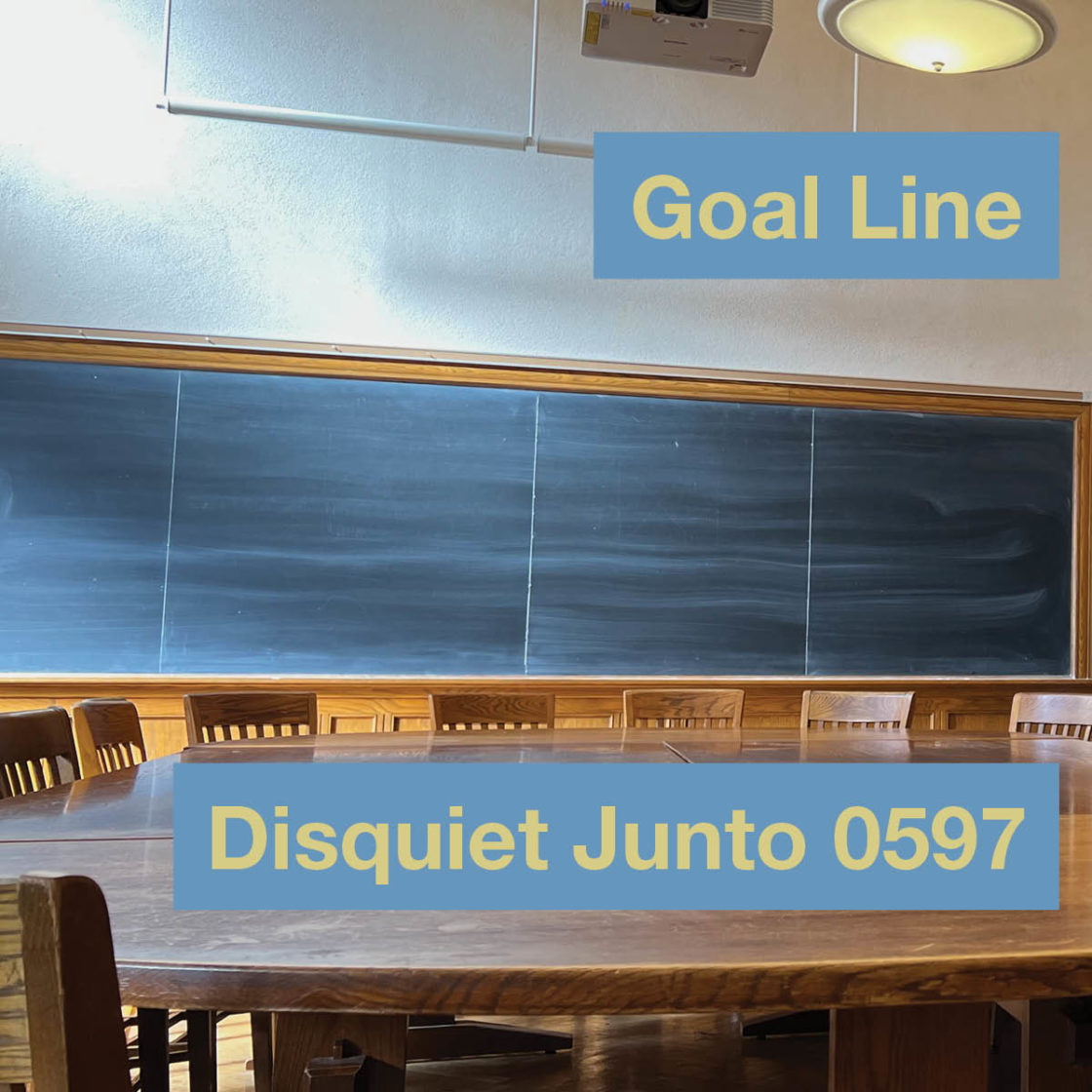
Disquiet Junto Project 0597: Goal Line The Assignment: Get started on a plan by getting over getting started.
Step 1: For a lot of people right now, it’s around the start of summer. For many of them, it can mean the start of one plan or another. You may very well have musical goals for the next few months. Think of one to focus on.
Step 2: Don’t wait. Record one piece of music that kick-starts whatever goal you’re working toward. Often the first step is the most difficult. Take that step.
This week’s project takes the start of summer as its theme. And if it’s the start of winter where you are, instead, I hope that it can still apply.
Eight Important Steps When Your Track Is Done:
Step 1: Include “disquiet0597” (no spaces or quotation marks) in the name of your tracks.
Step 2: If your audio-hosting platform allows for tags, be sure to also include the project tag “disquiet0597” (no spaces or quotation marks). If you’re posting on SoundCloud in particular, this is essential to subsequent location of tracks for the creation of a project playlist.
Step 3: Upload your tracks. It is helpful but not essential that you use SoundCloud to host your tracks.
Step 4: Post your track in the following discussion thread at llllllll.co:
Step 5: Annotate your track with a brief explanation of your approach and process.
Step 6: If posting on social media, please consider using the hashtag #DisquietJunto so fellow participants are more likely to locate your communication.
Step 7: Then listen to and comment on tracks uploaded by your fellow Disquiet Junto participants.
Step 8: Also join in the discussion on the Disquiet Junto Slack. Send your email address to [email protected] for Slack inclusion.
Note: Please post one track for this weekly Junto project. If you choose to post more than one, and do so on SoundCloud, please let me know which you’d like added to the playlist. Thanks.
Additional Details:
Length: The length is up to you. Sometimes shorter is less daunting.
Deadline: This project’s deadline is the end of the day Monday, June 12, 2023, at 11:59pm (that is, just before midnight) wherever you are. It was posted on Thursday, June 8, 2023.
Upload: When participating in this project, be sure to include a description of your process in planning, composing, and recording it. This description is an essential element of the communicative process inherent in the Disquiet Junto. Photos, video, and lists of equipment are always appreciated.
Download: It is always best to set your track as downloadable and allowing for attributed remixing (i.e., a Creative Commons license permitting non-commercial sharing with attribution, allowing for derivatives).
For context, when posting the track online, please be sure to include this following information:
More on this 597th weekly Disquiet Junto project, Goal Line (The Assignment: Get started on a plan by getting over getting started), at: https://disquiet.com/0597/
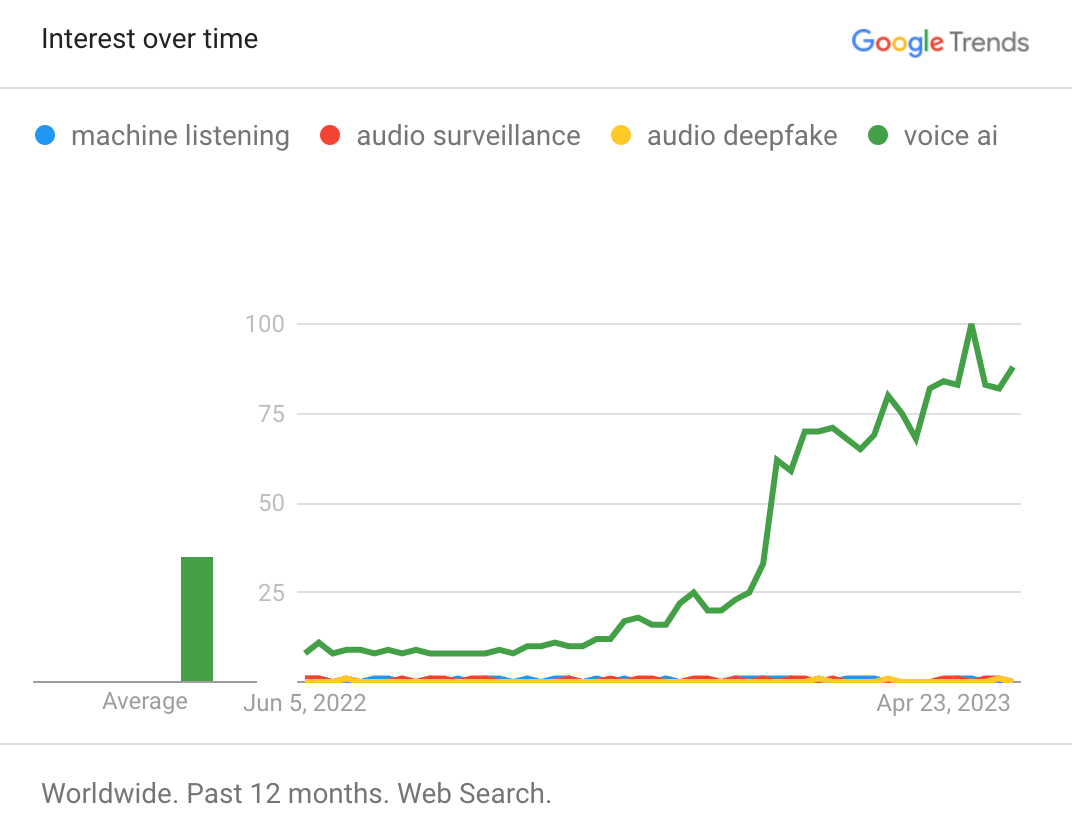
I was wondering about the relative frequency of certain topics that intrigue me in regard to contemporary, technology-oriented sound studies. For a quick glimpse, first I charted “machine listening” in Google Trends, then adding “audio surveillance” and, for a broader swath, “audio deepfake.” The three terms were almost identical in the narrow band of popularity they populated for the past few years. I sought to expand the subject matter with a fourth item, something related to artificial intelligence.
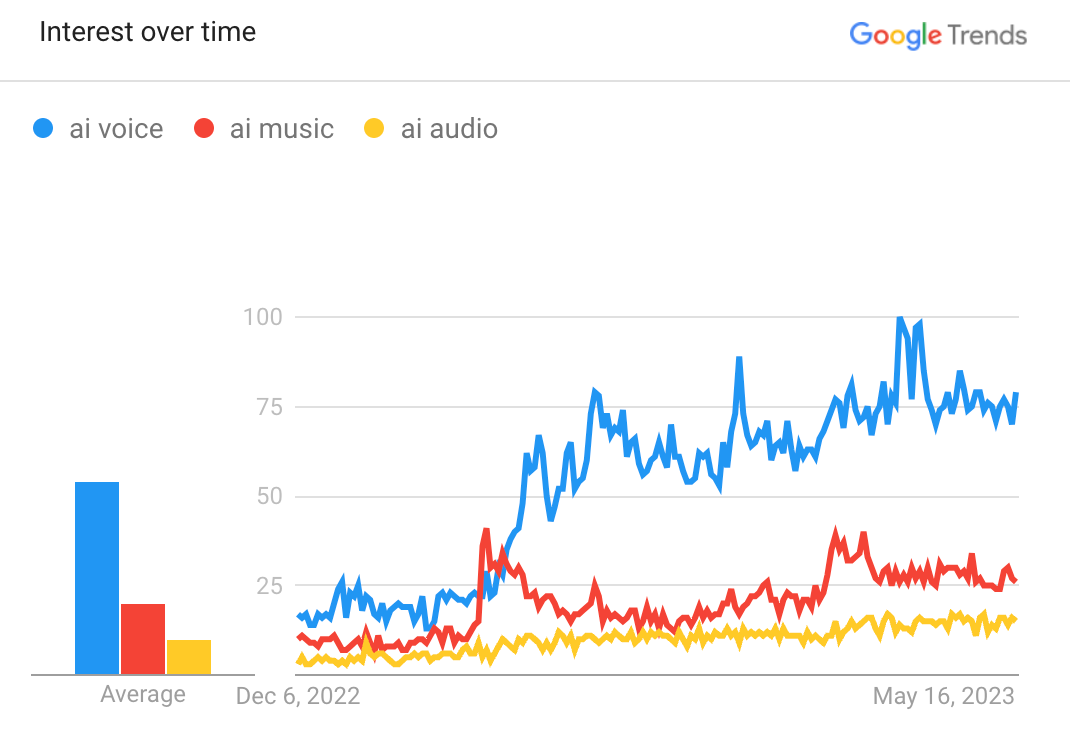
Needless to say, we’re in the midst of AI Summer. These days “AI + [anything]” — following the rise in chatter around DALL-E 2, Midjourney, Stable Diffusion, ChatGPT, DeepMind, Bard, and OpenAI, among other projects — is going to be more popular now than it was even six or seven months ago.
Still, when I selected a term, I was fascinated to see how much larger this one line item was than the others. To round out the set, I added what I imagined would be the more active “voice ai,” yielding the outlier green bar in the chart below. The results marked a significant shift:
What’s going on isn’t merely that “voice AI” is greater than the other three lines combined. It’s that “voice AI” renders any internal divergence among those three to a flattened data nothing-burger. To a degree, this divide might signal that a single term has become a catchall for all manner of subjects, fields, and anxieties in the popular imagination. Alternately, it could also mean that whatever energy might be spent more in more different ways is now focused, laser tight, on where the SEO money is. What would be great would be to see a wider variety of terms gain traction as time passes.