At the end of each week, I usually collate a lightly edited collection of recent comments I’ve made on social media, which I think of as my public scratch pad. I tag on what books I may have finished reading. Knowing I’ll revisit my social media posts, I’ve found, serves as a positive and mellowing influence on my online activity. I mostly hang out on Mastodon (at post.lurk.org/@disquiet), and I’m also trying out a few others. And I generally take weekends off social media.
And another especially light week on social media. Been busy.
▰ I planned to read Ken Macleod’s Beyond the Reach of Earth, but hadn’t read the prior novel, Beyond the Hallowed Sky, in quite a while, so to prepare I read reviews of Hallowed Sky, and then I opened Reach of Earth only to find that Macleod begins it with a concise, five-page summary of Hallowed Sky.
▰ I read the third volume of Yuto Suzuki’s ongoing manga Sakamoto Days.
Daniel Lanois concluded the slow, steady cadence of dropping tracks from his new album, Belladonna Nocturne, today, the day of the album’s release. They’ve all been instrumental so far, and this one maintains that mode. It’s the most straightforward of the batch, featuring relatively (though not entirely) unprocessed piano and guitar. The accompanying video takes a cue from the track’s title (“Canadian National,” presumably after the railway), combining snippets of views of roadside Canadian vistas, also lightly processed. Lanois previously released, back in 2005, an album of instrumentals titled simply Belladonna. This one appears to be, in essence, all instrumental as well. Emmylou Harris was listed in the initial announcement, along with drummer Brian Blade and bassist Daryl Johnson, raising the possibility of a more traditional song, but her presence appears to consist of a few moments of highly modified wordless vocalizing, meaning that she doesn’t break the atmospheric spell.
Each Thursday in the Disquiet Junto music community, a new compositional challenge is set before the group’s members, who then have five days to record and upload a track in response to the project instructions.
Membership in the Junto is open: just join and participate. (A SoundCloud account is helpful but not required.) There’s no pressure to do every project. The Junto is weekly so that you know it’s there, every Thursday through Monday, when your time and interest align.
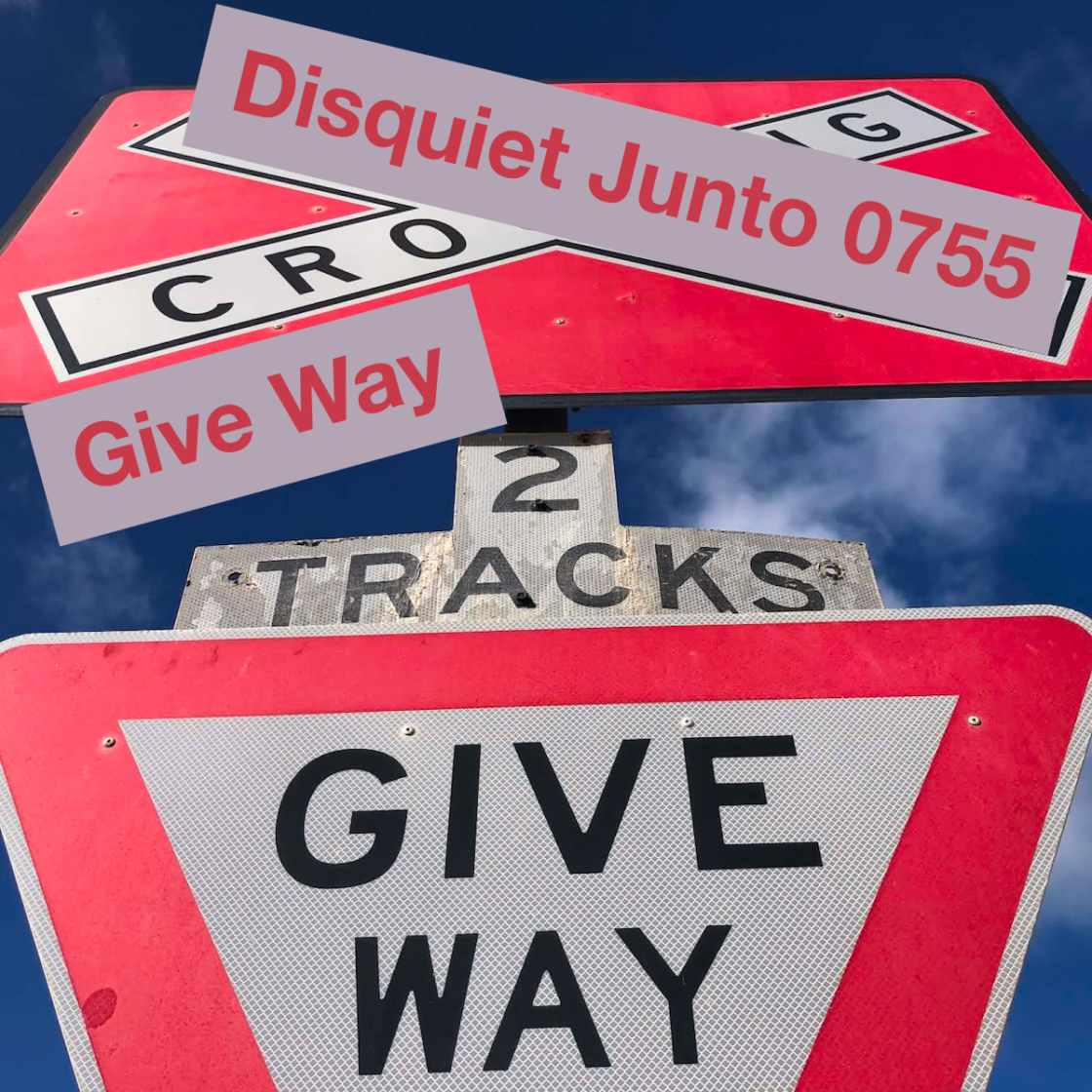
Disquiet Junto Project 0755: Give Way The Assignment: Combine two tracks.
There is just one step for this project: To create a piece of music, combine two different tracks with an ear to how they give way to each other.
Bonus: Post a sign from where you live, and maybe it will become a Disquiet Junto project down the road, so to speak.
Thanks to Jason Richardson (aka Bassling) for proposing the project. More from him at bassling.blogspot.com.
Tasks Upon Completion:
Label: Include “disquiet0755” (no spaces/quotes) in the name of your track.
Upload: A person participating in the Disquiet Junto should post only one track per weekly project (SoundCloud account preferred but not required). If on occasion you feel inspired to post more than one track (whether to a single account or across multiple accounts), you should clarify which is the “main” rendition for consideration by fellow members and (if on SoundCloud) for inclusion in the SoundCloud playlist.
License: It’s preferred (but not required) to set your track as downloadable and allowing for attributed remixing (i.e., an attribution Creative Commons license).
Please Include When Posting Your Track:
More on the 755th weekly Disquiet Junto project, Give Way — The Assignment: Combine two tracks — disquiet.com/0755
From Rachel Kushner’s The Flamethrowers, in which young Italian artists explore sound’s potential as a weapon:
The little gang played amplified noises on these evenings at the café, sounds that had been recorded at Lonzi’s apartment by hitting sledgehammers on anvils, or snipping giant hedge shears attached to pickup microphones, SNIP SNIP, open and closed, which they announced to the audience were the sounds of the pope’s feet being severed at the ankle. The king’s fingers sawed off at the knuckle. The optic nerve of God’s one big eye cut.