I do this manually at the end of each week: collating most of the recent little comments I’ve made on social media, which I think of as my public scratch pad. I mostly hang out on Mastodon (at post.lurk.org/@disquiet), and I’m also trying out a few others. And I take weekends off social media.
▰ Afternoon trio for laundry machine, passing motorcycle brigade, and refrigerator hum
▰ Excellent. Going to see Bill Frisell for the second time this year. Friday night he’s playing with drummer Herlin Riley in a trio led by trumpeter Ambrose Akinmusire.
▰ It’s sorta crazy we just completed the 650th consecutive weekly Disquiet Junto project. What’s especially crazy, in retrospect, is that when the Junto first started, back in January 2012, each week the instructions were translated by participants into numerous languages. Now that was a lot of work.
▰ Another week when I read a ton but only finished reading a single book, the Lou Reed one about Tai Chi, The Art of the Straight Line. Any recommendations out there for other books about Tai Chi, in particular Yang-style?
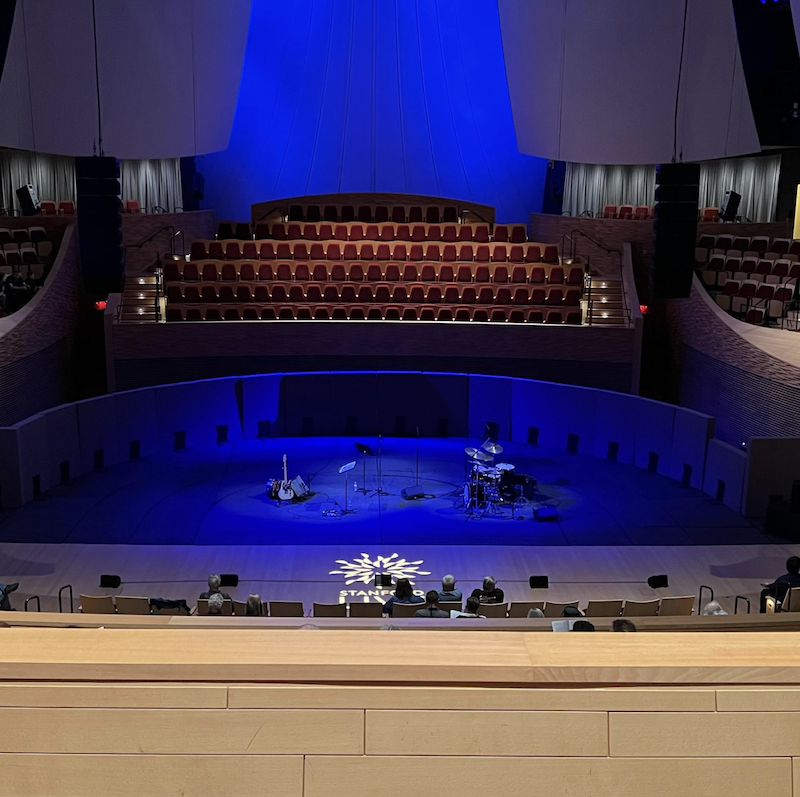
The Bing Concert Hall stage at Stanford University this evening, shortly before trumpeter Ambrose Akinmusire led the trio that included Bill Frisell and drummer Herlin Riley, who together built on the elegant lattice work that is their fantastic album, Owl Song.
The Assignment: Respond to a prompt from George E. Lewis.
/ By Marc Weidenbaum
Each Thursday in the Disquiet Junto music community, a new compositional challenge is set before the group’s members, who then have five days to record and upload a track in response to the project instructions.
Membership in the Junto is open: just join and participate. (A SoundCloud account is helpful but not required.) There’s no pressure to do every project. The Junto is weekly so that you know it’s there, every Thursday through Monday, when your time and interest align.
Disquiet Junto Project 0651: Why Compute? The Assignment: Respond to a prompt from George E. Lewis.
This project is the first of three that are being done over the course of as many months in collaboration with the 2024 Musikfestival Bern, which will be held in Switzerland from September 4 through 8 (details at musikfestivalbern.ch). We are working at the invitation of Tobias Reber, an early Junto participant, who manages the festival’s educational activities. This year is the sixth in a row that the Junto has collaborated with Musikfestival Bern.
This week’s prompt was proposed by George E. Lewis, musician, music theorist, music professor at Columbia University, and artistic director of the International Contemporary Ensemble. Lewis is the composer-in-residence at this year’s Musikfestival Bern.
Lewis asks, “Why do we want our computers to improvise?”
This week’s project: record a piece of music that responds in some way to Lewis’ question.
For background, this week’s prompt question is the title of an article that Lewis contributed in 2018 to the book The Oxford Handbook of Algorithmic Music.
Tasks Upon Completion:
Label: Include “disquiet0651” (no spaces/quotes) in the name of your track.
Upload: Post your track to a public account (SoundCloud preferred but by no means required). It’s best to focus on one track, but if you post more than one, clarify which is the “main” rendition.
Discuss: Listen to and comment on the other tracks.
Additional Details:
Length: The length is up to you.
Deadline: Monday, June 24, 2024, 11:59pm (that is: just before midnight) wherever you are.
About: https://disquiet.com/junto/
Newsletter: https://juntoletter.disquiet.com/
License: It’s preferred (but not required) to set your track as downloadable and allowing for attributed remixing (i.e., an attribution Creative Commons license).
Please Include When Posting Your Track:
More on the 651st weekly Disquiet Junto project, Why Compute? — The Assignment: Respond to a prompt from George E. Lewis — at https://disquiet.com/0651/
The cover image for this project uses a photo by Ioan Sameli, thanks to a CC BY-SA 2.0 license; it’s been cropped and text has been added to it.
For a long time, embeddable players from the website Bandcamp didn’t function on this website. I couldn’t figure out why, but my friend who helps me on the back end sorted it out this afternoon. It’s a relief, because while I trust people may click through to Bandcamp to listen, it’s a lot easier if the music is right here on this website as you read. To celebrate, here are three recent favorites of mine, along with the embeds, though click through to read more:
▰ Kenneth James Gibson (synthesizers, arrangements) and Paul Carman (saxophone) teamed up for Murals for Immersion, an ambient record that made me think about the difference, metaphorically, between “wallpaper” music and “mural” music:
More Bandcamp goodness to come. It’s a relief to have this sorted out.
Also as of this afternoon: the site is a lot faster (especially for me when I’m in editing mode) and the automated scheduling of posts appears to be fixed (we’ll know tomorrow if the Disquiet Junto project goes out on time).
These sound-studies highlights of the week originally appeared in the June 18, 2024, issue of the Disquiet.com weekly email newsletter, This Week in Sound. This Week in Sound is the best way I’ve found to process material I come across. Your support provides resources and encouragement. Most issues are free. A weekly annotated ambient-music mixtape is for paid subscribers. Thanks.
▰ SOFT MACHINE: “SoftBank Corp. announced that it has developed voice-altering technology to protect employees from customer harassment,” reports the Asahi Shimbun newspaper. This is to say, the software takes the edge off phone calls from customers who are registering complaints. The words themselves remain the same; “the pitch and inflection of the voice is softened.” I’m reminded of a recent incident when, in a lengthy email back and forth in a browser-based chat, I felt the need to confirm that my interlocutor was, in fact, a person. I had, a few days earlier, gone through a similar back and forth with a different company, that time via email, only to receive an email the next morning informing me that what I had been told in the emails was incorrect, and in fact I had been emailing with an AI the whole time, and the AI got it wrong. The chat-based helper, however, confirmed it was an actual person I was dealing with. What led me to ask was that there had been no sense of empathy in the other person’s responses. Now I wonder if the SoftBank software can work both ways — whether in the future, similar software will be able to make the voice of a customer-support employee sound more empathetic than it actually is. For the time being, SoftBank’s main concern appears to be employees: “Because it is difficult for AI to completely replace operators, [the software’s creator] said he hopes that AI ‘will become a mental shield that prevents operators from overstraining their nerves.’” According to the South China Morning Post, the SoftBank tool is only available currently in Japanese, “but the company has said it is considering developing versions in other languages for markets that require it.” In adjacent news, according to Gizmodo, “The Memphis-based regional bank First Horizon was planning to use AI to detect when a call center employee was on the brink of losing it, according to American Banker in March. The bank’s plan was to send the employees a relaxing video montage of photos of that employee’s family set to music. However, First Horizon has reportedly decided not to adopt the system.”
▰ WASH OUT: It’s Cory Doctorow’s and William Gibson’s and Neal Stephenson’s and Annalee Newitz’s world, and we’re just living in it. Case in point: A YouTuber’s video “was demonetized because a Samsung washing machine randomly chimed to signal a laundry cycle had finished while he was streaming,” reports Wired. Making the situation all the more ridiculous, the song in question isn’t even copyrighted: “The song was composed in 1817 and is in the public domain. Samsung has used it to signal the end of a wash cycle for years.”
▰ HOT WATER: A scientific/military research program near the Arctic seeks “to understand how climate change, which is warming the Arctic faster than the rest of the planet, is affecting the movement of underwater soundwaves.” This report notes a previous study exploring how climate change might affect “hunting for submarines in the warming ocean.” (That previous work proved inconclusive: “Our analysis suggests that trends in underwater sound propagation might make acoustic detection more difficult in certain regions, and that an extensive analysis is needed to assess the possible impacts of climate change on anti-submarine warfare.”)
▰ SOUND BITES:New Fruit Flavors:(1) Apparently the next major OS update for the Apple Watch, watchOS 11, will let you change its ringtone (I had no idea this wasn’t an option previously) and (2) the Vocal Shortcuts in upcoming iOS 18 will let you rename Siri, and (3) there will be more controls available in the Adaptive Audio settings. ▰ Amazon Delivers: A recent update to Kindle apps for Mac, Android, and iOS provides TTS (text-to-speech) service. ▰ Gross Out: “A Nevada Congressional GOP candidate is suing his former opponent, claiming he’s responsible for creating deepfaked audio of him and calling him a ‘sexual predator and deviant.’” ▰ Burger ChatGPTy: White Castle is among the latest companies to try AI at the drive-through (cue the “put some glue on it” jokes) — meanwhile, McDonald’s has stopped its trial run of a similar program. ▰ Audio Games: A list of the best video games, as gauged by the their employment of binaural sound, has been compiled by thegamer.com. ▰ Field Goal: Gordon Hempton and Perri Lynch Howard were the National Park Service’s ACA Soundscape Field Station artists in residence this year. ▰ Voice Activated: Research at Cornell claims that VALL-E 2 is “the first of its kind” to hit key “milestones” in speech synthesis: “speech robustness, naturalness, and speaker similarity.” ▰ Havana Bad Time: A report suggests the immediate response by the State Department to the so-called Havana syndrome may have not been sufficient. ▰ Bats, Man: Echolocation is essential to how bats navigate, yet they also travel in packs — so how can they hear their own vocal calls in a crowd? ▰ The Sopranos: A study of the biomechanics of sound production in high-pitched classical singing.”