I wrote about one of my favorite movies of all time for hilobrow.com, as part of a series of 25 pieces on “the topic of ‘offbeat’ movies from the Eighties” (the decade loosely defined). Here’s how it opens:
In 1993, the year Groundhog Day hit theaters, that furry near-term Nostradamus named Punxsutawney Phil gazed into the meteorological future and saw his shadow.
Historical records of this Americana hokum date back to the late 1800s, when Groundhog Day first became an annual ritual at Gobbler’s Knob, an inland Pennsylvania town with the sort of Capraesque name that lends itself to fables mixing homespun moralizing, commercial appeal, and a smidgen of self-awareness.
Groundhog Day legend has it that if Phil sees his shadow, winter will last another six weeks. What Phil — and Phil’s handlers, and the makers of the film Groundhog Day — certainly didn’t see coming was that 1993’s elongated winter wouldn’t hold a candle to the staying power of the movie itself.
On the one hand, this may seem off-topic for me — it even did to me, for a moment. I thought about adding a tag to Disquiet.com for “off-topic” things that I may post occasionally, but then I realized that part of the crux of my description of the movie is as follows: “It’s It’s a Wonderful Life reworked for memories trained on instant replay.” Which isn’t just on-topic; it connects directly to what I wrote about just yesterday, about music-making tools that let one access the recent past through memory buffers.
Other pieces in the Hilobrow series include Annie Nocenti on After Hours, Erik Davis on Repo Man, Susannah Breslin on Man Bites Dog, Dean Haspiel on Sid and Nancy, and Carlo Rotella on Robocop. Several are already up, and others will appear in the coming weeks.
I was talking, some time back, with a friend of mine about my fascination with buffers in the making of music, with the way digital memory access has become a normal function of sound production. One doesn’t simply play the sound of the moment, with the pluck of a string or the touch of a key on keyboard; one can reach back into the recent past and play something that has already occurred. Furthermore, if we gain a sense of ease in that prior moment, we can linger there, essentially inhabit that pre-moment moment for the length of the performance, and occasionally reach into the future to play that which has, in effect, not yet happened.
My friend, Mahlen Morris, has been developing virtual synthesizer modules for the freely available VCV Rack program. He does so under the splendid name Stochastic Telegraph. He got to thinking about what we were discussing, and began crafting not just one module but a suite of (currently) four modules that can be combined as one sees fit in order to create the memory-access tool of that best suits one’s imagination.
This video is a test run I made of Mahlen’s new tools. The source audio is a sample from a sample set by Lullatone, just a glistening tonal loop that plays on repeat. (It’s the first track off their Bowed Glockenspiel sample set, released back in September 2021.) That loop, 49 seconds long, is housed in that narrow little module to the left of the module labeled Memory. Memory and the five modules to its right are the ones that Mahlen is developing.
In a brief and far from comprehensive summary:
“Memory” contains the audio
“Depict” shows the waveform that represents not just the recording but the play heads (left hand horizontal lines) and record heads (right hand horizontal lines)
“Ruminate” accesses and plays the audio (there are three modules doing that work here)
“Embelish” is the record head.
Even though I have checked in with Mahlen during his development work, I am still myself in the early stages of using these, so I am probably describing some of this incorrectly. (And they are capable of far more than I do or describe here.)
In this video, two of the play heads, the red and blue ones, are traveling at twice the speed of the third play head, which is yellow. This creates an octave gap. For the first 30 seconds, that’s all that is happening. The Embellish module (the purple line on the right side) is recording to the buffer continuously from the Lullatone sample, and those three heads (red, blue, yellow) are accessing it in different ways. The lowest pitched of the play heads, the yellow one, is in “bounce” mode, meaning it plays backwards when it reaches the top. The others start again at the start — though to be clear, the buffer here isn’t constant; it’s being written over from the sample, which itself is looping.
At 30 seconds, I click the start button on the trigger sequencer, called “Algorhythm,” and it plays a simple eight-bar beat in which the third and sixth beats are silent. Each triggered moment causes the red bar to briefly play. Previously it was playing continuously; henceforth it will just play for a split second when triggered. Because it’s always accessing the same source sample, just in different places, it ends up producing a little melody where all the pieces are in tune with each other.
At 1:08, having set a melody of sorts into motion, thanks to the rhythmic consistency, I hit the random button on the Algorhythm module, which makes the remainder of the piece more abstract than what came earlier.
That’s it, three stages of the source audio: first the playback heads on their own, then the introduction of those precise little notes, and then the further randomization of the rhythmic appearance of those notes.
The other modules employed are rudimentary. “Clock” sets the pace. “RND” is a random trigger that sets where the little red play back head lands. “Push” sets the sample running (the player loops continuously — or, in the module’s compressed terminology, “cycle”s it continuously). The “Mixer” combines the three stereo channels. The “Audio” sends the sound out my laptop’s speaker. And the “Record” let me record this video.
Mahlen’s modules aren’t available yet, but they will be soon.
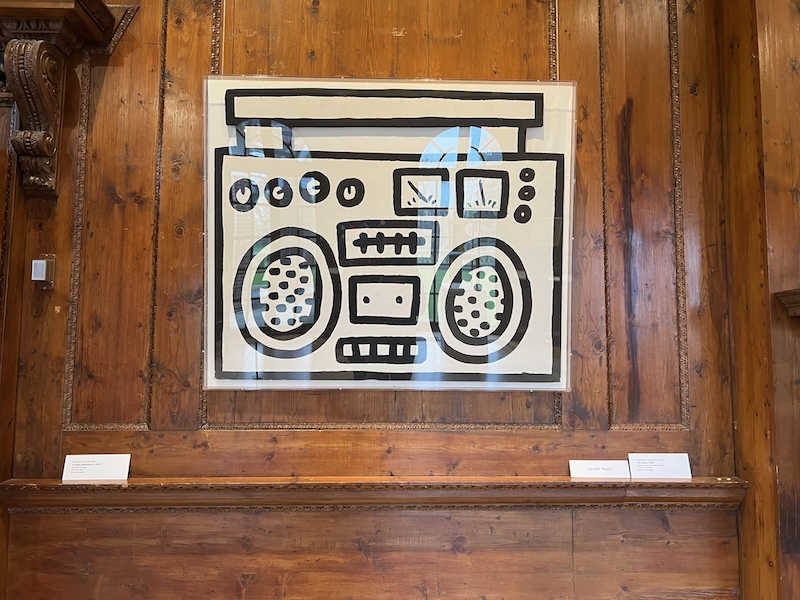
A Keith Haring boombox illustration from 1984, displayed as part of the Urban Art Evolution exhibit at the Nassau County Museum of Art through July 7, 2024
I do this manually at the end of each week: collating (and sometimes lightly editing) most of the recent little comments I’ve made on social media, which I think of as my public scratch pad. Some end up on Disquiet.com earlier, sometimes in expanded form. These days I mostly hang out on Mastodon (at post.lurk.org/@disquiet), and I’m also trying out a few others. I take weekends and evenings off social media.
▰ I was in New York for the past week — a few days in the city, then out on Long Island for family time — and thus I posted very little to social media. Back in San Francisco now. I’ll catch up with some items in the coming week.
▰ If keeping a journal is a struggle for you, I can’t express how much it helps to make a list of topics at the end of the day, just before bed — a list of words or phrases (events that occurred or ideas on your mind) that the next morning you can flesh out into brief (or not so brief) commentary. I will either jot these down or record myself stating them as they occur to me.
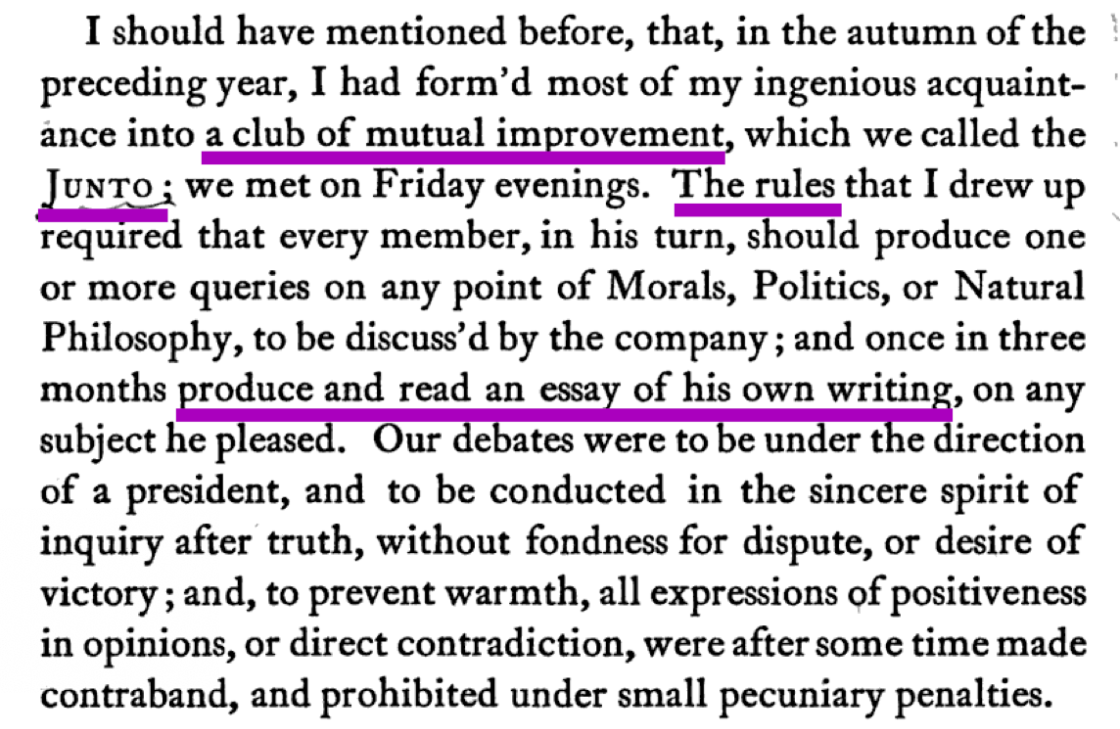
▰ This is the paragraph from Benjamin Franklin’s autobiography/memoirs that focused my thoughts on what eventually became the Disquiet Junto music community:
▰ Always looks like a record album to me:
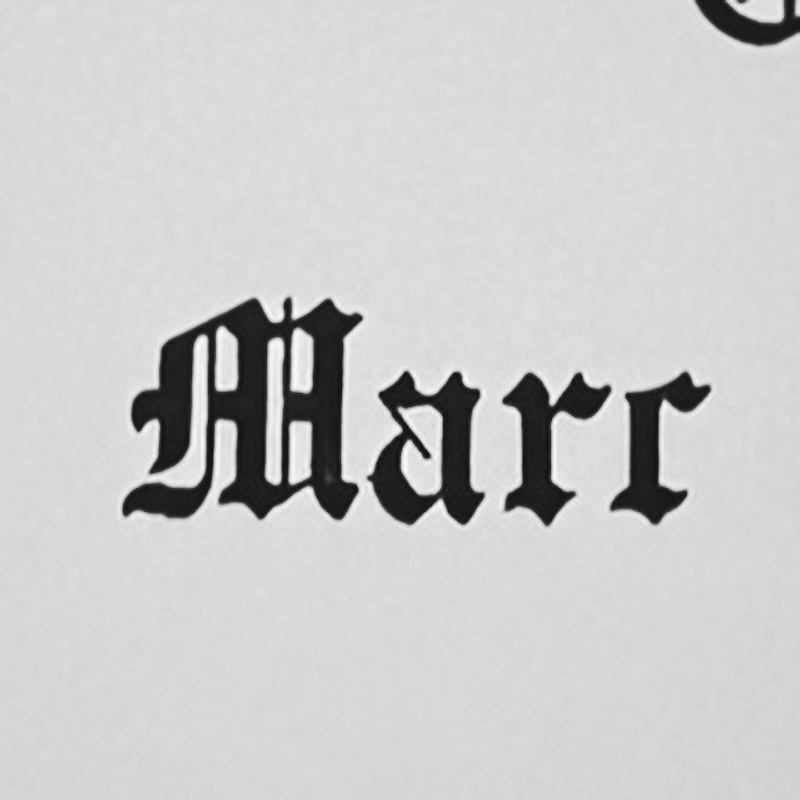
▰ I’ve been reunited with my high school diploma, which means I’ve been reminded of the ever so slight distinction between how the r and c in my first name are depicted. And no, despite this typeface’s appearance, I was not raised in Germany during the early 1800s:
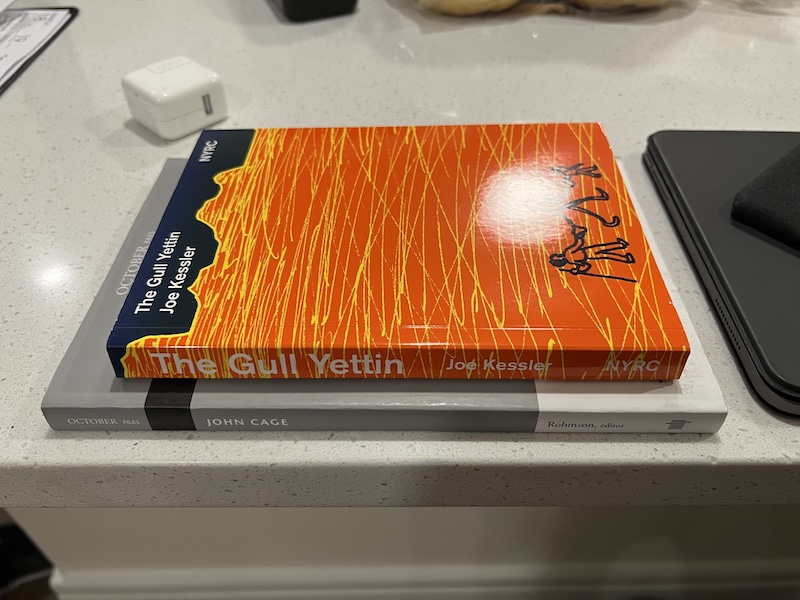
▰ I finished reading one novel this week, The Thief Who Couldn’t Sleep by Lawrence Block, several of whose Matthew Scudder novels I read recently. This one, while also the sort of crime story that fits in a back pocket, was more whimsical. The conceit that the main character can’t sleep didn’t seem to matter much to the story, except as a way to explain on occasion why he happened to be able to be awake, but made for occasional interesting asides. I may read the sequel.