

Author: Marc Weidenbaum
Make Themselves Present
An ongoing series cross-posted from instagram.com/dsqt

Nice to have the CD player hooked up again. I sometimes wonder if much of the music I most enjoy wouldn’t have existed, wouldn’t have taken the form that it did, wouldn’t have risen to the prominence it did, without the arrival of the CD. The tabula rasa of digital sound, not only recording but reproduction, meaning production and consumption in union — the lack of surface noise, the lack of ground hum, the ability for the quietest, humblest sounds to make themselves present in a room — allowed for experiments in subtlety, in nuance, that wouldn’t merely have been drowned out on cassette and vinyl, but likely wouldn’t have been attempted, let alone flourished.
Scratch Pad: Drive-bys, Lennon, Reznor
From the past week
I do this manually each Saturday, usually in the morning over coffee: collating most of the little comments I’ve made on social media during the preceding week. I tend to think of social media — Twitter especially, though I’m taking a break, and Facebook to a degree, and increasingly [Mastodon](https://post.lurk.org/@disquiet) — as my public scratch pad. It’s informative to revisit a week of thinking out loud in public. Also, knowing you’ll revisit what you say pulls in the reins a bit, in a good way.
▰ My year-end streaming summary tells me I’m in the top 20% of Led Zeppelin listeners. I’m like, whatever, streaming is just a subset of my listening. And then I look over at the turntable, and there’s a Led Zeppelin album on it.
▰ The new Metallica single sounds like someone asked an AI to make a new Metallica single
▰ A car just went by blasting “Blue Rondo à la Turk” — couldn’t they drive around the block a few times, or maybe even idle?
▰ “You will hear music until your call is answered.”
This feels like a prophecy more than it does a voice menu narration.
▰ I would totally join a cult that worshipped a trinity of tuning forks.
▰ Just the occasional note of astonishment as to how good the speakers on my 14″ MacBook Pro are — the stereo separation, the range. It’s kind of incredible. (Right now listening to the new Bill Frisell album on Blue Note, *Four*, featuring Johnathan Blake, Gerald Clayton, and Greg Tardy.)
▰ Been listening to a lot of Brad Mehldau, the pianist, lately. This one, his cover of “Dear Prudence,” hits hard on the 42nd anniversary of John Lennon’s death. This is from Mehldau’s *Largo* album. It is, I believe, just him, Jim Keltner (drums), and Darek Oleszkiewicz (bass). The record is over 20 years old. He has a new solo piano collection of Beatles covers due out in 2023. Keep music alive by interpreting it anew.
▰ The primary purpose of voice menus is to reassure us that voice AI is not nearly ready to take over the world.
▰ Ooh, time to take a break from the CD player, ’cause a new Trent Reznor / Atticus Ross score has arrived: *Empire of Light*, the new Sam Mendes film (or, perhaps more importantly, the new Olivia Coleman and Michael Ward film). And on that note, have a good weekend. See you Monday.
The New Old
An ongoing series cross-posted from instagram.com/dsqt

The household CD player, over 30 years old, died. After a bit of a hunt, I finally located a useful used replacement. The test run CD was an easy choice.
Disquiet Junto Project 0571: Child’s Play
The Assignment: Make music inspired by a nursery rhyme.
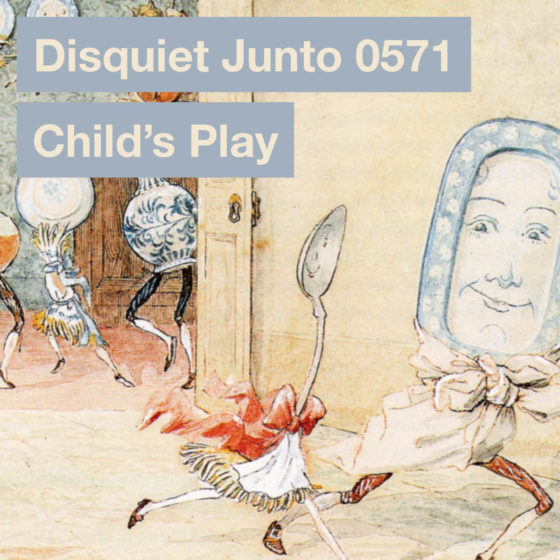
Each Thursday in the Disquiet Junto music community, a new compositional challenge is set before the group’s members, who then have just over four days to upload a track in response to the assignment. Membership in the Junto is open: just join and participate. (A SoundCloud account is helpful but not required.) There’s no pressure to do every project. It’s weekly so that you know it’s there, every Thursday through Monday, when you have the time.
Deadline: This project’s deadline is the end of the day Monday, December 12, 2022, at 11:59pm (that is, just before midnight) wherever you are. It was posted on Thursday, December 8, 2022.
Tracks are added to the SoundCloud playlist for the duration of the project. Additional (non-SoundCloud) tracks appear in the [llllllll.co discussion thread](https://llllllll.co/t/disquiet-junto-project-0571-childs-play/60026).
These are the instructions that went out to the group’s email list (at tinyletter.com/disquiet-junto):
Disquiet Junto Project 0571: Child’s Play
The Assignment: Make music inspired by a nursery rhyme.
This week’s project was proposed by Junto participant El90.
Step 1: Listen to some nursery rhymes — and do sing along if you like.
Step 2: Think about the idea of nursery rhymes, the nature of their melodies, lyrical content, rhyme scheme, form, and any other aspects you find striking.
Step 3: Make a piece of music based on, or inspired by, a nursery rhyme.
Step 4: Upload your piece, making sure to explain in your description the name of the nursery rhyme (or rhymes) that it is based on and how the source material has informed your work. Please also provide a link to a recording of the nursery rhyme if one is readily available.
Step 5: Listen to and comment on your fellow contributors’ pieces.
Eight Important Steps When Your Track Is Done:
Step 1: Include “disquiet0571” (no spaces or quotation marks) in the name of your tracks.
Step 2: If your audio-hosting platform allows for tags, be sure to also include the project tag “disquiet0571” (no spaces or quotation marks). If you’re posting on SoundCloud in particular, this is essential to subsequent location of tracks for the creation of a project playlist.
Step 3: Upload your tracks. It is helpful but not essential that you use SoundCloud to host your tracks.
Step 4: Post your track in the following discussion thread at llllllll.co [https://llllllll.co/t/disquiet-junto-project-0571-childs-play/](https://llllllll.co/t/disquiet-junto-project-0571-childs-play/)
Step 5: Annotate your track with a brief explanation of your approach and process.
Step 6: If posting on social media, please consider using the hashtag #DisquietJunto so fellow participants are more likely to locate your communication.
Step 7: Then listen to and comment on tracks uploaded by your fellow Disquiet Junto participants.
Step 8: Also join in the discussion on the Disquiet Junto Slack. Send your email address to [email protected] for Slack inclusion.
Note: Please post one track for this weekly Junto project. If you choose to post more than one, and do so on SoundCloud, please let me know which you’d like added to the playlist. Thanks.
Additional Details:
Deadline: This project’s deadline is the end of the day Monday, December 12, 2022, at 11:59pm (that is, just before midnight) wherever you are. It was posted on Thursday, December 8, 2022.
Length: The length is up to you.
Title/Tag: When posting your tracks, please include “disquiet0571” in the title of the tracks, and where applicable (on SoundCloud, for example) as a tag.
Upload: When participating in this project, be sure to include a description of your process in planning, composing, and recording it. This description is an essential element of the communicative process inherent in the Disquiet Junto. Photos, video, and lists of equipment are always appreciated.
Download: It is always best to set your track as downloadable and allowing for attributed remixing (i.e., a Creative Commons license permitting non-commercial sharing with attribution, allowing for derivatives).
For context, when posting the track online, please be sure to include this following information:
More on this 571st weekly Disquiet Junto project — Child’s Play (The Assignment: Make music inspired by a nursery rhyme) — at: https://disquiet.com/0571/
This week’s project was proposed by Junto participant El90.
More on the Disquiet Junto at: https://disquiet.com/junto/
Subscribe to project announcements here: https://tinyletter.com/disquiet-junto/
Project discussion takes place on llllllll.co: [https://llllllll.co/t/disquiet-junto-project-0571-childs-play/](https://llllllll.co/t/disquiet-junto-project-0571-childs-play/)