
There seemed to have been some sort of low-key Y2K-ish thing going on with WordPress and with Buttondown last night, the 28th of February. The post for this week’s Disquiet Junto project went live on Disquiet.com prematurely, after which I tried to set up the email newsletter to go out (the next day, as usual) but the interface wouldn’t allow such a thing: February 29 showed in the pulldown, but I couldn’t save the schedule setting. As a result, both the Disquiet post and the Buttondown email went live a few hours early (late on the 28th instead of early on the 29th — Pacific Time Zone, that is). In retrospect, it is sort of poetic that TinyLetter is being shut down by its parent company, MailChimp, on February 29th, as if it’s saying, “There are complexities behind the scenes, such as leap year, that require resources, the expense of which we can’t rationalize.” I’ll try to get the situation sorted over the course of the next four years, before the scenario potentially comes round again — clearly it’s not pressing. Also, this could all just be coincidence, or the technological equivalent of a bad hair day. And, I was pretty frazzled last night after a particularly long, and thankfully productive, stretch of writing.
Category: field notes
News, essays, reviews, surveillance
My Interview on Artists & Hackers
In which Lee Tusman asks me questions about the Disquiet Junto
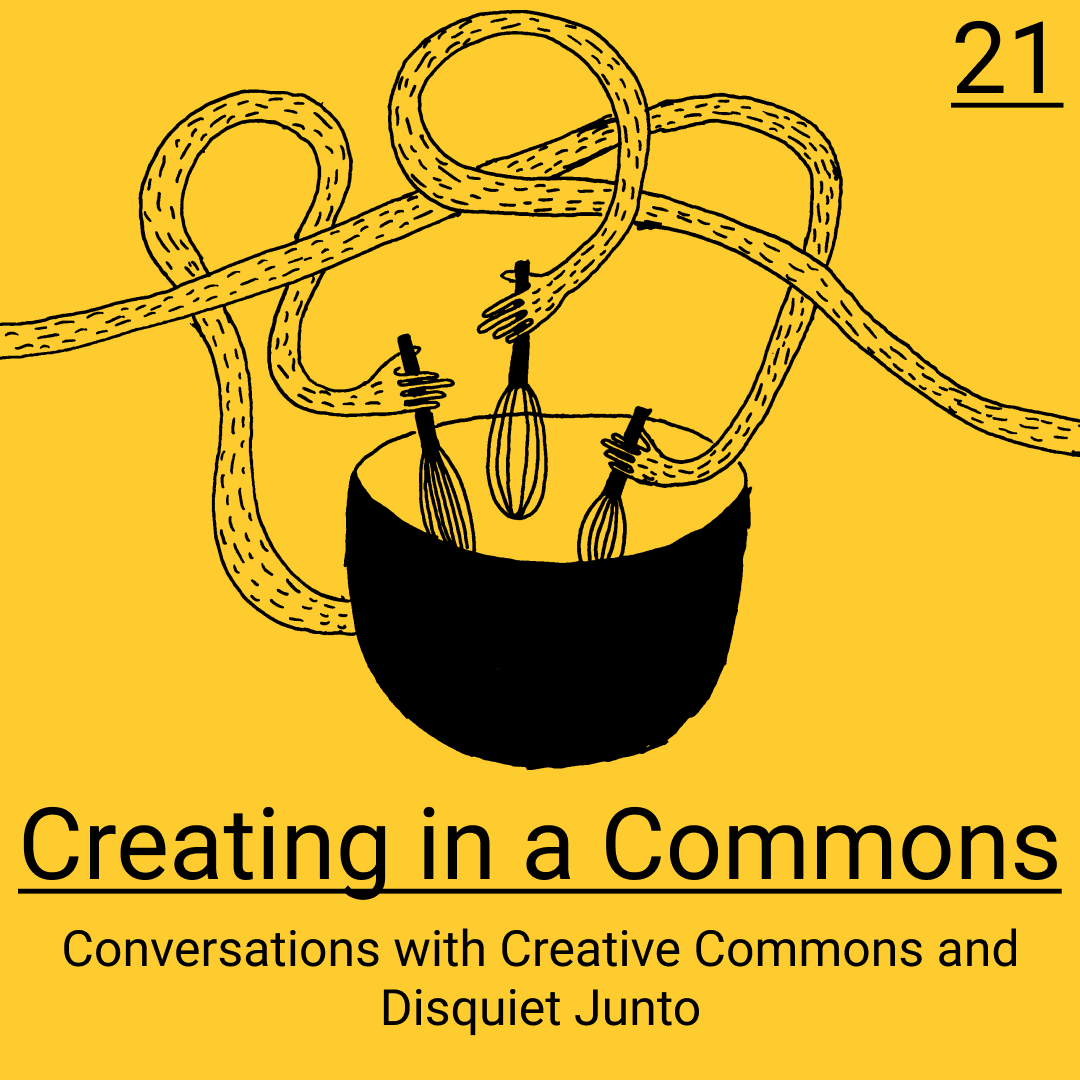
A new interview with me about the Disquiet Junto, experimental music, and online collaboration is up as part of the excellent Artists & Hackers podcast (mine’s the 21st in the series), courtesy of host Lee Tusman. The overarching topic is the Creative Commons, and appropriately the podcast and associated elements are licensed via a Creative Commons license, CC BY 4.0, allowing me to reproduce the materials here, which is what I have done. These include a full transcript. Also appropriately, the podcast employs music from past Junto projects, with tracks by wasabicube, analoc, he_nu_ri, caustic_gates, and NolanVerde.
. . .
Ep. 21 – Creating in a Commons: Conversations with Creative Commons and Disquiet Junto
Kat Walsh from Creative Commons joins us to talk about the history of Creative Commons as a ‘hack on copyright.’ Marc Weidenbaum speaks on the history of the Disquiet Junto, a long-running online distributed community creating new music in response to a weekly online composition challenge.
. . .
In this season of the podcast we’re working in collaboration with the Engelberg Center on Innovation Law and Policy at NYU Law. In addition to our usual crop of artists and programmers we’re adding in legal scholars to help us unpack some of the thorny issues for those working in art and code as they unleash their work into the world.
In this episode we dive into the world of Creative Commons, which is now over 20 years old. It is both an organization as well as a collection of copyright licenses used by artists, musicians, writers, directors and creators worldwide to communicate to the world how they want their work shared and potentially to be used as a source to build upon.
We also speak to Marc Weidenbaum, founder and steward of the Disquiet Junto, an online “community of practice.” Each week Marc sends out an email newsletter with a creative prompt, consisting of a title, and instructions. These instructions may read like a Fluxus event score, a recipe in sound, a concept or technical description. Those who choose to participate create a single piece of music, then post it online, to be shared, listened to and potentially discussed by the online community. Marc has been leading Disquiet Junto since 2012, and from the beginning has encouraged participants to share their work with Creative Commons licenses. In fact the creative re-use of Creative Commons licensed sound and music has often been an integral part of Disquiet Junto creative prompts.
Continue reading “My Interview on Artists & Hackers”The Sound of Broken Glass
Apologies to Nick Lowe
This is the sound of a window pane made of safety glass that has broken but not yet fallen apart. The glass is a splintered spiderweb of a thing. At some point soon it will likely collapse to the floor, but right now the glass is settling, this sound evidence of the uneasy peace inherent in its fraught physics. (It’s a double-paned window, and only the inside pane has broken.)
End of Day, End of Weekend

Scratch Pad: RSS, Egan, Noise
From the past week
I do this manually at the end of each week: collating (and sometimes lightly editing) most of the recent little comments I’ve made on social media, which I think of as my public scratch pad. Some end up on Disquiet.com earlier, sometimes in expanded form. These days I mostly hang out on Mastodon (at post.lurk.org/@disquiet), and I’m also trying out a few others. I take weekends and evenings off social media.
▰ I reset my RSS reader, looking at switching to Reeder/iCloud, removing Feedly from the signal flow. As a result, seeing how many feeds went dead over the years. Not a reflection on RSS, per se, since most new websites still automatically produce an RSS feed, but so many sites have come and gone. And of course in addition to the dead feeds are the zombie feeds that now spew generic posts about real estate, gambling, and other such topics, courtesy of someone — or somebot — out there having claimed the pre-existing URL.
▰ I’ll soon finish Jennifer Egan’s The Candy House. The title is appropriate, intentionally or (likely) not, in that it’s a treat after the more challenging A Visit from the Goon Squad. I’d totally subscribe to something where Egan sends out a new sliver of her imagined world each week/month. (The earlier book is more challenging in that it trained the reader, so when you get to Candy House the reading of connected fragments comes naturally. I get that the idea of subscribing to slivers of Egan’s world doesn’t do justice to the care she takes to adjust the various sections so they correlate. Still, “Good Squad as a Service” is enticing. Side note: two of my favorite writers are thoughtful world-builders named Egan: Jennifer and Greg.
▰ I’ve read a bunch about the idea of a “/now” page as a distinct thing on blogs/websites/etc., and I’m intrigued, but I’m also not convinced it’s meaningfully different from an /about page. Can’t you just — don’t you just? — include what you’re up to as part of your /about page?
▰ My experience with Reeder/iCloud instead of Reeder/Feedly is that Reeder/iCloud is much slower, to the point of being problematic. I’ll keep giving it a go, but so far I’m guessing I’ll be going back to Reeder/Feedly.
▰ Passkeys is a solution to a problem that manages to add another problem: you’re away from home without the tablet your account turns out it’s locked to (excuse me, protected by), and so aside from waiting “3 to 5 business days” you can’t access your account
▰ The game in which you add an album to the laptop running as a Plex server and then you check occasionally to see when the album evidences itself on Plex apps on other devices
▰ [Reads many books.]
“I won’t buy another book until I finish this one.”
[Reads faster and more frequently.]
▰ Being able to schedule the sending of the Disquiet Junto project emails is such a comfort. The issue goes out right on schedule — while I’m asleep — along with the automated posting of the instructions on my website (via Buttondown and WordPress, respectively).
▰ Actual language from a bank’s online interface: “The status is already pending. Hence cannot send one more add request.” That is the complete message.
▰ I was finishing an essay today, and I found myself writing in the most un-AI way I could imagine, with pauses and breaks and internal rhymes and rhythmic asides, with cultural references, some elided playfully
▰ After spending time listening to a Brahms cello sonata I put on some Brad Mehldau to remind me that a piano is a complex mechanism, capable of more than brute chords and wispy arpeggios
▰ Me last night: “Hey, maybe tomorrow I’ll record some spoken material and then I can stitch together a podcast episode.”
The city this morning: “You know how we’ve had markings and signs on and off for about three years suggesting we might demolish and rebuild the sidewalk? Today’s the day!”
▰ One of my favorite old-school Dropbox jams: “Reconnecting to the internet. This may take a moment.”
▰ I have two pairs of glasses, one for regular use and one for “computer” use. So it’s not really a Clark Kent / Superman situation. It’s more like a Clark Kent / Other Clark Kent situation. (And scrawnier in any case.)
▰ Update on sidewalk construction noise: so, I go to the teeny tiny office I rent, and of course next door they’re also doing construction. I truly don’t know what I’d do without noise canceling headphones, and white noise, and Godflesh.
▰ I finished reading two graphic novels this week: Daniel Clowes’ Monica, the end of which felt oddly familiar, and the interstitial narrative-adjacent (and -oblique) short stories a little filler-ish, and the “Why didn’t I just hire a private detective?” aside a bit defensive/anticipatory, but still it’s solid Clowes. Volume 3 of the Lemire/Sorrentino graphic novel horror series Gideon Falls, in which time and space get all the more splintered and things begin to take on a bit of a Lost vibe — with a classic horror baddie.
▰ And I finished another novel, The Candy House by Jennifer Egan. It’s the sequel to her fantastic A Visit from the Goon Squad. The sequel is a lot nicer, a lot sweeter, a lot simpler. It’s all endings, in a way, and warm ones at that. Central to the book is the concept of the Collective, in which countless people upload their consciousness, yielding potent shared experiences. I read the book on a Kindle, meaning I saw the moment in the book when its title appears within the story, and the sentence was highlighted™ by nearly 2,000 people: the Collective in nascent form. How many novelists can sound like William Gibson and Don DeLillo and themselves all at once? The last chapter in The Candy House seems like a paean to the opening of DeLillo’s Underworld, and my eyes filled with water at the closing sentence.