Scratch Pad: Social Media Detritus

From the past week

I do this manually at the end of each week: collating (and sometimes lightly editing) most of the recent little comments I’ve made on social media, which I think of as my public scratch pad. Some end up on Disquiet.com earlier, sometimes in expanded form. These days I mostly hang out on Mastodon (at post.lurk.org/@disquiet), and I’m also trying out a few others. I take weekends and evenings off social media.

▰ My kingdom for Boxhead Ensemble to cover Ragnar Kjartansson’s The Visitors

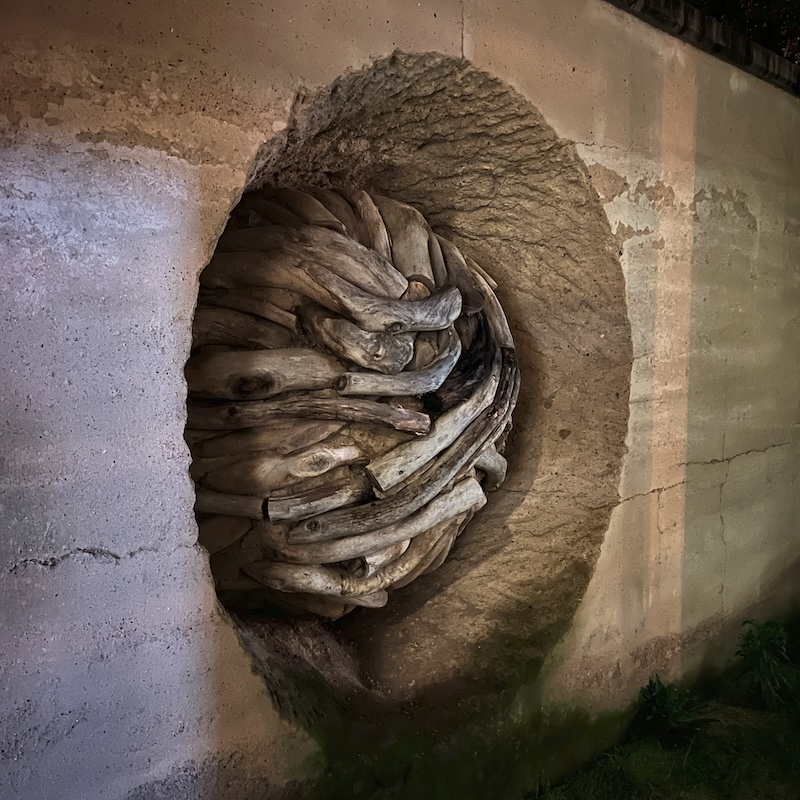
▰ I  never miss the opportunity to check out the Earth Wall installation by Andy Goldsworthy when I’m nearby in the Presidio. If I’m not mistaken, 2024 marks the 10th anniversary of its installation.

▰ I went to bed well before midnight on December 31, 2023, and I wasn’t woken by fireworks at midnight, so either it was an especially quiet New Year’s Eve here in my little swath of San Francisco, or I was even more deep asleep than usual

A Criterion Blooper

And a formal request

The Criterion Collection and its streaming service, the Criterion Channel, are synonymous with excellent taste in film, and so it’s all the more confusing that the company’s year-end “Room Tone” roundup from 2023 fails to actually deliver any substantial room tone. The otherwise cute supercut collects brief snippets of Criterion interviewees — among them Laura Dern and Martin Scorsese — sitting quietly and self-consciously as film crews record room tone for whatever video production was underway. In what is essentially a purposeful blooper reel, we hear the subjects occasionally joke about the discomfort inherent in staying still and we witness the unease on some of their faces and in their posture. Room tone serves the editing process: it provides background sound that can later be used to fill gaps during the assemblage of a film (or video — and it’s a necessity for audio-only projects, too, such as podcasts). Room tone is unique to a given place and moment — the physicality of the space, including what time of day it is, who’s in the room, even what they’re wearing. However, instead of getting to listen to the various room tones, we hear instead what appears to be a bit of a Nino Rota score. This seems like a missed opportunity on the part of Criterion. More to the point, it seems “off brand” for Criterion to employ a proper film term and to not make good on it (then again, Letterboxd has its “Rushes” and “Call Sheet,” which are neither). As one commenter on YouTube put the Criterion situation, “This was not the ASMR feast I was expecting… but I enjoyed it nevertheless.” Same here — and I hereby request a director’s cut that removes the repurposed background music entirely.

Looking Ahead to 2024

Or: plans about plans

The main place I hang out online is the llllllll.co, which is a message board mostly for people who work in music and sound. At the end of each year, artist and musician Marcus Fischer starts a new thread for people to discuss their goals for the coming year. The following is what I wrote on Lines, as the message board is called, ahead of 2024:

-How was 2023 for you?

Ups and downs. Net up by the end.

-What concepts/principals are you thinking about for the new year? How do they relate to the world around you (locally and globally)?

I think it’s pretty simple: focus, do more but selectively, take more breaks intentionally.

Staying focused — I got a new pair of glasses last month, and even though my prescription has barely changed, the simple fact of them being new (unscratched, un-smudged, slightly adjusted) means everything looks noticeably sharper. I’m taking this observation as a sign to strive to look at things more sharply and concertedly in the coming year. Pretty much by definition, to focus on one thing means to let other things recede.

Keeping my head down — Related to the above: You don’t need to be a time traveler from the future to identify 2024 as a divisive year, at least here in the U.S. I, for one, can easily get caught up in the anticipation of game-changing moments that never come.

Winnowing and organizing — In a novel I just finished reading, Sean Michaels’ Us Conductors, based on the life of Leon Theremin, the inventor suddenly is told he needs to, within 24 hours, return to Russia from the U.S. permanently after many years stateside. Asked by the movers what he’s taking with him, Theremin replies something along the lines of “The oldest, the newest, and the best.” There’s a lesson in that. There’s a term along these lines that has been making the rounds: Swedish death cleaning. I’m not entirely sure how much it even exists, as I’ve had some Swedish students who haven’t known what I’m talking about when I’ve brought it up, but in any case: the idea of trimming back so things are more manageable for others after you’re gone. (That sounds a bit morbid, so to be clear: I just wanna streamline a bit.)

-What old things do you want to shed and what new things would you like to cultivate?

Taking the word “things” literally first, I have a heap of old vinyl and CDs I don’t listen to much, so I’ll be ripping much of it and making physical space by getting rid of it. I’ve long joked that if I sold all my vinyl I could easily put an upright piano where the records are, and while I mean it more metaphorically than literally, I think the metaphor is a valuable one.

I recently stepped back from administering a Slack I’d moderated since 2016 and doing so has been a freeing experience. I’m thinking about what else I can step back from. There isn’t much, but I’m thinking about it.

Transition time — bus rides, long lunches, and liminality in general have long since declined in my life, and I need to bring back that attenuated interstitial aspect of existence. Midday walks are an attempt — a step forward, as it were. As is not keeping email open all the time during daylight hours.

Time zones — I am generally more productive in the morning, so I’m trying to schedule stuff involving other people later in the day, to the extent that I can.

Plex time — I recently set up Plex as a means to collate my vast and ever-growing collection of digital audio. Doing so has been centering, though the whole thing may turn out to be a fool’s errand — or in this case, a fool’s chore.

-What would you like to accomplish? Do you have a plan for making it happen?

Finish writing a book. Maybe two.

Send some short stories to magazines.

Write more in general.

Put together some standalone recording projects, adjacent to the Disquiet Junto, along the lines of the commission projects I did before forming the Junto, like Our Lives in the Bush of DisquietInstagr/am/bient, and LX(RMX) / Lisbon Remixed, among others.

Put my podcast back together. That appeals to a whole different constituency than reads what I write. (I say this every year, but maybe this year I’ll do it.)

As for the plan, the plan is what I wrote at the top: focus, as well as giving myself meaningful breaks. Also, do more project proposal outreach — I tend to do things I’m invited to do, rather than inquire about collaborations and opportunities.

Inbound: Celtic Frost

Comin' up soon

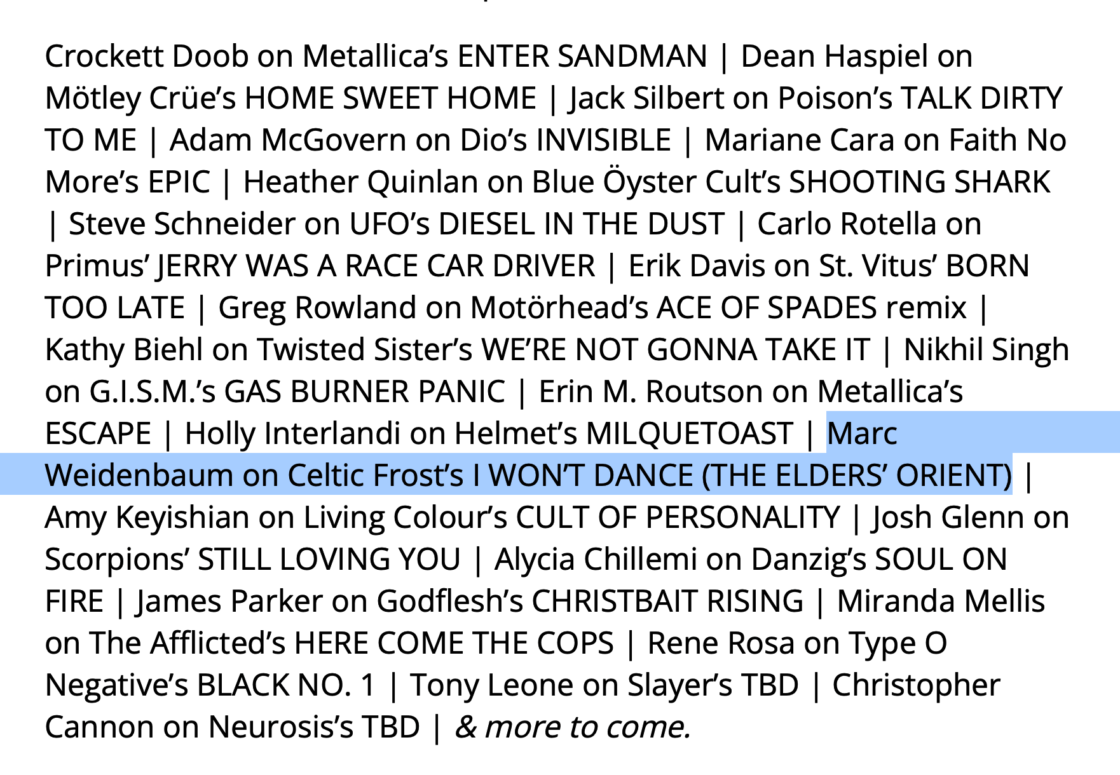
A fun multi-author series of mini-essays has begun at Hilobrow on “metal records from the Eighties.” My piece on Celtic Frost will be up later in the series. I’m stoked to see my old friends Dean Haspiel and Erik Davis are part of it. You can read the introduction by Heather Quinlan, the series’ editor, now, as well as the first entry, on Metallica, by Crockett Doob.

Roy’s Radio

And a related question

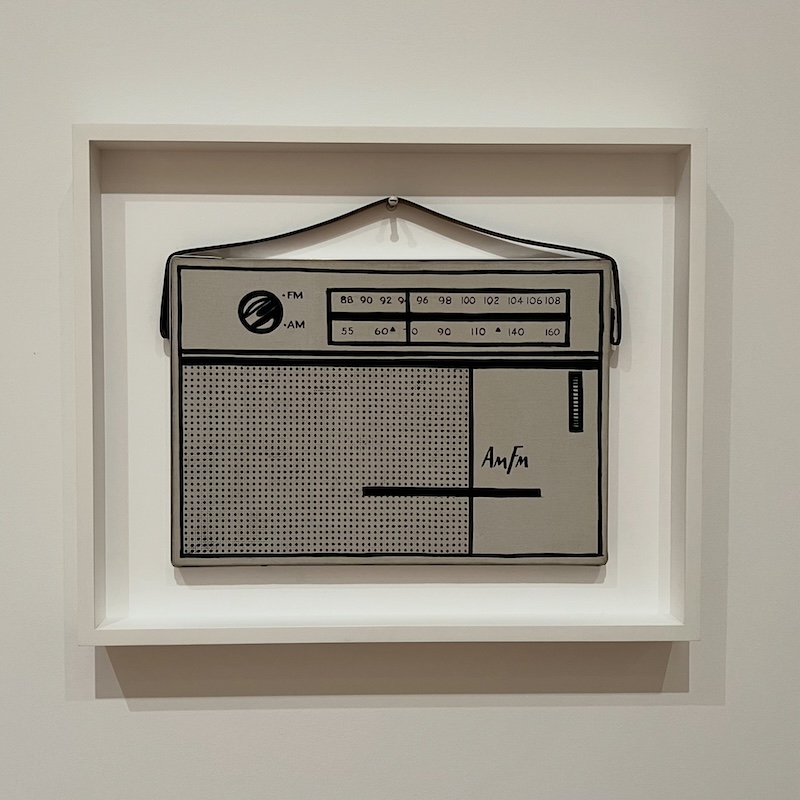
I always love coming upon this three-dimensional piece by Roy Lichtenstein at the San Francisco Museum of Modern Art. Painted in 1962, it’s a great example of how the artist, best known for his oversized appropriations of comic book illustrations, found beauty in the geometries, textures, and purpose of everyday commercial objects. The dots that depict this radio’s speaker here bring to mind the signature dots of Lichtenstein’s famous paintings, dots that were themselves investigations of the patterns inherent in the printing process. He blew up what was previously invisible, ignored, taken for granted, or merely a subset of a larger story in a different context, and drew attention to details in a manner that made them alternately abstract or hyperreal — sometimes both simultaneously. For the first time, I found myself focusing on the radio station to which this imaginary device is tuned, just above 94 on the clearly selected FM dial. I wonder what station that was at the time, presumably in New York City. (If it’s of interest, I’ve written previously about Lichtenstein’s famed Blam, a painting that also dates from 1962.)