Making Trios Together Over Time

An annual tradition in the Disquiet Junto

This is from the note that went out to members of the Disquiet Junto music community early on Thursday, May 8, 2025:

There are a few projects we do each year in the Disquiet Junto. We start the year with the “ice” project (record the sound of ice in a glass and make something with it), and we end with the “diary” project. And somewhere during the year, we do the “trios” project. That’s about to happen, starting today. 

A longtime Junto participant and observer, music educator Ethan Hein has described this particular sequence — it’s actually three projects over three weeks, though to be clear, you don’t have to do all of them — as “a horizon-broadening creative experience.” 

Here’s how I’ve summarized the trio projects in the past:

[T]he first week, participants upload a solo piece, one that is intended to, over time, with the contributions of other musicians, become a trio. Thus, for the first week, it’s helpful for participants to leave room for who and what will follow. 

The second week, musicians each select solo pieces from week one, pan them to the left, and add a second channel on the right, creating not just duets, but incomplete ones. Then the final week, new participants add a third track in the center, thus completing the trios. 

It’s a pretty incredible project to listen to as it unfolds, especially when, come week two, you can sometimes hear multiple duets built from one initial solo track — and the same, when the trios are complete, come week three.

To receive the weekly Junto project announcements, sign up, for free, at juntoletter.disquiet.com.
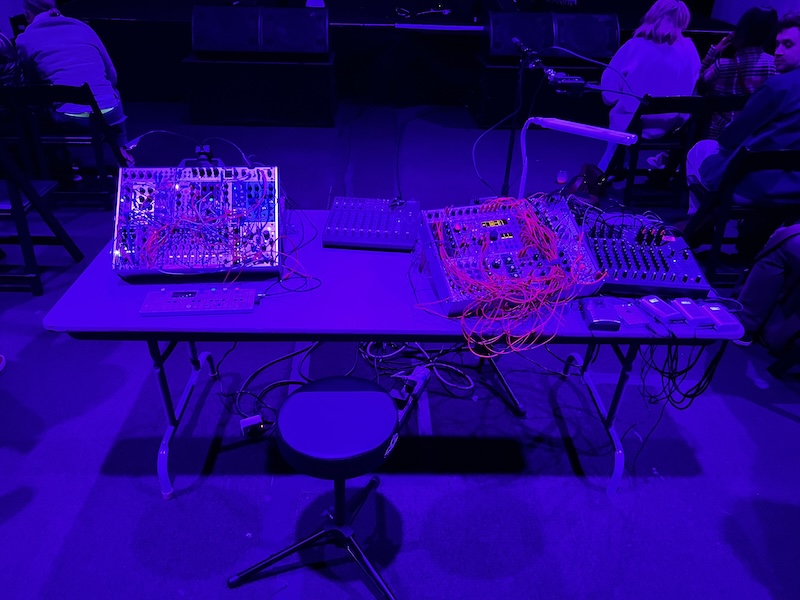
Pekler & Jelinek, Hardware Dept.

Eurorack central

I’ve been meaning to post this photo since I mentioned attending the excellent recent Andrew Pekler and Jan Jelinek (and Chris Otchy) concert at Gray Area here in San Francisco a couple weeks ago. Just for the historical record, that is Pekler’s setup on the left and Jelinek’s on the right. They did not play at the same time. Otchy opened, then came Pekler, and then Jelinek.

Scratch Pad: Algorithm, Apps, Mycology

From the past week

At the end of each week, I usually collate a lightly edited collection of recent comments I’ve made on social media, which I think of as my public scratch pad. I find knowing I’ll revisit my posts to be a positive and mellowing influence on my social media activity. I mostly hang out on Mastodon (at post.lurk.org/@disquiet), and I’m also trying out a few others. And I generally take weekends off social media.

▰ I sometimes wonder if the Algorithm processes that much of the music I Shazam is stuff I can’t stand, so I can avoid it in the future. The Algorithm can’t regularly distinguish curiosity from affection from dislike.

▰ Listened to some old Power Station albums for the umpteenth time and remain astonished by Tony Thompson’s drum production

▰ I love when it’s clear a website has tweaked its backend because suddenly the RSS reader is full of a dozen or so old posts

▰ I’ll take a small pleasure at the end of the week. I use an phone app a lot, and I so send a note to its developer with a small suggestion, and less than a day and a half later my suggestion is part of the app, and now I’m using the app even more regularly. Doesn’t matter, really, what app, or what feature. Just a kind of interaction and response and sense of connectedness I marvel at, and hope not to stop marveling at.

▰ End of week:

▰ A lot of foghorns and a lot of wind, that’s what’s going on here. Have a good weekend.

▰ I didn’t finish reading any books this week, but I’m about halfway through the first Bosch novel (by Michael Connelly), The Black Echo, and about a quarter of the way through The Mushroom at the End of the World (by Anna Lowenhurst Tsing). I love how seemingly unrelated books that one might read at the same time end up having connections. For example, without giving too much away about the Bosch book, both it and the mushroom book center around skills gained by people in Vietnam and around Southeast Asia, and how those skills then get transferred to the United States: in one case, of military veterans committing crimes based on skills learned in tunnel combat; and in the other, of mushroom hunters foraging in the forest.

More Live/Stream Venues

In both Boston and Brooklyn

The word “livestream” is for events that are streamed live. During the early pandemic, that was in lieu of an in-person audience, and these days it means simultaneous with the live performance. These latter events are something special, not “livestream” so much as “live/stream”: offering locals and the far-flung (and the infirm, or otherwise homebound) opportunities to attend. I made a list earlier this week of a bunch of venues that live/stream regularly, and here are two more, courtesy of folks on the very interesting izzzzi.net social network, where I hang out a bit:

▰ A member named brandon directed me to Boston-based Non-Event (nonevent.org), which is not livestreamed but has a heap of archived material from past events at various places, including a 45-minute Robert Aiki Aubrey Lowe show at Boston City Hall, which as of this writing merely 214 people have streamed, Jessica Pavone at First Church a few months back, Raven Chacon, Neil Leonard performing Phill Niblock, and much more. These are egregiously under-viewed full-length concert recordings. I’m used to being one of 10 people seated on folding chairs at a concert, but a year and a half later, a Seth Cluett solo show should have more than 414 views. I’ve now subscribed to the Non-Event YouTube channel, and look forward to what’s next, and exploring its past. (And Non-Event is not a venue in the physical sense. It puts together shows at a wide range of places.)

▰ And courtesy of another izzzzi member, onewayness, I’ve been introduced to Wonderville in Brooklyn, which has a presence on Twitch and YouTube, a lot of live coding, modular, and other musical activities. I’ll be digging in.

I’ve added both these to my “Livestreams After Lockdown” post.