#30s Play Misty

The city wakes to rain

It hasn’t rained in ages, and then overnight the modest tides of the colloquial atmospheric river shifted, and drops began to accumulate on the ground. Around 3:45am, I wasn’t sleeping well, which is unusual for me. In retrospect, the rain must have begun, the unfamiliar nocturnal noises registering louder than they actually were. Likewise, after I woke, I wasn’t yet aware rain had fallen or, for that matter, continued to fall. Strange little plinks and pops registered as background texture, disparate as stray thoughts, until I raised a window blind and saw the gentle precipitation. The street in particular sounds different during the rain. Cars creep along like footsteps on Saran wrap, and they are more likely than generally to obey the nearby four-way stop sign. Far less chatter passes by, as morning walkers stay home, perhaps hoping for a respite later in the day. This goes as well for rattling skateboards and chiming bicycles. There is a squish and crunch and a mushy whir to the city when it is waking to the rain. This is what it sounds like, through the living room window, which overlooks the street from the second floor.

Recorded in San Francisco’s Richmond District at 8:42am on Wednesday, December 17, 2025. Recorded on an iPhone 17 Pro using the standard Voice Memos app. Posted to Freesound and SoundCloud. This post is part of a collection of field recordings that last for roughly 30 seconds and are collectively titled #30s.
#30s Retail Phase

At night in the aisles

I found myself in an office supply store after dark, dark coming early this time of year, mid-December. The plan was to purchase some take-out Chinese food around the corner for dinner, but first came this errand. I wandered the aisles, items large and small on shelves that occasionally flirted with the emptiness one might associate with bankruptcy. A palpable emptiness defined the place, a single floor taking up a substantial portion of a city block, yet nearly devoid of people. There were two other customers: one on his phone, the other standing in a corner saying “hello” repeatedly in hopes of earning the attention of the two present employees, one of whom was stationed at the register, the other also wandering the aisles. At times the five of us were spread out as if we had claimed some portion of the known territory as our own. The customer who wasn’t saying “hello” was on his phone narrating his day to someone else, what seemed to be a close friend. This customer apologized to the friend for having been “irrespective” of his interlocutor’s recent emails. I wandered over to what I came to understand was my corner of the store, from which I could barely hear the repeated hellos or the phone conversation, and in that emptiness a sound caught my ear — two sounds, in fact: a pair of repetitive clicks. I drew closer to several rows of hanging backpacks, all connected by lengthy cabling, and each affixed by a plastic alarm. I came to understand that this clicking was somehow the result of the shoplifting-prevention system. The clicks circumnavigated the modest gallery of backpacks, the pair of them running at ever so slightly different speeds, so they came in and out of phase with each other. In the background, amid the muffled sound of traffic and the rumble of the HVAC, you can just make out people talking, and as well as the sharp ping of a distant cash register.

Recorded at roughly 6:50pm in San Francisco’s Richmond District on Tuesday, December 16, 2025, on an iPhone 17 Pro using the standard Voice Memos app. Posted to Freesound and SoundCloud. This post is part of a collection of field recordings that last for roughly 30 seconds and are collectively titled #30s.

In Sequence

It's about time

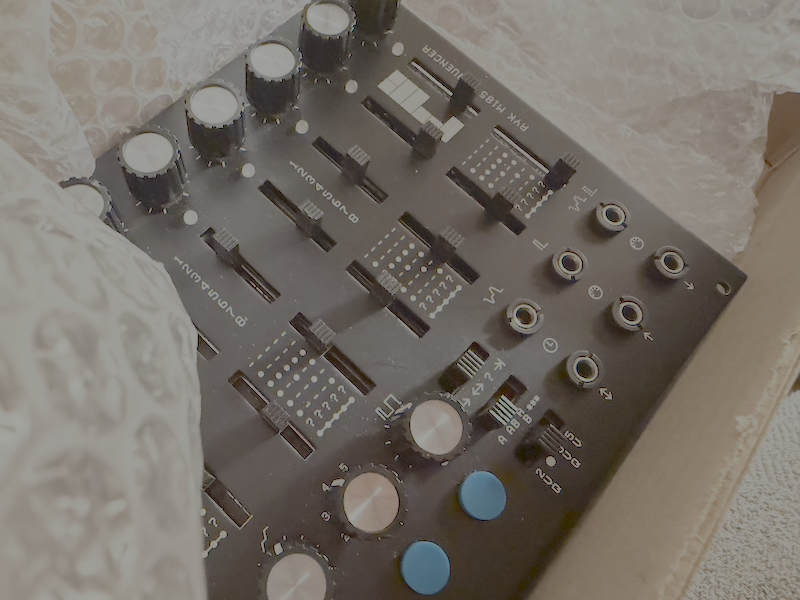
I haven’t gotten a new (used) module in a while. I’ve wanted a sequencer for some time, and though I’ve had gate sequencers and trigger sequencers and sequencers that are a tiny part of a larger thing, and I’ve constructed the results of a sequencer from various modules, I’ve never before owned what you might call a proper sequencer, a dedicated sequencer — not until now. Looking forward to learning the ins and outs of this one. There are more advanced, or at least more fully featured, versions of the foundational elements found in this one, but the price was right, and I can always level up — and, of course, constraints are the name of the game.

Test Post with Image

Hey, it worked

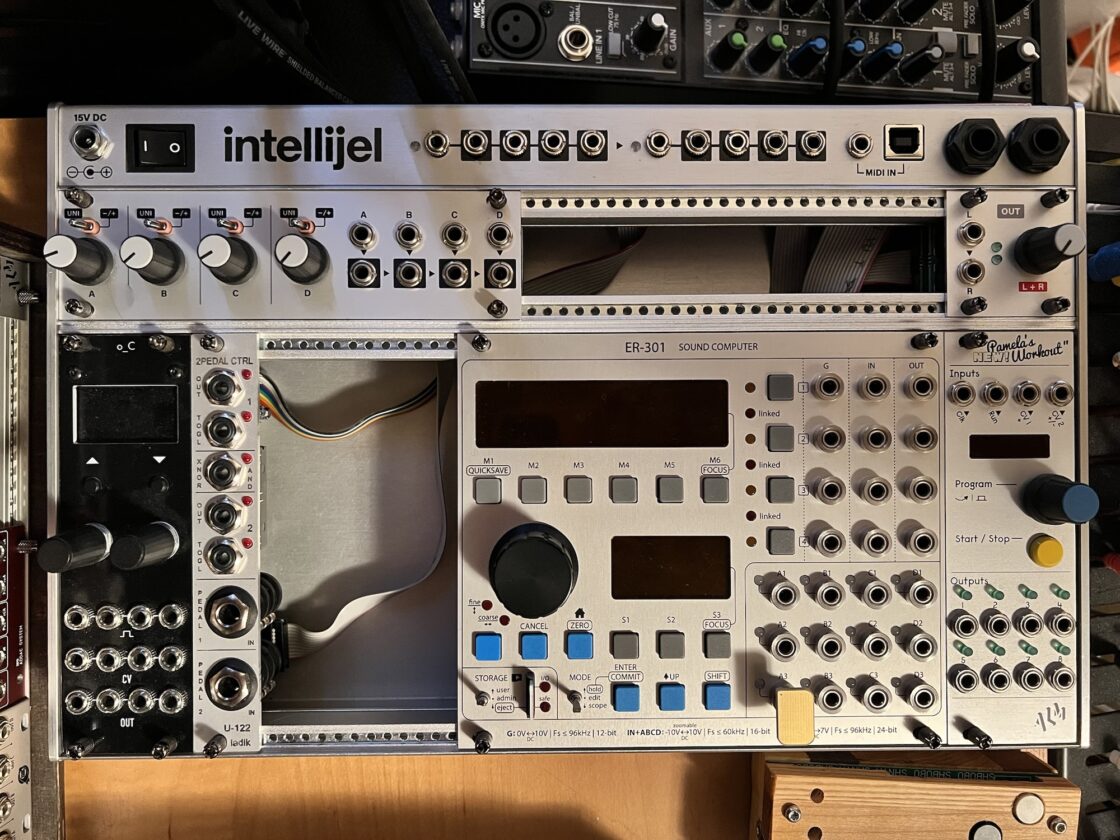
This is the current status of my small Intellijel case for Eurorack synthesizer modules. That spot on the bottom will soon be filled with a joystick. I have wanted a joystick module for a long time. As a friend joked yesterday, I’ve had joysticks in the past, but they’ve just been for video games. He was right. I just haven’t had one that works with my synthesizer.

It took me a long time to decide what joystick module I even wanted, a key decision being whether it would be one where the stick immediately returns to the center, or one where it stays where it has been positioned. I opted for the latter. We’ll see how it goes.

Racks like this, I’ve long since learned, are often in flux, so I’m under no impression that it’s gonna last forever but it feels pretty good and I’ve been having fun with it.

That spot at the top is TBD. I think I wanna put some sort of input in, but I’m having trouble locating a small module that would work well with guitar with sufficient gain, but I may be reading the specs of the various options incorrectly, so maybe there are some obvious ones I’m mistaken about. Also, my definition of “small” may be too narrow, so to speak.

Anyhow, the point of this post is primarily to see if I can actually publish a post to my site with an image from my phone, now that I’ve got the WordPress app working properly.

SubSix x VCV Rack

Six strings, one at a time

I picked up one of the SubSix pickups from Submarine last year and then promptly hurt my hand bad enough that I have barely touched the guitar in the time since. I fiddled with it a bit, but now I’ve finally set up the SubSix properly. The SubSix separates the guitar’s half dozen strings into individual channels. The result is not pristine, but the device does a solid job, and I’m learning to work with it.

The main issues I face are (1) the electric guitar signal is quite clean, so I have to do something with it promptly in the signal chain, or it sounds sort of anemic, and (2) I’m still getting a buzzing, even having raised the action on my Telecaster. I’ll sort out both those issues.

I made a little Eurorack setup with six small VCAs, one for each string, and then sent those into my laptop (thanks to a pair of Expert Sleepers modules: ES-6 and ES-8), running VCV Rack, the modular synthesizer emulation software. As it turns out, one of my VCAs doesn’t work (I may have blown it out), but fortunately my Pulp Logic case has a pair of mono inputs, so I can use that as a temporary replacement.

This video is a quick test run. Each of the three oscilloscopes shows a pair of strings, moving from lowest string to highest string, from left to right. I set it up in VCV Rack with a set of send/return modules, so I can easily augment any of the individual lines (this video doesn’t do that). I’ve been experimenting with varying delay lengths, and doing fun things with panning, and using one string as a trigger, and also with leaning into the SubSix’s lack of purity — that is, recording the sympathetic vibrations in the strings I haven’t struck.

This video is just a proof-of-concept recording of how I’ve arranged things currently in VCV Rack. I saved this patch as a foundation for future experiments.

More on the SubSix pickup at submarinepickup.com.

More on VCV Rack at vcvrack.com.