Been working on my guitar practice. I remain a terrible guitarist, but I enjoy the learning process and have been trying to use my practice time more effectively. I take lessons weekly. Current areas of focus:
Working on 7th chords, and some 9th chord forms, as well
Working on a mix of holding the pick with two fingers and using the remaining three fingers for individual string picking and arpeggios
Working on better recognizing which notes in a given chord form are the root, third, and fifth
Still trying to memorize the fretboard (in EADGBE), which continues to elude me
Still working on one song at a time over an extended period of time
Voice leading remains a big priority for me
Still working on using my guitar through a synthesizer, but not mistaking the time with the synth as guitar practice, per se
Ordered a nifty device that will, apparently, let me isolate each of the six strings for individual processing and/or recording, something I’ve previously attempted to approximate with equalizers and filter banks
Now I need an audio interface with sufficient inputs to take advantage of the above nifty device, likely something like this
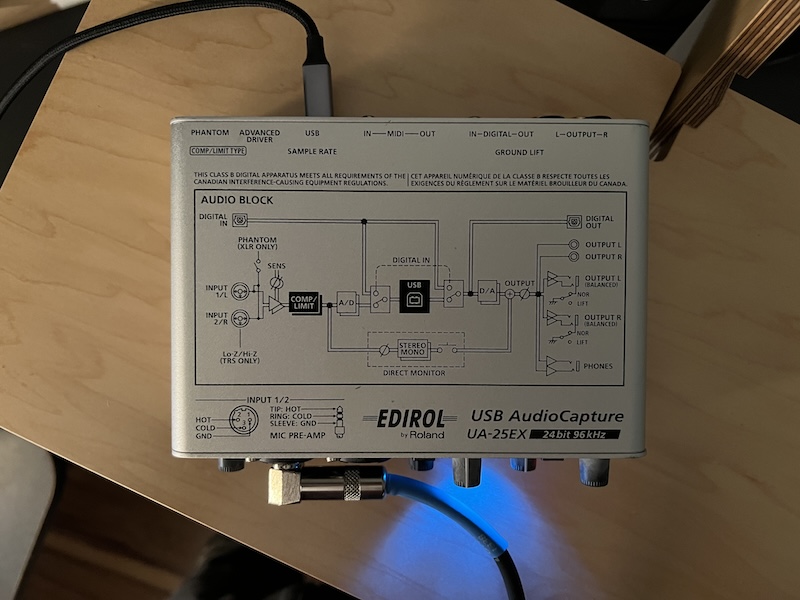
I’m so glad this old audio interface still works — first, because I can leave it in my office for use when I’m there; second, because I love the way the exterior of its casing features a diagram of what’s going on inside.
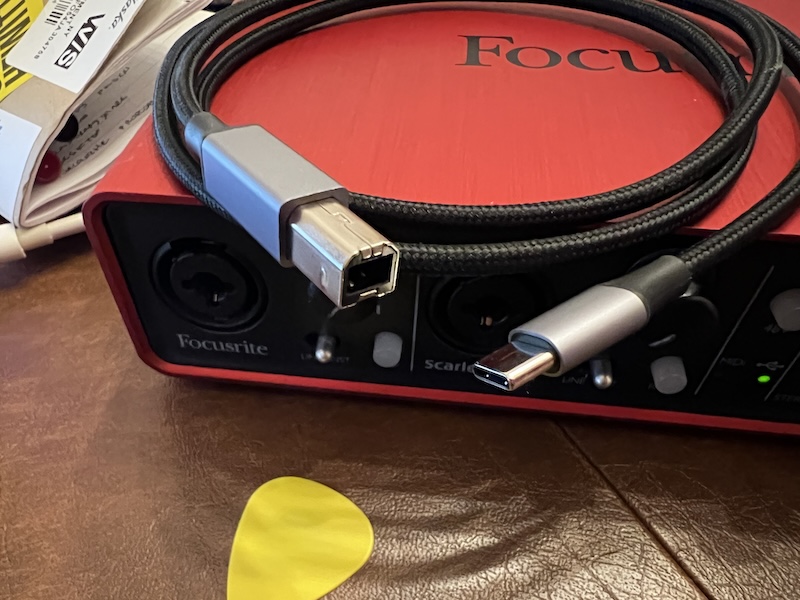
Goodbye to yet another dongle: I have been slowly replacing a lot of old cables with ones that have USB-C on one end, so that they can go directly into my laptop (and iPad, etc.). This one here features the somewhat archaic (yet still prevalent in music technology) USB Type B on the left. I believe that USB Type B dates back to 1996. I purchased four of these cables: two at three feet, two at six feet.
It’s been just shy of 10 years now that I’ve fiddled with a slowly growing, sometimes contracting, and always morphing modular synthesizer. The playing has greatly informed my work interviewing and collaborating with and writing about musicians — and it’s a lot of fun. I know this anniversary is coming up because Marcus Fischer sent me a photo a few days ago from when I gave a talk in Portland, Oregon, at Powell’s Books, an event at which he performed, along with Brumes (aka Desiree Rousseau) and the OO-Ray (aka Ted Laderas). Fischer used a modular synthesizer for his piece, and the next day he took me by the store Control Voltage, tucked off of N. Mississippi Avenue, to look at what felt to me, for the first time, as meaningfully proximate and approachable — and, yes, enticing.
In the intervening years, I’ve regularly failed at one thing in particular in this regard, which is documenting for myself my experiments with the synthesizer. Recently, I’ve come upon a system that works for me. Now, those last two words are the most important ones: “for me.” There are lots of different ways to track one’s work, and what I’m outlining here is just something that I’ve found works for me. For context, I am a big note-taker, but I am not a big written-note-taker. I jot words on paper regularly, but just as loose fodder for typing. I’ve typed for far too long to be a written-journal keeper. Also, I like the opportunities that computer files provide for searchability and cross-linking.
So, what I use is Obsidian, a free cross-platform document-editing tool that works with files in the markdown (.md) format (if it’s not familiar, more here). I format my synth journal documents very much like the one I use for my daily personal journal, though in this case also employing embedded images. (My personal journal is all text, no pictures — though my success with this Obsidian synth journal may feed back, so to speak, and inform my personal journal efforts down the road.) My system is to keep one file per month, with an entry within that file for each day, including a running checklist of next steps to pursue. (There’s also a separate to-do list for longer-term activities.) The approach yields a page that looks like this:
And if you have had success keeping a synth journal, I’d love to know what works for you.
The four free software modules that make up the Memory system for the also free VCV Rack virtual modular synthesizer became available earlier today. At their core, the modules enable a musician to record music and access the audio with different virtual tape heads that, per the documentation, “move independently within it.” The quartet of modules popped up in the VCV Rack online library as part of the Stochastic Telegraph brand, which has previously released five other modules, including a linear function generator called Drifter, a trigger utility called Fuse, a programmable sequencer (among other things) called BASICally, a note-taking blackboard called Fermata, and a value logger (TTY). The new modules are Depict, Embellish, Memory, and Ruminate:
These are the modules by Mahlen Morris that I’ve mentioned here twice previously. To support the appearance of the modules in the VCV Rack library, Mahlen has also released a new video in which he does a walk-through of the various parts of the ensemble and some of what they’re capable of:
Tantalizingly, he opens the video by saying that the Memory system consists of four different modules “at the moment” — suggesting more modules may be in the works, in addition to potential upgrades of the existing modules. And, I’m pleased to report, some of the opening example features guitar recordings I made for Mahlen.