
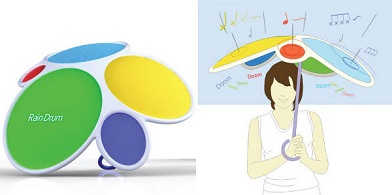
Here’s one interactive sound device unlikely to be reproduced as an iPad app, the Drumbrella, which emits sound as the rain hits it from above:

Found via makezine.com and design-fetish.blogspot.com.
Here’s one interactive sound device unlikely to be reproduced as an iPad app, the Drumbrella, which emits sound as the rain hits it from above:
Found via makezine.com and design-fetish.blogspot.com.
The glass harmonica is one of the earliest ambient tools, long predating the arrival of domestic electricity, let alone of electronic music. The harmonica, generally a wine glass filled with a liquid, can be pitched according to how much liquid is in it. But pitch aside, the harmonica’s powers are twofold. First, there is the ability to play it at length, the finger making its way around the circumference of the class; with two harmonicas, one can simulate an endless note. Second, there is the wavering quality of its sound. The music emitted by a glass harmonica comprises a paradoxical noise, one that has the sinuous manner of liquid yet often seems shot through with bright, sharp overtones. James Fahy, who records as Ambienteer, recently ventured through a wine glass darkly and posted the results of his trip. Titled “Crimson,” the lengthy piece (just under 18 minutes) expands the glass harmonica’s vocabulary by treating it with digital effects (MP3), resulting in an aural field of texture and tone.
Writes Fahy of his venture:
I made this dark and brooding piece in the early hours. It’s made from just a few samples of me playing with a glass of red wine. Using my hands to make it sing, I then manipulated it in Ableton Live, using only its internal effects. To experience the intended result, this track needs headphones and a dark silent space in which you can relax undisturbed.
As I let my mind drift, I started to hear additional frequencies, fleeting voices, but I couldn’t be sure if they were real or imagined. I hope you get something from it? It won’t be for everyone.
I’ve also made a stretch version of this, but at 120 mins in length, I’ve yet to decide if I’ll post it.
That audio above is the lightweight, 96kbps version. There’s also a 320kbps rendering (MP3). More details at Ambienteer’s website, ambienteer.com.
At some point, it may be necessary to retire certain sources from the Disquiet.com week-daily Downstream series of legal, freely downloadable MP3s — they’re be treated the way certain jersey numbers are when they’re retired by sports teams. The list of such luminaries to be hung on the proverbial wall would include eminent podcasts, such as Touch Radio and Phoning It In, whose bounty alone could fill up a week’s postings — and it would include certain prolific musicians, such as Ooray, aka Ted Laderas.
Laderas’ main tool is his cello, which he shifts through all manner of devices until he becomes a one-man orchestra, a strings-only affair that sounds at times like the Boston Pops doing a show of My Bloody Valentine. Well, that’s an imprecise comparison — the Boston Pops would play up the melodies buried deep in the shoegazer music that MBV helped define. Meanwhile Laderas, to his listeners’ pleasure, comes at that sonic legacy from the opposite direction. His thick, rich, ethereal pieces emphasize the textures, the sonorous miasma of shoegazer pop.
Take “Lalalalah,” which he posted recently. Unlike some Ooray work, which is lush beyond ambiguity, the piece is clearly played on a cello — there’s enough slow sawing to keep that self-evident. But in time that cello is heard as one among many, perhaps an infinite many, cellos laid out to the horizon as in a carnival hall of mirrors:
Original track at soundcloud.com/ooray. More on Ooray/Laderas at myspace.com/ooraygun and 15people.net.
 Upright bass? Check. Taut, mechy beat? Check. Loungey echo? Check. Washboard chucka-chucka? Check. Light keys? Check. Sudden break? Check. Entirely refreshing? Check. The opening track from David Rinman‘s Beyond the Billows of Boom continues the Dusted Wax label’s string of jazz-meets-electronica releases in fine form. Titled “Based On Instrumental” (MP3), the piece mixes up brief samples of instruments — samples long enough to have musical form, but brief enough that the repetition plays up the tension between inherent acoustic resonance and the 20/20 hindsight of instant, continuous repetition. With each return to that funky little bass riff, the analog sound drifts toward digital, its looseness providing something retroactively formal. Rinman plays up the rhythm by switching out the drums, or introducing florid elements toward the end, including a bright keyboard line and some sublimated chanting.
Get the full set of tracks at dustedwax.org.