“Backyards present themselves as interesting places to make recordings.”
So wrote Tristan Louth-Robins recently, in regard to a project he’d undertaken with fellow Australia-based musician Sebastian Tomczak. Louth-Robins had set out to make audio documents of various spots in his backyard. The documentation wasn’t purely sonic. In a more literal sense of the word “map,” he also plotted the points visually. The result was a pair of pages that resemble a Fluxus musical score, despite (or perhaps specifically because of) the pure practicality of their construction.
There is the map itself:

And the legend to the map:

Tomczak made similar recordings in his backyard, and then the two men performed a live collaborative piece drawing from the raw materials at the Electronic Music Unit at the University of Adelaide in Australia earlier this month. They posted the results as a series of 15 tracks. The music ranges from the rough, random quiet of an untempered field recording (MP3) to heavily percussive, if still moderate in tempo, pieces (MP3). In the latter, real-world textures peek out from within dub-derived rhythms and effects.
[audio:”http://www.archive.org/download/TristanLouth-robinsSebastianTomczakImprovisationWithFieldRecordings-/0101.mp3|titles=”Improvisation with Field Recordings – Volume 1 (Track 01)”|artists=Tristan Louth-Robins & Sebastian Tomczak]
[audio:”http://www.archive.org/download/TristanLouth-robinsSebastianTomczakImprovisationWithFieldRecordings-/1010.mp3|titles=”Improvisation with Field Recordings – Volume 1 (Track 10)”|artists=Tristan Louth-Robins & Sebastian Tomczak]
Louth-Robins provided additional background on his backyard:
Backyards present themselves as interesting places to make recordings ”“ in one sense demarcated, intimate and familiar yet open to the influence of neighbours, traffic and the greater urban landscape. I live in the suburb of Unley ”“ a leafy, upper-middle class area located about 2km south of the main Adelaide CBD. It’s a relatively quiet area, though our street is a regular thoroughfare for cars and semi trailers on their way to the supermarket/mall up the road. The backyard itself is a modest size, there’s a traditional hills hoist in the centre, grapevines (at the moment) covering one side of the fence, a small vegetable garden (currently being reformatted) a couple of trees and a generously sized shed that sits at the end of the driveway.
And he had a realization that is often the case for people who take the opportunity to actually listen to sounds they are accustomed to merely hearing on a daily basis:
It’s actually a lot more noisy than I first imagined! A recording of such a space, removes the visual element and the perceived stillness of the backyard is transformed in a calamitous sonic space of droning traffic, rattles of fences and the many activities of our neighbours ”“ mainly our Italian landlord ex-bricklayer Pasquale; who is always doing something with a shovel, lawnmower, angle grinder and his mouth.
The 15 tracks that comprise the release, which Louth-Robins and Tomczak titled Improvisation with Field Recordings — Volume 1, are, in fact, one long piece divided into segments. The duo did a solid job of locating moments when the unique properties of their improvisation come to distinguish themselves, when the field recordings are prevalent versus when the relative artificiality of the introduced synthesis is more apparent, and when beats give way to a misty atmosphere.
The divisions between the album’s individual sections are no more arbitrary than they are fixed; sounds bleed easily from one to the next. And that description could just as easily apply to the original field recordings the Louth-Robins and Tomczak made in their backyards. The dots on that landscape map up above are, of course, not isolated, self-contained places; they’re merely vantages on an encompassing, ever-shifting environment.
More on the recording process at Louth-Robins’ blog, tristanlouthrobins.wordpress.com, and get the full release at archive.org. More from, and on, Tomczak at little-scale.blogspot.com.

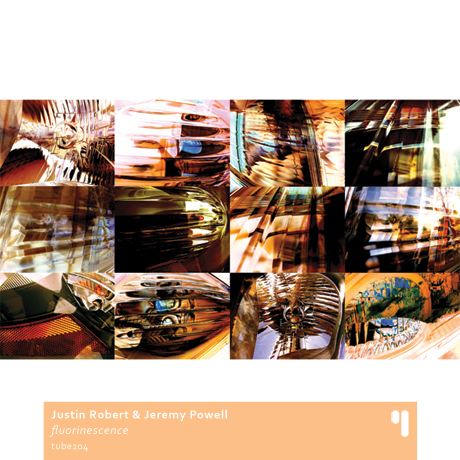 When Pedro Leitão, proprietor of the great netlabel Test Tube, says of Justin Robert and Jeremy Powell‘s Fluorinescence, “This is a diamond in the rough. This is Acid Jazz for the 21st century” he could just as well be saying this is fusion for the 21st century. What he’s getting at is that the mix of analog jazz and computer synthesis captured on their record holds unique promise. The standout track is arguably the album’s 10th one, in which a subdued saxophone is heard against and amid wisps of computerized miasma, and intermingling with warm beds of minimal keyboards. What’s fascinating about Robert and Powell’s brand of fusion is that they have chosen to embrace the very elements that have been widely seen as the source of the death of electric jazz — the chimes-like filigrees that all too often relegated the music into the background — and managed to introduce nuance where, once upon a time, there had been merely, at best, mood.
 Live-looping cellist Ted Laderas, who goes by Ooray, has been known to layer enough of his strings in one single track to fill a standard orchestra pit, or to ladle in enough snarling feedback to challenge all comers at a Jimi Hendrix sound-alike competition. On “The Boy Who Took Everything Seriously,” a recent track in his ever-expanding catalog of freely downloadable music, Laderas takes the time to apply deeply considered patience to his ever-more-refined mode of music-by-accrual. The track may, in fact, have more than two overlapping waves of sing-song droning, but that remains the clearly defined, soothing foundation for the whole song’s nearly four minutes of playing time.
 We all may mellow with age, but few to the extent of Justin K. Broadrick. He joined the classic grindcore/dark-metal band Napalm Death halfway through its 1980s heyday, before co-founding Godflesh, which helped industrial metal find its cold, mechanized, introspective heart. There were hints of a future, mellower Broadrick in Godflesh’s modus operandi — the band artfully moved metal’s deathly focus from metaphor to texture. Godflesh managed to slow down metal with one hand, while quickening its pulse with another. Unusual among its metal peers, the most ferocious thing about Godflesh may have been its emphasis on restraint.