On Susie Ibarra on Nature’s Rhythms

A piece I wrote for The Wire

This is a review I wrote for the July 2024 (Issue 485) of The Wire. It appears here with some very light edits:

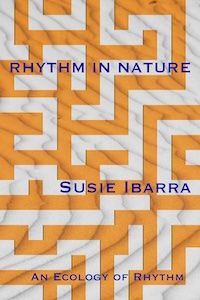
Rhythm in Nature: An Ecology of Rhythm
Susie Ibarra
Habitat Sounds Pbk 158 pp
The great drummer and composer Susie Ibarra — born in Anaheim, California, home to Disneyland, among the most artificial environments on Earth — has long embraced the natural world as intrinsic to her music. In 2002, her Songbird Suite, released by John Zorn’s Tzadik label, teamed her with a supergroup (the label’s term) of Jennifer Choi, Ikue Mori, and Craig Taborn. Uncredited were additional participants: the birds whose music could be heard on the title track, not merely sampled, but having provided evident inspiration for her antic percussion and for Taborn’s impressionistic piano playing. Two decades on, Ibarra’s Walking on Water (Innova, 2021) melded a larger ensemble with more birds and, trenchantly, the sounds of glaciers in decline. At times during Walking on Water, a listener might think Ibarra’s music had lost a battle with the field recordings, before coming to recognize the water is, in fact, the music.

There are ecological and musicological facets to Ibarra’s efforts in deploying, as a composer, the sounds of everyday reality. On the one hand, she focuses on the matter of our rapidly changing planet, and to that end has collaborated with Dr. Michele Koppes of the University of British Columbia, most recently for an ongoing project called Listening to Climate Change. On the other hand, as a musician, Ibarra is deeply engaged with how the cycles of the natural world as well as the sounds inform art and the human experience.

In her new book Rhythm in Nature: An Ecology of Rhythm, Ibarra channels her hard-won insights into a sequence of examples that might appeal to numerous readers — listeners, environmentalists and fellow musicians.

The book is as much a supplement to as it is an overview of Ibarra’s work as an educator and composer. It is broken into six main sections, one each on glaciers, oceans, trees, birdsong, deserts, and natural echoes (combining canyons and — stretching the definition of nature — human-made metal cisterns). Throughout, Ibarra exudes a holistic, imperturbable sense of humankind’s place in the larger natural order. An investigation of glaciers leads to the realisation that the rhythms of water are equivalent to that of popular music around the globe: “We are continually playing, listening, and seeing water rhythms while out in the field.”

The book isn’t merely a study of the sound of the world. It’s a study of the structure of sound. An exploration of glass informs her understanding how liminal states — “moving from one moment to another” — are essential to her art. Work with trees yields an appreciation for fractal mathematics. “The anatomy in the tree,” she writes, “reveals the sonic rhythms.” In addition to her descriptions, there are numerous photos (so many, in fact, that you might think they’re included to expand the page count to book length) and fascinating bits of scores (for those who read music).

The book’s main downside is it bears the imperfections of self-publishing, with more than its share of typos, as well as descriptive text that could benefit from an editor. Nonetheless, the reader reaches the conclusion to which Ibarra has served as a naturalist guide: pondering our place in the world. As she puts it at the end, she doesn’t know “if I am the rhythm or maybe I am the landscape.” It’s a small world, after all.
An Anatomy of a Flourish

A deep dive

I spend a lot of time watching YouTube tutorials and demos of the sort of equipment either I fiddle with myself or that exemplify the sort of synthesis I like writing about. In a few recent videos from the musician Lightbath, notably this one (“Twist, Slide, Tap | Hybrid Modular • Ep 3”), he has talked a lot about a particular thing he does, which he terms his “flourish.” It’s a sound I love, this sweep through various stages — sometimes octaves, sometimes aspects of an effect, sometimes notes in a chord — that sends my ear back to Laurie Anderson, circa Mister Heartbreak, and that I’ve experimented with thanks to a module called the Bizmuth.

You can dial in to an example at 14:22 in this video. Note that this is a very in-depth tutorial, and it’s just one in a series that provides an even more detailed explanation of the hybrid of computer and physical modular synthesizers that he employs. I’m noting it here specifically because of this one detail that he lingers on. (Thanks to Chris McAvoy for having brought the video to my attention. I subscribe to Lightbath’s YouTube channel and have written about his music in the past, but this one had eluded me.)

The Many Shades of “Axel F”

Lorne Balfe hit the archives

While under the weather over the weekend, I watched a bunch of movies, including Beverly Hills Cop: Axel F. I was never particularly into Eddie Murphy, as something of a non-comedic-oriented consumer of pop culture, but if you’re Gen X, as I am, then the Pointer Sisters’ “Neutron Dance” has a power not unlike the role “All Along the Watchtower” played for Gen C (by which, of course, I mean Cylons). (Murphy, by the way, is quite something in the movie, fully in control of manner in which he navigates and comments on generational and racial divides.)

For a weekend spent largely in bed, the new one hit the spot pretty solidly, but the main thing I want to note is how effectively it did what so many movies and TV shows do (I’m looking at you, The Detectorists and Succession), which is to repeatedly redeploy the theme melody over and over, and to do so in different ways as a means to serve as the backing score to different scenes with varying emotional and narrative states. One might even draw a comparison between the way the riff changes throughout the movie and the “code-switching” that is referenced in a scene when a valet parking attendant suddenly adopts a British accent to deal with a regular.

Apparently the film’s composer, the prolific Lorne Balfe (Mission: Impossible – Dead Reckoning Part One, Dungeons & Dragons: Honor Among Thieves, Ambulance), did some tech-historical research to accomplish what he was after. Writes Drew Taylor at thewrap.com:

“Balfe worked with the Vintage Synthesizer Museum, located in the Highland Park neighborhood of Los Angeles, to source the instruments and to find players who could operate them. ‘It’s like an archeological deep-dive of finding out what the sound was, recreating the patches, trying to get it back to how it did sound originally,’ Balfe said.”

The theme in question is, of course, the indelible “Axel F,” composed by Harold Faltermeyer for the very first Beverly Hills Cop, back in 1984. The Vintage Synth Museum is a fantastic resource. It used to be in Oakland, for eight years, before relocating to Los Angeles at the end of 2021.

Framed

An ongoing series cross-posted from instagram.com/dsqt

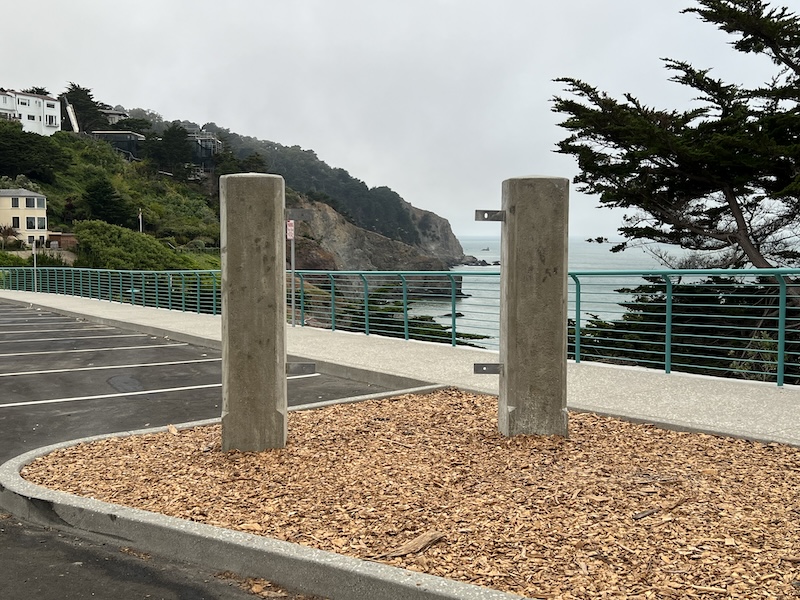
These two sizable, nearly 6’ tall, cement posts frame the space that will soon enough hold, presumably, a brand new sign identifying this spot on the San Francisco coast as China Beach. For the time being it frames the view as you approach.

Sonic Storytelling in The Straight Story

AKA "Parable of the Mower"

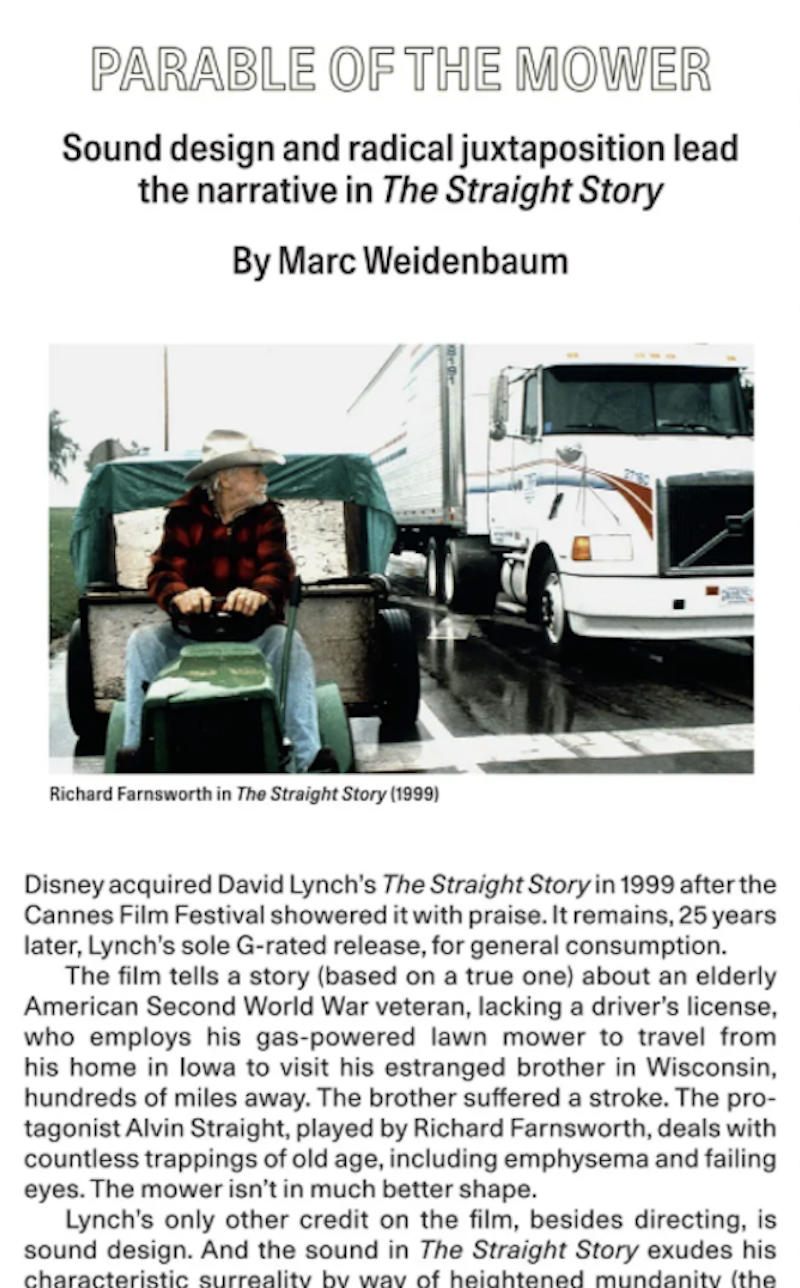
Articles rarely carry titles written by their authors. My longtime favorite assigned to me was “About Face,” about the type foundry and magazine Emigre. Then came “The Man Who Fell for Earth,” an interview I did with science fiction author and environmentalist Kim Stanley Robinson. The crown has been passed to “Parable of the Mower,” on David Lynch’s 1999 movie, The Straight Story, which came out in between Lost Highway (1997) and Mulholland Drive (2001).

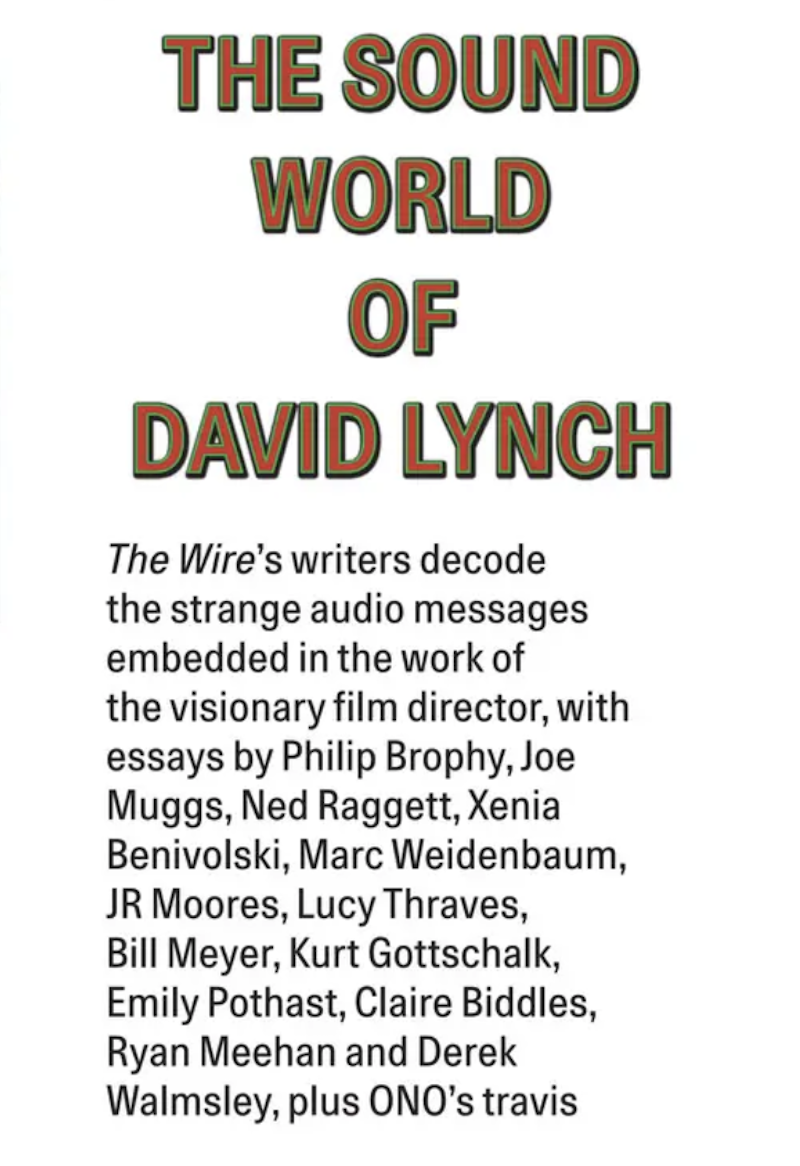
That’s in the new issue of The Wire, which has a special section dedicated to David Lynch’s work. It’s packed with cool stuff, like the role of finger snapping, backward speech, the wind, and other sonic elements — and of course, his scores.