Habit: YouTube

Thinking about watching

I’ve been thinking through why YouTube is such a prominent part of my daily media consumption. I hesitate to put it that way, because the term “media consumption” puts media in the realm of food, which can include fast food, and is really (just) a biological imperative. That is, you have to eat, and it almost doesn’t matter what. I’d put most of my YouTube time in a more civilized category, much more on the order of my reading diet. (And yes, I’m aware that with the word “diet,” the consumption metaphor persists. Metaphors will do that.) It wasn’t that long ago that I didn’t even watch YouTube very much. At some point, I recognized it wasn’t a bland let alone neutral medium; despite some vile corridors, it can be a usefully temperate one. I started exploring, and more and more I found myself drawn back to material — both “native” and “archival,” both born on YouTube and housed there after the fact — I couldn’t find elsewhere.

As I think through how I spend my time on YouTube, this is what comes to mind:

  • Live music performances (concerts, home studio sets)
  • Music technique, music gear overviews, and tutorials (music, coding)
  • Essays (music-related and not)
  • Rare recordings not on general music streaming services (e.g., Spotify, Apple Music)
  • Videos of people wandering neighborhoods*
  • Musician/author/filmmaker/etc. interviews**
  • Movie/TV/game/etc. trailers

That list is in declining order of frequency. (I also sometimes post to YouTube, but that’s not what this consideration is about.)

*I’m working on some long-form writing about field recordings (more correctly, perhaps: sonic environments), and coverage of these is part of it. Also, I am long a fan of the multi-monitor work mode, and sometimes I just have one of these running on a side screen as visual background noise. (Not unrelated: the tiny office I rent doesn’t have a window.)

**I particularly recommend the Amoeba Records series What’s in My Bag? and the Criterion Channel closet series.

Cellphones and Concerts, a PSA

Speaker of the house

One of the most solemn PSAs in the public sphere is the often unheeded request at the start of cultural events for members of the audience to turn off their cellphones. The most effective method I’ve witnessed is also the most buzz-killing, except when it can be pulled off with exactly the correct mixture of humor and admonition: when the performers themselves pull out a cellphone from a pocket, raise it high, invite the audience to do the same, and then instruct them to turn it off. As entreaties go, this works pretty well.

Just before the start of the San Francisco Symphony concert I attended this week, a loud voice reminded people to turn off their phones. This is the common approach — a disembodied, non-accusatorial encouragement to do what’s right. As everyone from the CDC to the Fire Marshall to a school teacher can tell you, it generally isn’t the most effective approach. 

What was interesting at the symphony was specifically who was making the request. The disembodied voice identified herself as one of the symphony’s cellists. This struck me as smart: It’s one thing for an anonymous administrator or voice actor to remind people. It’s another for a member of the orchestra to do so. It felt personal. It felt like what’s called a “nudge” these days, a gentle prodding toward better behavior. It’s one thing to ignore an anonymous speaker. It’s another to hear the message from the very same person you’re supposedly about to pay a lot of attention to for two hours straight (not counting intermission). 

I mention the following at the risk of diminishing what I’ve described thus far: Still, at least two phones buzzed and one rang near me during the concert.

The Cello Incident

Orchestral maneuvers mid-Dvořák

I went to the symphony this week — my third concert in six days. That’s after, first, the Audium, and second, a four-group ambient/noise/drone show at the Luggage Store Gallery. I have to say, concertos often aren’t my thing — too much emphasis on bag-of-tricks technique showboating. Often I end up thinking what I’m listening to is kinetic schmaltz. At the end of the first movement of one piece at the concert, there was a lot of mistaken applause from the audience. I think the soloist deserves some of the responsibility, because it was quite easy, based on the “Olympic gymnast who just landed on both feet after a quadruple whatever” stance, to misconstrue that the piece was, in fact, over — which it wasn’t. (Reminder: In jazz, we clap after each solo. In classical music, we don’t clap between movements. Also in classical, if you refuse to stand for the apparently now mandatory ovation, you will be cast out from society.)

Anyhow, a remarkable sequence of events occurred during the Dvořák “New World” Symphony. At one point, the first cellist shook his left hand in what appeared to be confusion. It seemed that one of his strings broke and it hurt his palm or one of his fingers, or perhaps something else went haywire. He promptly traded his cello with that of the cellist seated to his right. Then that guy carried — while the orchestra was still playing — the first cellist’s cello up to the third row of cellists, where he exchanged it with another cellist, a woman. She then carried the first cellist’s cello offstage. This is, again, all while the orchestra was still playing, full force. The guy to the right of the first cellist promptly returned to his seat and proceeded to play on the cello belonging to the woman from the third row. After the movement ended, the woman returned from offstage with the first cellist’s cello (this retelling has become the sort of thing you have to say six times fast in a bar bet). The guy next to the first cellist walked up two rows with her cello to reverse the exchange. He then walked back to the first row, returning the first cellist’s repaired cello and reclaiming his own — thus completing the brigade cycle. The first cellist then used his bow to, graciously, acknowledge his colleague from the third row who’d carried his cello offstage for it to be fixed. Everyone applauded (caveat: sometimes it is OK to applaud between movements). The conductor made a comment that, yes, this is live music. The camaraderie-in-action was pretty great.

Scratch Pad: Fireworks, Bootlegs, Spock

From the past week

I do this manually each Saturday, usually in the morning over coffee: collating most of the little comments I’ve made on social media, which I think of as my public scratch pad, during the preceding week. These days that mostly means Mastodon (at post.lurk.org/@disquiet), and I’m also trying out a few others, including Bluesky (disquiet.bsky.social), which remains behind a beta firewall at the moment, and, yes, Threads (threads.net/@dsqt). Today’s Scratch Pad entry went out at the end of the day, because I drove to Stockton and back to attend a comic book convention.

▰ When I was in high school I worked for the school newspaper. One day, a kid said he was gonna start an “underground” school paper. I went to that meeting. It was the same people. This is what every new social media app feels like.

▰ The life cycle of (solo effort) to-do list tools: single text/markdown doc spreadsheet wide range of apps single text doc

▰ If only the annual San Francisco fog cover could muffle the sound of fireworks as effectively as it dims the rumored visuals

▰ Listening to a bootleg of a concert you attended in 1989 and wondering if that was your own voice you just heard amid the cheering

▰ Several people have uploaded their Disquiet Junto tracks this week to Bandcamp, and I thought, “Hey, since I can make a playlist on the mobile Bandcamp app, I’ll do so.” Then I realized I can’t share that playlist with anyone else

▰ Pretty sure that’s the most musicians we’ve ever had in a single Disquiet Junto project: 73. We had 67 on SoundCloud and 6 on Bandcamp.

▰ Strange New Worlds is already my favorite recent Star Trek. Spock getting a noise complaint for playing his Vulcan lute was icing on the cake.

▰ I memed, inspired by the recent episodes of Strange New Worlds:

▰ I remain convinced that most categories of online services are akin either to hair salons, to grocery stores, or to movie theaters. That is, either you choose one service and stick with it, or you have a main one but go to others, or you don’t really care but have some preferences. I think social media has mostly been a hair salon until recently. I don’t think it can persist in movie theater mode, which lately is how things feel. We’ll see what happens next.

▰ Interesting that this whole thing Meta built is built around the assumption you’ll wanna create threads — rather than standalone posts. Or perhaps “threads” is also meant to include conversations. I generally see threads on TUS* as a bonus not the point. But maybe that’s because I work in paragraphs for a living, and single-thought posts feel like a holiday.

*the unmentionable service

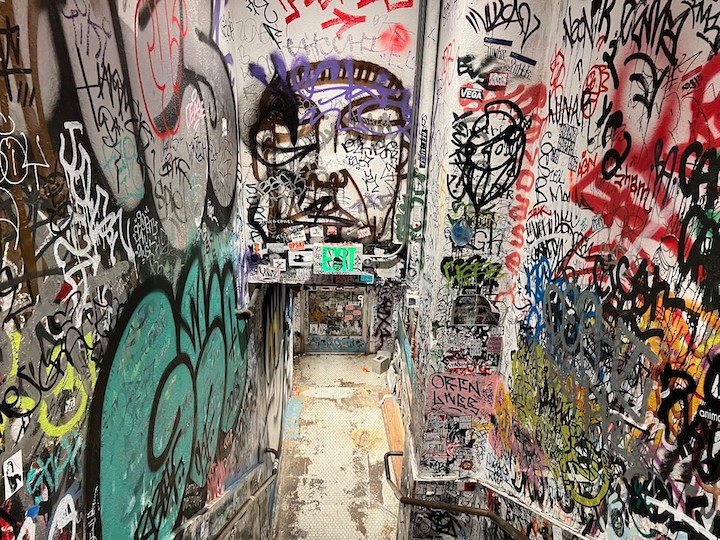
▰ The stairway at the Luggage Store Gallery is one of my favorite passageways in the entirety of San Francisco

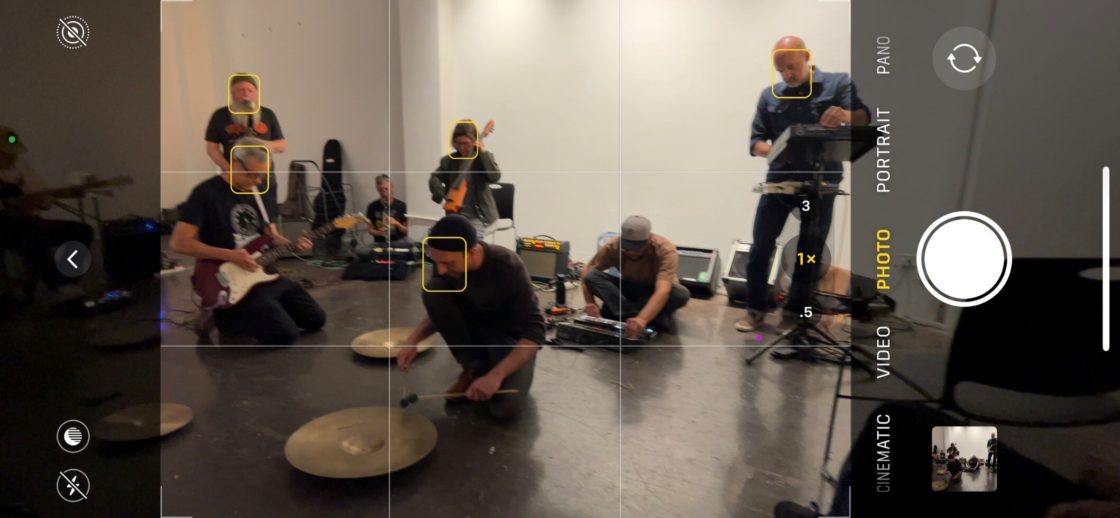
▰ When you attend a drone noise improv performance, and your phone starts cosplaying like it’s the rogue AI from Person of Interest

▰ It’s weird. The concept of threads on Twitter originated as a user innovation, drawing from pre-Twitter online discussion platforms, and then Twitter built the ability to construct threads into its UX. As of this past week, Thread is now the name of a competing service. On this competing service, even a single post is called a “thread” though by the original definition — the definition at least until the day this competing service went live — a single post isn’t a thread.