A Melody as It Slowly Evaporates

A note from the Disquiet Junto

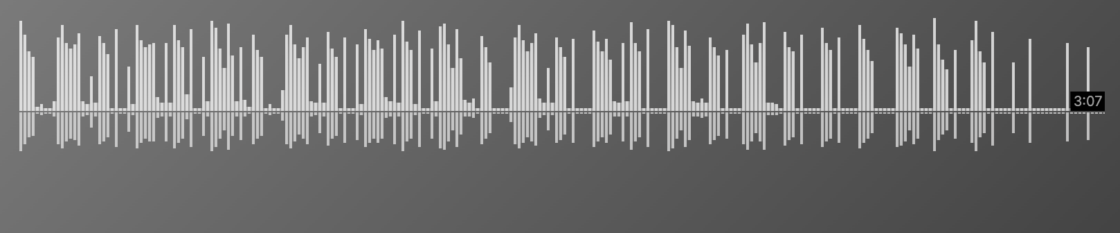
Take a look at that waveform for a moment. Note the way it changes as it makes the steady transition from left to right. Understand that the waveform is a visual representation of sound. Hold off before proceeding to read the following explanation, and first just spent a little time looking at the image.

Now, what that image depicts is not just a melody, but a melody as it slowly evaporates. The piece itself is simple, the same melody over and over — well, almost. Each time the melody repeats, you see, a note is removed. This process of repetition and reduction continues until there is no melody left — except, that is, to the extent that melodies involve silence as much as they do notes. Which is to say, even the absence of notes is, in effect, a melody, all the more so since the ear hears the notes that go missing. Which, in turn, means that at the end of a piece such as this, perhaps we still “hear” the melody, just with our inner ear.

This is a track submitted by one of the participants, who goes simply by lp, in this week’s Disquiet Junto project. You can listen to it here, and read more about the project, and listen to a playlist of all the tracks people are contributing.

Scratch Pad: Lore, 1988, Obsidian

From the past week

At the end of each week, I usually collate a lightly edited collection of recent comments I’ve made on social media, which I think of as my public scratch pad — and I tag on what books I may have finished reading. Knowing I’ll revisit my social media posts, I’ve found, serves as a positive and mellowing influence on my online activity. I mostly hang out on Mastodon (at post.lurk.org/@disquiet), and I’m also trying out a few others. And I generally take weekends off social media.

Right now, though, I’m on a more extended social media (and adjacent) break, through the start of January 2026. Which raises the question: when I’m on such a hiatus, what constitutes this site’s Scratch Pad, since this Saturday habit is, by definition, a collation of stuff I posted to social media throughout the given previous week? Apparently it’s random notes I make to myself that I would have posted online, plus bits I’ve sent to friends via email and other means. Just because I’ve stopped posting doesn’t mean my brain has stopped making posts. Anyhow, here’s this past week’s roundup:

▰ Back early on when I was teaching a course on sound at a local art college, maybe 2013 or 2014, a student asked me, during discussion toward the end of a semester, what I though the normalized state of everyday being would become, given how fast things seemed, at the time, to be changing — and this is a decade-plus ago — and my response, in the moment, was “flux.”

I though “flux” might become an everyday sensibility. We might be concerned about flux but we would also adjust to and even take pleasure in flux. Flux was sort of the opposite of the supposed “end of history,” or an aslant corollary. Flux was change as a manic constant.

What I didn’t foresee was “lore,” which has clearly prevailed. Lore is the glue — whether fictional, or as a matter of heightened narrative-providing, dot-connecting facets of everyday life — that keeps things together. Lore’s prevalence in particular in the consumption (and collective contribution to) popular fiction feels like an expression of a desire for such continuity outside of fiction: lore as an antidote to flux. Lore is the anti-flux.

I still take pleasure in flux. To me, flux is riding the everyday, a bit like standing while on a public bus, or dodging fellow pedestrians while keeping up a good pace on a city sidewalk. I’ve never had great balance physically, but I can handle the cultural and technological flux okay. Keeping track of lore is not as much of a strength for me, come to think of it.

▰ I’m always keeping an eye on the Obsidian roadmap, Obsidian being my note-taking and writing cross-platform app of choice. Excited for a lot of what’s ahead, especially multiplayer, mobile widgets, and Bases support for Publish.

▰ It’s kind of funny to attend a concert in a church with a massive pipe organ, and the pipe organ just serves as a visual backdrop. No one plays it.

▰ I had an iPod but the vibration of the pre-SSD ones weirded me out. I think I used mostly rando Sandisk-type ones until the Touch came out.

▰ I have, based on recent evidence, found myself deeply in a phase of my life where I find concerts of songs that are all verse chorus verse, and during which there’s no musical improvisation, to be fully claustrophobia-inducing.

▰ When I got out of college, in 1988, I lived, for a spell, walking distance from the old Knitting Factory, the one on Houston Street. This year, 2025, here in San Francisco, I managed to walk from my home to concerts featuring Marc Ribot (in Golden Gate Park) and Fred Frith (at the 4 Star), both of whom I saw at the Knitting Factory way back when. More of this in 2026, please.

▰ I didn’t finish reading anything this week, but considering what I finished reading last week, I think that’s OK. I’m very close on Jon Fosse’s Morning and Evening and Sarah Gailey’s Spread Me.

A URL of My Own

Disquiet.com at 29: things become things

December 13, 2025, marks the 29th anniversary of the day I bought the URL disquiet.com. On December 13, 1996, I submitted the paperwork to make the purchase. This involved a fax machine and a photocopy machine and a phone call. I’d had server space, accessible by http:// on nascent Internet (it was capitalized back then) browsers, for several years, but up until that point I’d never had — to borrow the formulation from Virginia Woolf and, in between, Michael Pollan — a URL of my own. I feel like it was all http:// back then, and I’m not certain when the move to https:// fully set in. The added “S” stands, I believe, for “security,” which may say something about the postdiluvian internet we now inhabit.

The word “blog” reportedly didn’t arrive until 1999, but a blog Disquiet.com was. Along the way, a friend of mine, the illustrator and designer Jorge Colombo, proposed I add datelines next to posts. Jorge commented that adding dates to posts would aid returning regular readers in situating themselves in the flow of information. Little did either of us know how much of the rest of our lives would involve situating ourselves in the flow of information.

Today, in 2025, a dateline may seem inherent in the concept of blogging, but before there were blogs there things becoming blogs, much as before “social media” there was “microblogging.” Things become things. That was the case in more ways than one with Disquiet.com. At first the website was just remnants of my server-stage web content, and then it was articles I first published elsewhere, notably in the music magazines of Tower Records (Pulse!, Classical Pulse!, and epulse), which I had, toward the close of 1996, just stopped working at as an editor in order to start a gig at a company of the sort that was then called a dot-com and is now called a startup. (Lest anyone jump to conclusions, I did not get rich, nor was that the expectation. It was a job.)

Much like with the adding of publication dates to individual posts, I stumbled upon the idea of posting directly to Disquiet.com. People would say things like, “Hey, great interview, when’s the next one?” And I’d say, “Well, first I need to get assigned a freelance article, and then it needs to get published” — this was 1996 and 1997, so I meant in print — “and then enough time needs to go by that I feel comfortable posting it online.” And eventually one of the people who asked this question of me must have said something like, “Hey, why don’t you just write, ya know, for Disquiet.com?” And so I did.

This was all being coded by hand, by the way. Disquiet.com continued to be all hand-coded HTML, including the eventual RSS feed, from 1996 until 2007, when I paid someone to port it all to WordPress. I think about this phase of my life a lot, and on the 13th of each December each year, if I have the time — as I have a bit of today, after a walk to the ocean and back —  I jot down the memories. I’m interested to look back and see how details shift and are clarified and gain (and provide) context as the years go by.

I should mention that my pre-vanity-URL Internet server space had simply come along with the ISP (Internet Service Provider) subscription that enabled a dial-up connection in my apartment. The fact that the ISP subscription included server space says something about the sort of people who were using dial-up service at that time. Today, internet access doesn’t come with, let alone encourage, the use of personally identifiable space online; that change may say something as well, something about how the internet has transformed from a loose many-to-many system to an archipelago of commercial platforms. I avoided the word “blog” for a long time, enjoying being able to note, as a kind of honorary digital native, that my website preceded the word, so I was grandfathered in as something else, something less easily characterized. As time passed, however, a funny thing happened. I stopped disliking the word blog and started encouraging its use. More than ever, I think blogging is important. I think more people should have URLs of their own.

Next year will mark Disquiet.com’s 30th anniversary. Looks like we’ll have at least one live event in the San Francisco Bay Area to note it. Maybe some other activities, too. I never know with anniversaries if the lead up to or the time after is the “celebration zone,” so I guess I have roughly two years to have fun with.

Max Richter Live and Online

Some thoughts on Cercle Odyssey

I’ve mentioned the ConcertLab online video series, in which much care is given to the filming of short individual performances by a wide array of musicians, leaning heavily classical, in a wide array of arrangements, focused largely on chamber ensembles, small groups, and solo players. The consistently modest scale of these videos provides the ConcertLab directors and producers with the opportunity to situate the video viewer near and even within the performance.

Cultural phenomena and trends online and off often intersect, and so the Cercle Odyssey traveling series of “360-degree immersive nomad concert installation” settings (also mentioned here recently) suggests, to me, not just a portable experience vaguely akin to the Sphere in Las Vegas, but also an in-person rendition of the kind of experience that crafted performance videos provide on platforms like YouTube. A question for live event producers is how the intimacy of home viewing — perhaps best exemplified by NPR’s Tiny Desk series — can manifest itself in-person.

There’s an interesting intersection of unintended consequences at work in the importance of live music to the livelihood of working musicians. Much of this economic shift has to do with streaming having cut revenue significantly, and that change dovetails with the desire for in-person experiences by people whose life and work increasingly involve staring at two-dimensional screens for much of the day. These twin scenarios — the need to put on a show that encourages word of mouth, and the desire to see things that don’t lose the intimacy of home viewing — find their fruition in events like Cercle Odyssey.

The video that stoked these thoughts is a new upload from Cercle, of an extended performance by Max Richter and a small chamber string group (consisting of Eloisa Fleur, Max Baillie, Zara Hudson, Max Ruisi, and Abby Baillie). They perform post-classical, even neo-romantic, music surrounded by their audience who are, themselves, surrounded by massive screens projecting images throughout the set. It’s a new type of performance set-up, and judging by the length of the videos’ credits, not a small undertaking — all the more understandably when part of the plan is to, later, share the live show online.

Disquiet Junto Project 0728: Note Down

The Assignment: Delete a note at a time.

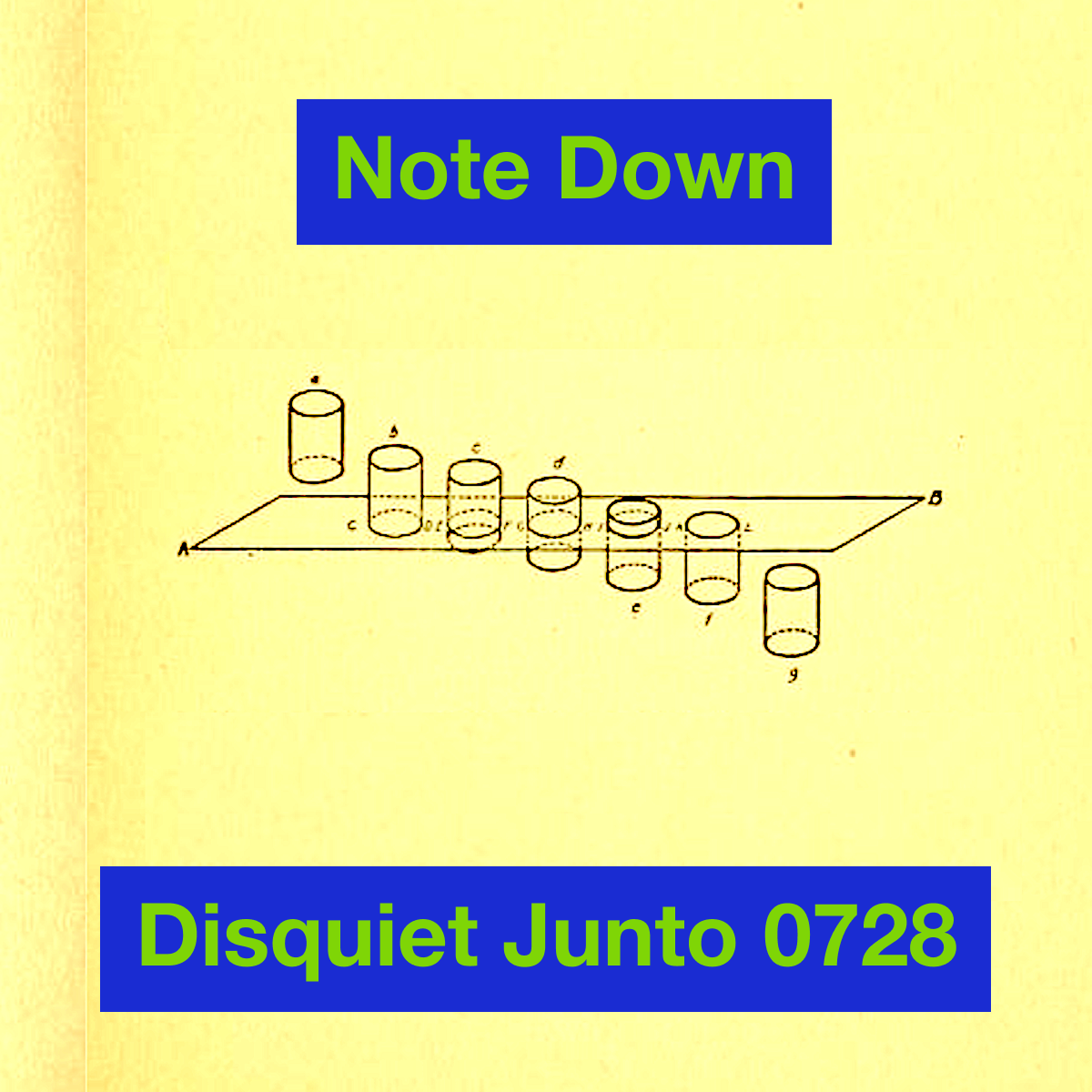
Geometric image of objects going below a plane, plus name and number of the project

Each Thursday in the Disquiet Junto music community, a new compositional challenge is set before the group’s members, who then have five days to record and upload a track in response to the project instructions.

Membership in the Junto is open: just join and participate. (A SoundCloud account is helpful but not required.) There’s no pressure to do every project. The Junto is weekly so that you know it’s there, every Thursday through Monday, when your time and interest align.

Tracks are added to the SoundCloud playlist for the duration of the project. Additional (non-SoundCloud) tracks also generally appear in the lllllll.co discussion thread.

Disquiet Junto Project 0728: Note Down
The Assignment: Delete a note at a time.

There is just one step to this project: Record a piece of music with a slow melody that repeats. Each time the melody cycles around, remove one note, until during the final repeat none of the notes in the melody remain.

Tasks Upon Completion:

Label: Include “disquiet0728” (no spaces/quotes) in the name of your track.

Upload: A person participating in the Disquiet Junto should post only one track per weekly project (SoundCloud account preferred but not required). If on occasion you feel inspired to post more than one track (whether to a single account or across multiple accounts), you should clarify which is the “main” rendition for consideration by fellow members and (if on SoundCloud) for inclusion in the SoundCloud playlist.

Share: Post your track and a description/explanation at https://llllllll.co/t/disquiet-junto-project-0728-note-down/

Discuss: Listen to and comment on the other tracks.

Additional Details:

Length: The length is up to you. How slow can you go?

Deadline: Monday, December 15, 2025, 11:59pm (that is: just before midnight) wherever you are.

About: https://disquiet.com/junto/

Newsletter: https://juntoletter.disquiet.com/

License: It’s preferred (but not required) to set your track as downloadable and allowing for attributed remixing (i.e., an attribution Creative Commons license).

Please Include When Posting Your Track:

More on the 728th weekly Disquiet Junto project, Note Down — The Assignment: Delete a note at a time — at https://disquiet.com/0728/.