
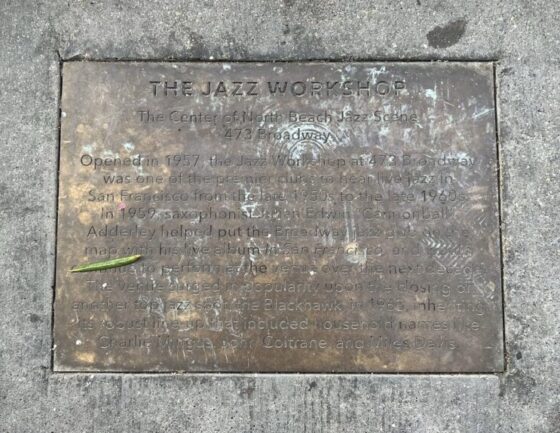
I knew the Jazz Workshop had been in North Beach, but I don’t think I’d ever noticed this plaque before.
I knew the Jazz Workshop had been in North Beach, but I don’t think I’d ever noticed this plaque before.
A fantastic, pop-minimalist use of a classic E-Mu synthesizer. The footage has received a treatment that might make you think it’s from the early days of synthesizers (the elbow patches don’t hurt — I imagine they’re also a “patch” joke, as in “synthesizer patches”), but this is a contemporary recording. That is Benge, aka Benjamin David Edwards, a specialist in vintage/retro synths, performing. He manages to summon up a lovely little melody that plays out in very simple tones, lovely little sounds that bring to mind some of Aphex Twin’s more subtle work. (I am likely mistaken, but I think that equipment is original, and not the mos-lab.com replica.)
[bandcamp width=640 height=472 album=467281636 size=large bgcol=ffffff linkcol=0687f5 artwork=small]
Oceans Above And Skies Below, by the London-based musician who goes by the name still fades (lowercase), is well-titled. The tracks on the album are often oceanic in their scale and, when not, have a slowly billowing quality. And when oceanic, they emphasize the sublime: the surface below which much is happening. Heavy echoes here of Harold Budd’s music, in a good way. More from still fades at instagram.com/stillfades and youtube.com/@stillfades.
The musician also runs Sound Ghost, which makes synthesizer plug-ins, sound packs, virtual instruments, and other tools. Details at soundghost.net. I’m especially interested in musicians who make instruments and instrument makers who make music, because those parallel paths suggest a tight feedback loop in terms of utility, on that taps into the sense that anyone who makes things that helps musicians is a sort of meta-musician.
[bandcamp width=100% height=120 album=3482933323 size=large bgcol=ffffff linkcol=0687f5 tracklist=false artwork=small]
It’s hard to define in specific terms what distinguishes generic drones from interesting ones, as sometimes the difference can be a matter of context, but generally it’s because something is happening in the drone, perhaps a richness to the overtones, perhaps additional sonic elements. The quality can be fairly subtle and, yet, substantively transformative. Both those latter points — the overtones and the extraneous sounds — are central to The Roots of the Mountain Ash Embrace The Stone II by composer Natalia Beylis.
The sounds — thick as a chocolate shake — are made from a pump organ. Beylis’ interest is the way the simple act of the air making its way through the device creates microtonal variations. In addition, there is something almost alive in the creaking of the instrument. As she puts it in the accompanying liner note: “The clatters and groans heard within this recording are the sounds of my old pump organ leaning into its idiosyncratic self.”
This isn’t meditative music, per se, because at times the dense sine waves of the organ speed up, and then they quickly, even suddenly, subside. Such is not the stuff of a peaceful listen. However, it is fascinating as music to make peace with, to enter into a contract with to just listen for the half hour or so straight, and follow where the sounds take you. More from Beylis, who is based in Ireland, at nataliabeylis.com.
On Sundays I try to at least quickly note some of my favorite listening from the week prior — things I would later regret having not written about in more depth, so better to share here briefly than not at all.
▰ I’m still in the process of wrapping my head around the highly imaginative Estuario by Juliana Kaiser, who mixes tonal synthesizers, environmental field recordings, rickety percussive ticks, and slightly muffled voice recordings, among other elements. Intoxicating and transporting. It’s almost like a drama-less radio drama. Kaiser is from Patagonia, Argentina, and lives in Buenos Aires.
[bandcamp width=640 height=307 album=3993283033 size=large bgcol=ffffff linkcol=0687f5 artwork=small]
▰ I’m a sucker for that realm where the orchestral, the glacial, and the granular become virtually indistinguishable, and such is the case with Drift by LA EL, who is based in Houston, Texas:
[bandcamp width=640 height=241 album=1478110844 size=large bgcol=ffffff linkcol=0687f5 artwork=small]
▰ After the Wildfire is a fantastic album of Fourth World music from Jan Bang (“live sampling, electronics”) and Arve Henriksen (“trumpet, voice”), though despite the title credits, it’s actually a quartet, rounded out by Eivind Aarset (“guitar, electronics”) and Ingar Zach (“percussion”), and in fact more than that, as it also involves them playing “set within the orchestral textures shaped by” the FAMES Institute Orchestra and Macedonian voices, arranged and conducted by Džijan Emin. The quartet are all from Norway. The other musicians are based in the Republic of North Macedonia, where the sponsoring body for this work, the Skopje Jazz Festival, is based.
[bandcamp width=640 height=406 album=1487780329 size=large bgcol=ffffff linkcol=0687f5 artwork=small]
I tracked down some footage on YouTube (see below). I recommend starting the album with “Halfway Between Noon & Sunset.”