
This recording was made in my backyard while I was deep asleep. At precisely 1am on June 22, 2023, the device, called the AudioMoth, turned on and at precisely 6am it turned off. In between those start and stop points, the AudioMoth recorded 55 seconds followed by a pause of 5 seconds, and then it repeated the process. This automated scenario filled, over the course of the night, the AudioMoth’s tiny, removable SD card with 301 files: one for each of the recordings (that’s 5 hours times 60 instances of 55-second audio snapshots), plus a single text file listing details of the session. The text file noted the device’s settings, which are configurable via my laptop thanks to a free piece of software. There’s also a free piece of software to set the AudioMoth’s internal clock, and another one to upload the firmware that runs the device. And there’s a free phone app (for iOS and Android) that serves one purpose: it plays a chime that syncs the AudioMoth’s clock. Which is to say, the device’s microphone isn’t just listening to record; it is listening for instructions.
For the June 22 session, my device’s maiden voyage (to the extent that being affixed to an umbrella pole in an urban backyard can be termed a voyage), it just used all the default settings. For the June 23 session, I made one change: I enabled the AudioMoth to automatically place each individual day’s recordings into a separate folder. Nothing has quite made me excited to get up in the morning like my AudioMoth recorder. I find myself unable to wait to go outside to retrieve it and hear what wonders it has recorded: birds, insects, passing critters, automobiles, planes — and all the better, the orchestrated combination thereof. I’m going to try to hold off until Monday (three mornings from today), now that the auto-foldering of daily recordings will save me a lot of data housekeeping.
Dealing with all those files was one of two concerns I had after I started using AudioMoth. The other was knowing how the alkaline batteries were holding up. It turns out that when you switch the thing off, one of its two lights blink. If there are 4 blinks, the batteries are full — then it goes 3 blinks, 2 blinks, or 1 blink as the batteries drain. The fifth alert (lowest in terms of battery strength, highest in terms of expressed urgency) is 10 rapid blinks, so you can’t miss it. This solution is so simple, so clear. It exemplifies the efficient brand of ingenuity embodied by the AudioMoth.
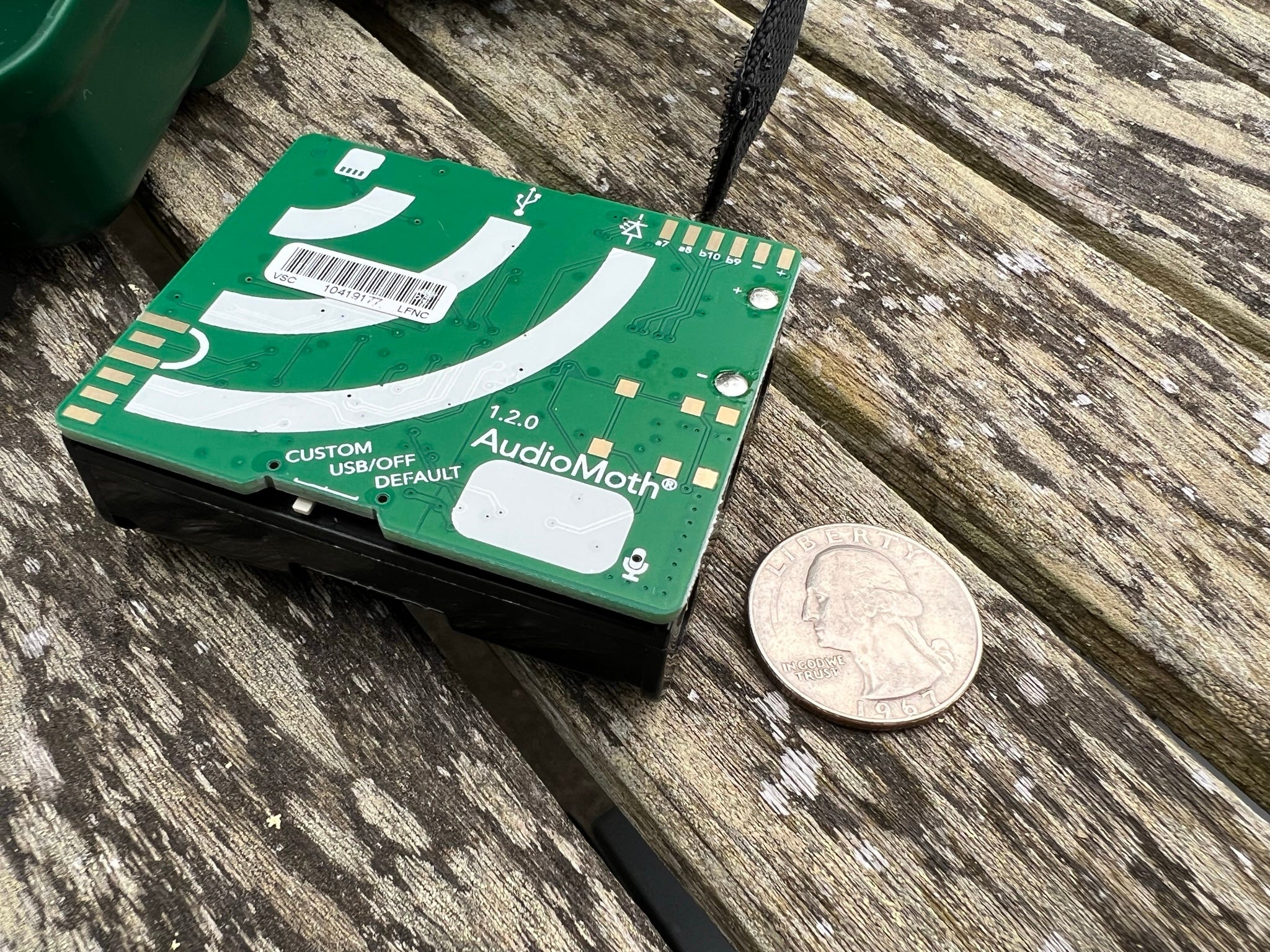
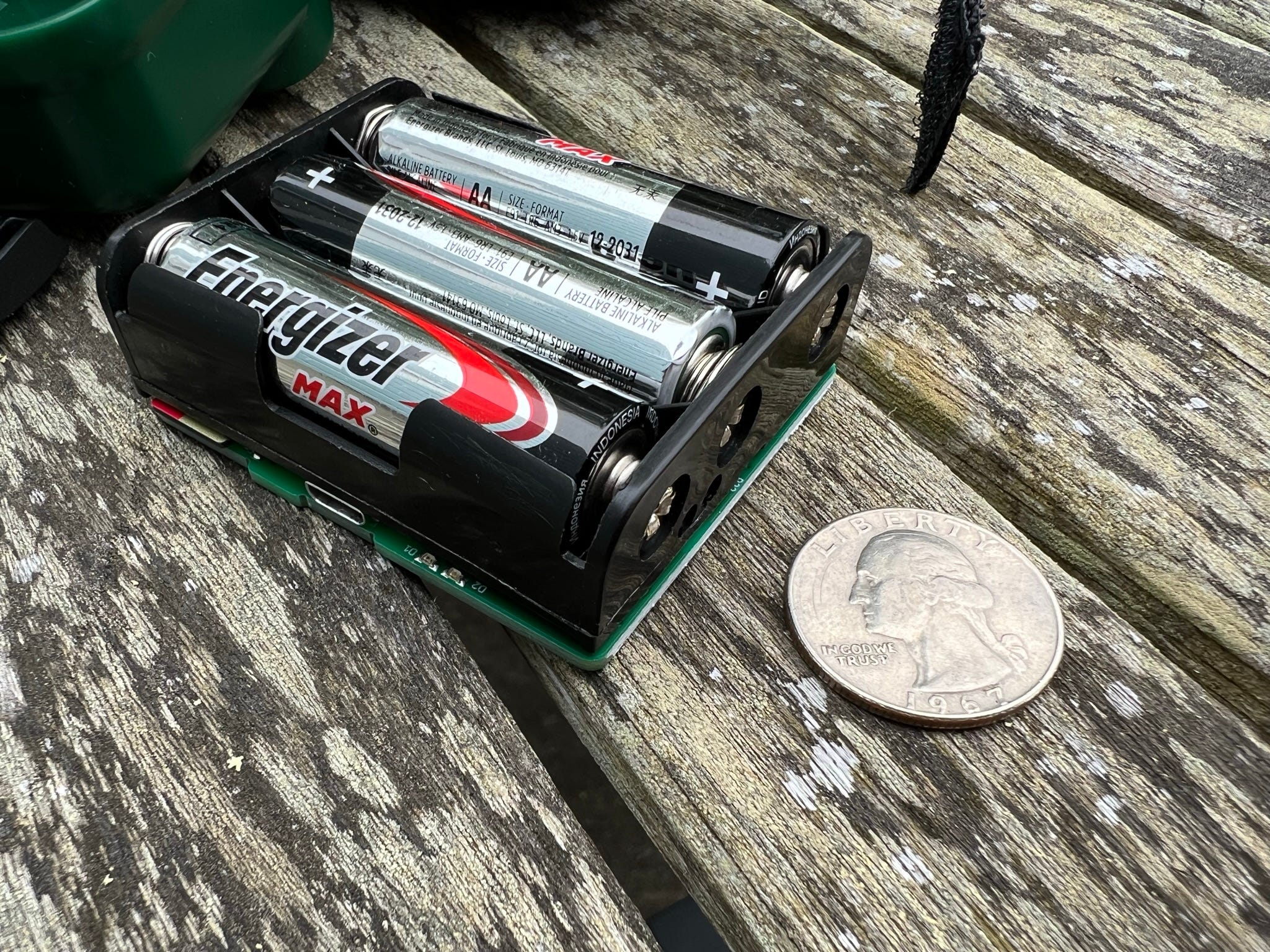
The one I purchased is part of a growing family of devices designed to enable acoustic ecologists and other audio practitioners to make audio recordings remotely. There is also a smaller version called the μMoth, a water-safe one called the HydroMoth, and something called AudioMoth Dev, which was designed with software and hardware developers in mind. The AudioMoth itself is little more than a naked printed circuit board, most of its size given over to the three AA batteries that provide power.
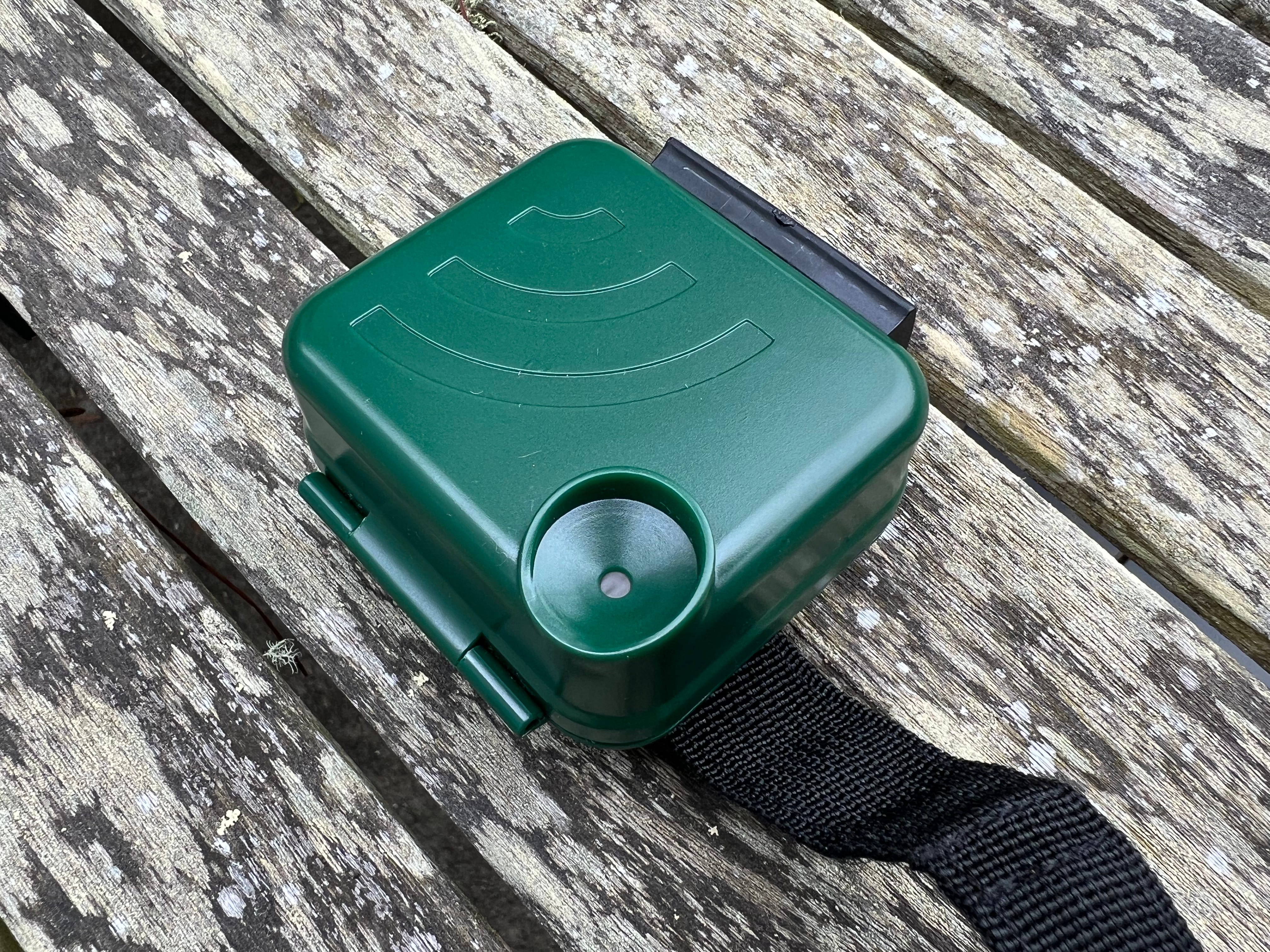
There’s also a small green plastic capsule available, complete with a velcro strap. For the June 22 session, I attached the thing to a table umbrella pole in the backyard. For June 23, I attached it to a chair, hoping to cut down on the wind. For the next three days, it’s attached to one of three stakes keeping a sapling erect. My next steps involve learning more about the device’s settings, in particular using built-in filters to limit noise, and about how to manage all these files — what are the best practices for identifying key moments when you’re faced with multiple hours of what many would simply call silence?
Hi Marc, great to see that you’ve made a foray into experimenting with an AudioMoth! With regard to sifting through all of the data, this is one of the reasons I started using data science tools and workflows to quantify observations and identify unique events/trends using computations like an acoustic index (e.g. Bioacoustic Index, Normalised Difference Soundscape Index (NDSI), Complexity Index.)
It depends on what kind of events/trends you’re looking for, but a good starting point is something like the Bioacoustic Index (for measuring bird sounds) or Complexity Index (for general acoustic activity.) NDSI is also very useful since it quantifies ratio of biotic (natural) sound to industrial sound. In the case of the latter, I used this index to measure the striking lack of road and air traffic around my neighbourhood during the 2021 pandemic restrictions.
Of course, a bit of knowledge of Python or R is essential (I do the bulk of my work in R), but I have been thinking of ways to further simplify the process for anyone who wants to learn more about their data. I’m getting a little better at application design, so maybe some day I’ll be able to build an app that performs the bulk of the process (i.e. a simple click and drag of files by the user with results at the other end.)
I think you might have previously come across my acoustic ecology + data science blog that I started a couple of years ago? I’ve included a couple of links below to case studies of these acoustic indices at work.
In the interim, if you’re keen to summarise some data please let me know and I can run your files through one of my workflows and provide spreadsheets/visualisations. If you’re interested, just get in touch. It’s not a great deal of work for me since data processing and visualisation has become the main thing I do with my practice nowadays. :)
March 2021 – Intro to ACI/BI
https://wranglingintheantipodes.wordpress.com/2021/03/12/exploring-acoustic-ecology-with-the-soundecology-package-part-1-aci-bi/
April 2022 – Detailed overview of NDSI
https://wranglingintheantipodes.wordpress.com/2022/04/09/ndsi-parameters-in-context/
April 2023 – ACI for measuring underwater sound
https://wranglingintheantipodes.wordpress.com/2023/04/14/return-to-lady-bay-part-1-tides-and-seagrass-exploration/