This whole series of Disquiet Junto projects got started, to a good degree, on Twitter, back when it was actually called that — and to a lesser degree on Instagram, back when it seemed like it was mostly fuzzy photos of nature and street scenes — as a result of discussions there toward the end of 2011. I’m still on social media, mostly Mastodon, but as Bluesky has been having a bit of a moment lately, I figured I’d mention: if you’re on Bluesky, please let me know your account name (email me: [email protected]). I’ve begun a “Starter Pack” — which is, in part, a way to collect Bluesky users with some shared characteristic — of Disquiet Junto participants. You can find it at https://go.bsky.app/EaKoSoS.
The Assignment: Make a handful of sonic alerts for various purposes.
/ By Marc Weidenbaum
Each Thursday in the Disquiet Junto music community, a new compositional challenge is set before the group’s members, who then have five days to record and upload a track in response to the project instructions.
Membership in the Junto is open: just join and participate. (A SoundCloud account is helpful but not required.) There’s no pressure to do every project. The Junto is weekly so that you know it’s there, every Thursday through Monday, when your time and interest align.
Disquiet Junto Project 0672: Day Break The Assignment: Make a handful of sonic alerts for various purposes.
Step 1: You’re going to make alarm sounds. Think about the alarms and alerts — phone, egg timer, microwave, neighborhood church bells, etc. — that currently go off regularly in your life.
Step 2: Make a list of a handful of instances you want to create an alert for, like something urgent and something that’s a gentle reminder, and so forth. Maybe you have a different tone for each morning of the week?
Step 3: Record roughly five (more or less) sonic alerts for the purposes you decided upon in Step 2.
Step 4: Make one track with each of the alerts separated briefly by some silence. When posting the track online, be sure to list the intention behind each alert.
Tasks Upon Completion:
Label: Include “disquiet0672” (no spaces/quotes) in the name of your track.
Upload: Post your track to a public account (SoundCloud preferred but by no means required). It’s best to focus on one track, but if you post more than one, clarify which is the “main” rendition.
License: It’s preferred (but not required) to set your track as downloadable and allowing for attributed remixing (i.e., an attribution Creative Commons license).
Please Include When Posting Your Track:
More on the 672nd weekly Disquiet Junto project, Day Break — The Assignment: Make a handful of sonic alerts for various purposes — at https://disquiet.com/0672/
My ongoing Listening Diary of the newly released dozen Autechre live sets from 2023 and 2024 has passed the 2,000 words milestone, with no signs of slowing down, and thus far I’ve still only touched on half the latest AE_2022- recordings. Today I focused on the Melbourne date for the first time, with side trips to Turin, and to Japan, and to William Gibson’s early fiction (speaking of which, Neuromancer turned 40 this year). In the process of keeping this diary, I’ve also been building up a much larger collection of “Other Notes” at the bottom of the post than I had expected to, most recently to share some examples of the software Autechre utilizes (live and in the studio), as well as to strike an accidental contrast between these new sets and one of the ones from the seven that were released in 2023.
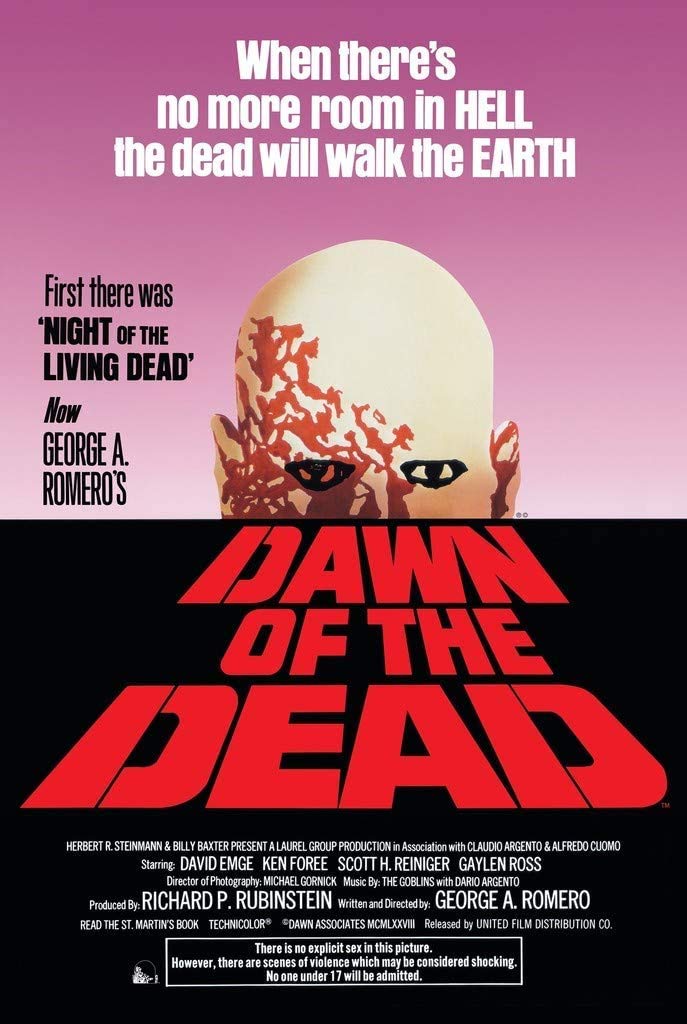
Anti-eroticism. Architectural literacy. Consumerism finger-poking. And zombies, lots of zombies. I wrote about the original Dawn of the Dead (1978), one of my favorite movies of all time, for Hilobrow’s ongoing horror series. The 25-part collection, titled Scream Your Enthusiasm, has some great contributors, including comic book artist and playwright Dean Haspiel, film editor Crockett Doob, author Lynn Peril, and series editor Heather Quinlan, just to name a few. I didn’t have space to get into the music, but of course the film’s classic score was the result of a team-up between the band Goblin (“the Goblins” on the poster) and Dario Argento. I dedicated the short essay (as I did an earlier Hilobrow piece on Celtic Frost) to my late friend Eric Engelhardt.
I’ve been doing a lot of research these past few years into field recordings, those of both the natural environment and the built environment. Bridging, in a manner of speaking, the gap between the two respective realms are the environmental sounds that fill video games, virtual reality, and the like. They are artificially created yet intended to give the impact of something real, something heightened or extrapolated, something — to use the ubiquitous term — immersive. Many of these high-definition sonic studio concoctions are derived from actual field recordings, while others are produced more synthetically. Such recordings are, of course, intended to be experienced in a given context.
However, as with the one heard (and seen) below, in which a driver navigates the nighttime streets of the 2013 game Grand Theft Auto V, there is a large and growing audience for prerecorded video game experiences, and though they are, inherently, audio-visual, many of these fan recordings are couched in sonic terms, like “ASMR” and as “sleep aids.” There is something lulling, indeed, to this city drive, which the title informs us has “NO LOOPS” — which is to say, it is a constant, non-repeating stream of different journeys around the open world of the video game, courtesy of the channel named Video Game Weather ASMR. It is also, per the functional title, eight hours long. The primary things I found myself listening to are the car engines and the rain, and I found myself listening for variations therein. Your mileage may vary. I recommend starting at the beginning and then checking out the different scenarios, each from the point of view of a different driver/character in the game. There is a clickable table of contents to the video, helping situate you should you want to know where you are — or more to the point, who you are — at a given moment.