Time with the Mux

Up and away

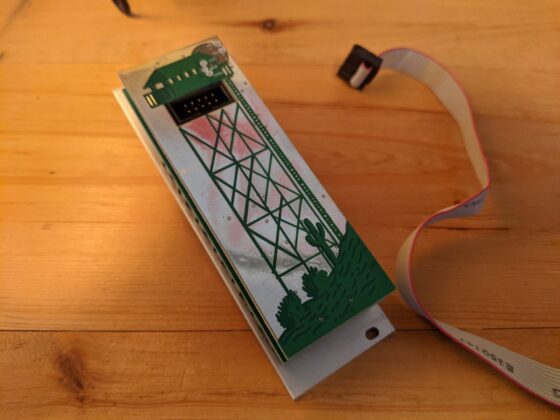
This is the rear of another module I’ve enjoyed but am putting back into the pool. It’s the Befaco Muxlicer, and in many ways it did exactly what I wanted, sorting through variations, treating disparate elements as equals. But I’m going to try some other approaches to the same end, and see what comes of it. I may end up with one of these again down the road, but for the time being I’m keeping my setup fairly compact. Before sending it off, I wanted to capture its beautiful printed circuit board.

Buddha Machine Variations No. 36 (Glass Tiles)

A series of focused experiments

Been a few days since the previous Buddha Machine Variation. The camera died, after it had [stopped playing nice with audio](https://disquiet.com/2020/05/20/paper-music/
). And I got a new, smaller synthesizer case (from Pulp Logic, who were super helpful with plotting it out). This is the first time I’ve ever used an expression pedal with my synth, thanks to one of the three tiles in the upper left corner of the box. (“Tiles” being a term for the shorter modules seen top and bottom here, above and below the ER-301 module.) Very simple little patch. Just a proof of concept. The tiny foot (well, hand) pedal is triggering the recording of a microloop (400 or so milliseconds) of the choral audio coming from the Philip Glass 80th-birthday edition of the Buddha Machine. The expression pedal is varying how much we’re hearing the inbound Glass loop, and how much we’re hearing the microloop. If you’re wondering where the Buddha Machine is sending its audio into the synth, there are jacks in the side of the case itself.

For further patch-documentation purposes, here are two shots of the synthesizer:

Video originally posted at youtube.com/disquiet. There’s also a (https://www.youtube.com/playlist?list=PLAgCxRbmR1MIM4mCYe17nERi9xeEWAD2w) of the Buddha Machine Variations.

Back into the Cold (Mac)

Waving goodbye

Shown here is the back of the Cold Mac synthesizer module from the company Whimsical Raps. I’ve enjoyed using it, but I’m putting it back in the pool of circulating used synthesizer equipment. Before doing so, I’m commemorating its time in my modular synth with this photograph of the lovely rear of its printed circuit board.

Paper Music

When the machines fail us

The semi-bad news is I spent a considerable amount of time a year or so ago researching how people notate their synthesizer patches, never coming to a conclusion that I felt was (yet) substantial enough to write about. That is, how they draw, or photograph, or otherwise annotate for future reference the combination of cables and knobs, sliders and (increasingly) menu settings of their modules.

The not unrelated good news is, having done that work, I had developed some fledgling ideas as to how to accomplish such a task, ideas I drew upon this evening when my camera failed to record audio for what would have been the day’s Buddha Machine Variation.

The second of the images below is how I transcribed some menu settings (on the ER-301 module, using the Feedback Looper unit). I was, apparently, especially (presciently?) primed to take these notes, because the first of these two images is something I wrote in a notebook last night when an idea for today’s patch first suggested itself. So, these are the before and after. What’s missing is the middle, the actual recording.

Buddha Machine Variations No. 35 (Tripled Suite)

A series of focused experiments

This was an experiment in exploring the device as a whole: not just as a set of loops contained in one object, but the sequence of those loops, and the way the loops progress as a result of the object’s design. All the previous Buddha Machine Variations to date have involved one loop per machine. Here the multiple loops of such a device, one from the second-generation of Buddha Machines, are heard not just in sequence, but in overlapping sequences. They’re considered as a suite.

There are three subsets of whatever loop is playing at a given time. Each is a subloop: one three seconds, one four seconds, one five (in the ER-301 module, using the Feedback Looper unit). Each of the subloops is extracted from a different narrow band of the audio spectrum (via the FDXf module). As the piece proceeds, the button on the side of the Buddha Machine is clicked. One or more of the subloops begins recording the new audio almost immediately, but there is some time before the preceding loop is entirely eradicated. At the very end, the audio cable is pulled out of the Buddha Machine, and eventually all the subloops give way to silence. (This was less sudden when rehearsed, but it works OK here. I’ll be trying this all again with a slightly different approach.)

For further patch-documentation purposes, here is a shot of the synthesizer:

Video originally posted at youtube.com/disquiet. There’s also a (https://www.youtube.com/playlist?list=PLAgCxRbmR1MIM4mCYe17nERi9xeEWAD2w) of the Buddha Machine Variations.