End of Week Notes

Four quick items

1: I’m going to see the Brian Eno documentary, Eno, this evening at the Palace of Fine Arts Theatre here in San Francisco. As I’ve joked since the movie was announced, I feel like Dieter Rams should have composed the score, since Eno scored the Rams documentary by the same director, Gary Hustwit. Since every showing of Eno is a little different, due to the projection process Hustwit employs, I do plan to see it a second time, but at $40 a pop, I’m going to wait.

2: I’ve been trying to do one audio thing a day, just getting back in the swing of things after spending a way larger percentage of my modest music-making time on guitar practice. This week that included:

  • reorganizing one of my main modular synthesizer racks
  • getting my recently obtained Expert Sleepers ES-9 module hooked up with my laptop and iPad
  • sending audio from the iPad to the synth with the ES-9 (in this case, running it through the excellent reverb module Bunker Archaeology)
  • using some Jacklights to identify activity on some modules so technical their functions have eluded me thus far
  • reminding myself how to use my H4N as an audio interface, and learning by chance that this can be done without batteries (the USB transfers sufficient power to it)
  • I’m trying to get into the habit of ABR (“always be recording) but I’m not quite there yet.

3: I’m plotting the return of my Disquietude podcast. I sent requests out to artists whose music I want to feature, and I quickly (within an hour or so) heard back from most of them. I only feature music by artists who have themselves approved its inclusion, or whose record label or management provided approval.

4: If you haven’t seen the new Paul Simon documentary, In Restless Dreams, I recommend it so far — by “so far” meaning I’m about halfway through the first two episodes. It mostly takes place in the present (and yes, he is quite old, and yes, he seems to be becoming Mel Brooks — and yes, he can still play and sing, boy can he), as a summary of his recent album, Seven Psalms, but also threads a simple chronology of his life. The director is Alex Gibney (The Inventor, Going Clear, We Steal Secrets, Taxi to the Dark Side). There are some exceptional moments, like a hand-drawn grid of the relative chart movements of the top 20 singles made by Art Garfunkel when he was a teenager, a moment when Simon (off screen) tells us he is crying (“weeping”) after summoning up a simple memory, and an instance when Simon recounts going deaf in one ear in October 2023 and at that moment in the film the audio gets muddy in a way that brings the audience into a semblance of his experience. The effect isn’t subtle, but it’s still quite well done. The Garfunkel chart, by the way, is straight outta the “Great Rock and Roll Pauses” section of Jennifer Egan’s A Visit from the Goon Squad (and the related material in The Candy House).
Disquiet Junto Project 0645: Speed Trap

The Assignment: Record something, slow it down, and then record over it.

Each Thursday in the Disquiet Junto music community, a new compositional challenge is set before the group’s members, who then have five days to record and upload a track in response to the project instructions.

Membership in the Junto is open: just join and participate. (A SoundCloud account is helpful but not required.) There’s no pressure to do every project. The Junto is weekly so that you know it’s there, every Thursday through Monday, when your time and interest align.

Tracks are added to the SoundCloud playlist for the duration of the project. Additional (non-SoundCloud) tracks appear in the lllllll.co discussion thread.

These following instructions went to the group email list (via juntoletter.disquiet.com). 

Disquiet Junto Project 0645: Speed Trap
The Assignment: Record something, slow it down, and then record over it.

As always, it helps to read the instructions in full before proceeding, and considering the steps as a whole.

Step 1: Record something to serve as roughly half of a complete track.

Step 2: Slow the result of Step 1 to half its original speed.

Step 3: Record something in addition to the result of Step 2 to complete the track.

Tasks Upon Completion:

Label: Include “disquiet0645” (no spaces/quotes) in the name of your track.

Upload: Post your track to a public account (SoundCloud preferred but by no means required). It’s best to focus on one track, but if you post more than one, clarify which is the “main” rendition.

Share: Post your track and a description/explanation at https://llllllll.co/t/disquiet-junto-project-0645-speed-trap/

Discuss: Listen to and comment on the other tracks.

Additional Details:

Length: The length is up to you.

Deadline: Monday, May 13, 2024, 11:59pm (that is: just before midnight) wherever you are.

About: https://disquiet.com/junto/

Newsletter: https://juntoletter.disquiet.com/

License: It’s preferred (but not required) to set your track as downloadable and allowing for attributed remixing (i.e., an attribution Creative Commons license).

Please Include When Posting Your Track:

More on the 645th weekly Disquiet Junto project, Speed Trap — The Assignment: Record something, slow it down, and then record over it — at https://disquiet.com/0645/

Chris Hanlon’s Attenuated Rhythm

A modest percussion technique

A glistening scintillate largely constitutes the ethereal substance of Chris Hanlon’s “Long While,” which joins a growing amount of recording these days that blurs the line between ambient music and ambient sound. The melty bits of warped tape here, simulated or otherwise, further that instinct by lending a nostalgic quality. But what really makes the piece, what distinguishes it, is a sequence of occasional muffled thuds, something like footsteps, or a cane on a carpeted floor, or even distant bombs going off. These are almost — almost, but not quite — far enough apart to not count as rhythmic, but there is a pace to them, and that’s the point: just enough time for each pair of thuds to frame what comes between, and to make you wait for the next. The element is a welcome addition. Hanlon is based in Belfast, Ireland.

Heavy Metal

An ongoing series cross-posted from instagram.com/dsqt

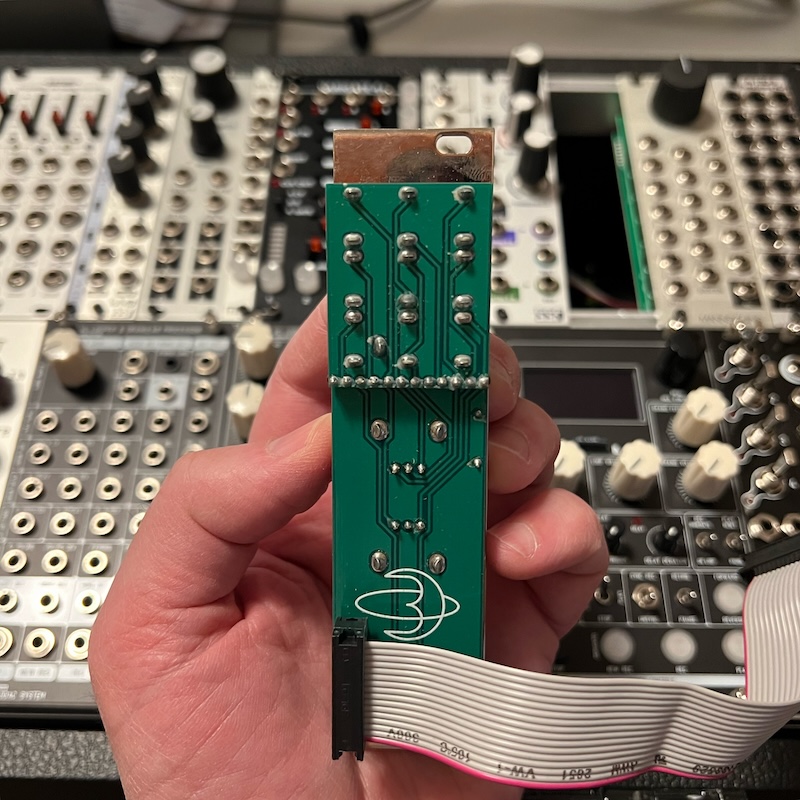
A glimpse of the rear of a synth PCB before the module goes back into the slightly rearranged case. This one looks like the map of a city metro line. Oddly, the name of the module, the Bizmuth, was a word in the New York Times Strands puzzle today, May 7, 2024.

The Memory System Modules Are Live

A great addition to VCV Rack

The four free software modules that make up the Memory system for the also free VCV Rack virtual modular synthesizer became available earlier today. At their core, the modules enable a musician to record music and access the audio with different virtual tape heads that, per the documentation, “move independently within it.” The quartet of modules popped up in the VCV Rack online library as part of the Stochastic Telegraph brand, which has previously released five other modules, including a linear function generator called Drifter, a trigger utility called Fuse, a programmable sequencer (among other things) called BASICally, a note-taking blackboard called Fermata, and a value logger (TTY). The new modules are Depict, Embellish, Memory, and Ruminate:

These are the modules by Mahlen Morris that I’ve mentioned here twice previously. To support the appearance of the modules in the VCV Rack library, Mahlen has also released a new video in which he does a walk-through of the various parts of the ensemble and some of what they’re capable of:

Tantalizingly, he opens the video by saying that the Memory system consists of four different modules “at the moment” — suggesting more modules may be in the works, in addition to potential upgrades of the existing modules. And, I’m pleased to report, some of the opening example features guitar recordings I made for Mahlen.