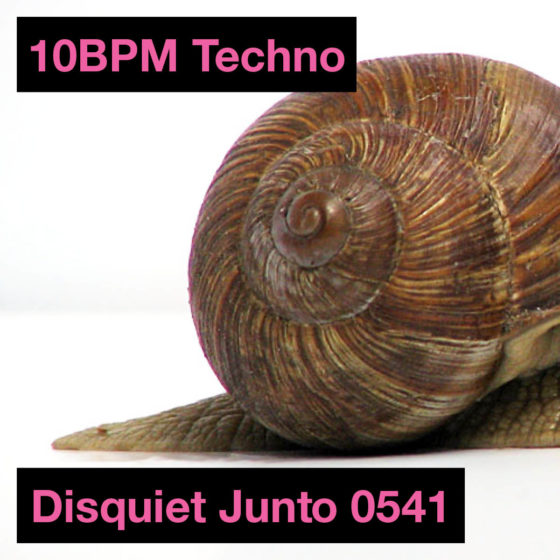
Disquiet Junto Project 0541: 10BPM Techno

The Assignment: Make some snail-paced beats.

Each Thursday in the Disquiet Junto group, a new compositional challenge is set before the group’s members, who then have just over four days to upload a track in response to the assignment. Membership in the Junto is open: just join and participate. (A SoundCloud account is helpful but not required.) There’s no pressure to do every project. It’s weekly so that you know it’s there, every Thursday through Monday, when you have the time.

Deadline: This project’s deadline is the end of the day Monday, May 16, 2022, at 11:59pm (that is, just before midnight) wherever you are. It was posted on Thursday, May 12, 2022.

These are the instructions that went out to the group’s email list (at tinyletter.com/disquiet-junto):

**Disquiet Junto Project 0541: 10BPM Techno**
The Assignment: Make some snail-paced beats.

There are two ways to do this project.

Option 1: Record some 10BPM techno.

Option 2: Record what you imagine it would sound like to attend a club event of 10BPM techno, including crowd noise.

Eight Important Steps When Your Track Is Done:

Step 1: Include “disquiet0541” (no spaces or quotation marks) in the name of your tracks.

Step 2: If your audio-hosting platform allows for tags, be sure to also include the project tag “disquiet0541” (no spaces or quotation marks). If you’re posting on SoundCloud in particular, this is essential to subsequent location of tracks for the creation of a project playlist.

Step 3: Upload your tracks. It is helpful but not essential that you use SoundCloud to host your tracks.

Step 4: Post your track in the following discussion thread at llllllll.co:

Project discussion takes place on llllllll.co: [https://llllllll.co/t/disquiet-junto-project-0541-10bpm-techno/](https://llllllll.co/t/disquiet-junto-project-0541-10bpm-techno/)

Step 5: Annotate your track with a brief explanation of your approach and process.

Step 6: If posting on social media, please consider using the hashtag #DisquietJunto so fellow participants are more likely to locate your communication.

Step 7: Then listen to and comment on tracks uploaded by your fellow Disquiet Junto participants.

Step 8: Also join in the discussion on the Disquiet Junto Slack. Send your email address to [email protected] for Slack inclusion.

Note: Please post one track for this weekly Junto project. If you choose to post more than one, and do so on SoundCloud, please let me know which you’d like added to the playlist. Thanks.

Additional Details:

Deadline: This project’s deadline is the end of the day Monday, May 16, 2022, at 11:59pm (that is, just before midnight) wherever you are. It was posted on Thursday, May 12, 2022.

Length: The length is up to you. Slow doesn’t necessarily mean long.

Title/Tag: When posting your tracks, please include “disquiet0541” in the title of the tracks, and where applicable (on SoundCloud, for example) as a tag.

Upload: When participating in this project, be sure to include a description of your process in planning, composing, and recording it. This description is an essential element of the communicative process inherent in the Disquiet Junto. Photos, video, and lists of equipment are always appreciated.

Download: It is always best to set your track as downloadable and allowing for attributed remixing (i.e., a Creative Commons license permitting non-commercial sharing with attribution, allowing for derivatives).

For context, when posting the track online, please be sure to include this following information:

More on this 541st weekly Disquiet Junto project — 10BPM Techno (The Assignment: Make some snail-paced beats) — at: https://disquiet.com/0541/

More on the Disquiet Junto at: https://disquiet.com/junto/

Subscribe to project announcements here: https://tinyletter.com/disquiet-junto/

Project discussion takes place on llllllll.co: [https://llllllll.co/t/disquiet-junto-project-0541-10bpm-techno/](https://llllllll.co/t/disquiet-junto-project-0541-10bpm-techno/)

Image used thanks to this license: Creative Commons Attribution-Share Alike 3.0 Unported: [https://en.wikipedia.org/wiki/File:Grapevinesnail_01.jpg](https://en.wikipedia.org/wiki/File:Grapevinesnail_01.jpg).

Ambient Jam

By Perry Frank

Music is built on tools, and tools are built on music. Music is made with available tools. Tools are made to produce sounds in a more immediate or more nuanced manner than previous tools might have allowed for. Which is why a small synthesizer and a smaller reverb pedal can, together, sound like an ancient pipe organ performed in an old church where the roof has been torn off and the sounds are straining as they reach for the naked heavens. This is Perry Frank’s ambient jam.

This is the latest video I’ve added year to my [ongoing YouTube playlist](https://www.youtube.com/playlist?list=PLAgCxRbmR1MJxihgJkCPEnehAPvjoF71-) of fine live ambient performances. Video originally posted at [youtube.com](https://www.youtube.com/watch?v=f_o9bZ7FcOw). Perry Frank is based in Italy.

This Week in Sound: Clustering the Detected Keystrokes

A lightly annotated clipping service

These sound-studies highlights of the week are lightly adapted from the May 9, 2022, issue of the free Disquiet.com weekly email newsletter This Week in Sound ([tinyletter.com/disquiet](https://tinyletter.com/disquiet)).

As always, if you find sonic news of interest, please share it with me, and (except with the most widespread of news items) I’ll credit you should I mention it here.

That mechanical keyboard isn’t merely loud — the volume makes each key identifiable, such that a website can sort out what you’re typing just by listening. Andrew Liszewski explains how it works: “by clustering the detected keystrokes based on their sound similarity and then using statistical information about the frequency of the letter n-grams in the supposed language of the text.” ➔ [gizmodo.com](https://gizmodo.com/website-can-track-mechanical-keyboard-typing-just-by-li-1848890545)

Voice interfaces have moved from the cellphone to the modern factory: “Companies are starting to take this form of automation onto the factory floor where a hands-free connection to the plant automation system and its equipment can deliver substantial efficiency. This is yet another version of consumer technology making its way onto the factory floor. You could call it the iPhone-ification of plant automation.” ➔ [designnews.com](https://www.designnews.com/automation/new-bot-plant-floor-your-voice)

The musical legacy of 1980s Amiga computers: “Back in the 90s, a buoyant ‘demo scene’ coalesced around the Amiga, where home programmers put together animated music videos, fitting them on tiny 880k floppy disks,” writes Tamlin Magee. “Pirated software, meanwhile, would usually feature home-brewed intros, complete with the pirates’ own music, that users had to sit through before they could access their bootlegged copies.” ➔ [theguardian.com](https://www.theguardian.com/music/2022/may/02/poor-man-studio-amiga-computers-modern-music-jungle-calvin-harris)
*(via Alexander Scholz at holo.mg)*

Fascinating to watch the ongoing noise pollution crackdowns in India, such as this report from the city of Madurai: “Private buses making stopovers at the bus stand were checked for the presence of banned air horns, which were seized citing that they create noise beyond the permitted range between 70 and 80 decibels.” ➔ [thehindu.com](https://www.thehindu.com/news/cities/Madurai/dindigul/article65391749.ece)

More on the noise effort in the Indian state of Uttar Pradesh: “The UP government’s drive to rein in decibel levels had the potential to trigger a loud backlash,” writes Pathikrit Chakraborty. “But by proactively consulting with communities, religious leaders and village elders, the state has pulled off the impossible.” ➔ [indiatimes.com](https://timesofindia.indiatimes.com/india/how-uttar-pradesh-is-setting-an-example-in-taming-loudspeakers/articleshow/91341288.cms)

“With a period of oscillation of 10 million years, the sound waves were acoustically equivalent to a B-flat 57 octaves below middle C, a tone that the black hole has apparently been holding for the last two billion years.” Dennis Overbye on what it sounds like when a black hole sings. ➔ [nytimes.com](https://www.nytimes.com/2022/05/07/science/space/astronomy-black-hole-sound.html)

A new noise machine by Pentagram partner Yuri Suzuki has a grid of 32 switches: “With options ranging from white noise to ocean waves, the switches let you mix and match tracks, and add effects like reverb.” Suzuki explains: “I was very interested in manipulation without instruction.” The object is a collaboration between Suzuki and E&Y, a Japanese furniture company. ➔ [fastcompany.com](https://www.fastcompany.com/90749437/the-white-noise-machine-gets-a-glorious-redesign)

How a discarded water tank in Australia has become a music-performance wonder: “for all the solidity, strength and longevity of the concrete, grey river pebbles and steel, Murcutt also sensed a fecund fragility in the water tank, likening it to the shell of an egg, with the sound chapel as its yolk,” writes Rita Glennon of this collaboration between architect Glenn Murcutt and composer Georges Lentz. ➔ [brisbanetimes.com.au](https://www.brisbanetimes.com.au/culture/music/how-a-dusty-water-tank-became-a-new-chapel-of-sound-20220206-p59u42.html)

Reviewed Carl Stone for The Wire

A livestream from last month

Barely a month ago, on April 2, Carl Stone performed a livestream concert with an interesting organization called MSCTY “a global agency for music + architecture,” per its website). The set consisted of upcycled field recordings of Tokyo, and I reviewed it for the latest issue of The Wire magazine. Below is the opening section of my article. The full piece is in issue #460, the one with Japanese musician Phew on the cover.

And here’s the full concert:

Sound Ledger¹ (Audiobooks, Grooves)

Audio culture by the numbers

8: number of nonfiction audiobooks read by their authors in the current New York Times top 10

0: number of fiction audiobooks read by their authors in the current New York Times top 10

3: length, in minutes, of audio listened to by individuals who participated in a Japanese study of how the brain responds to “groove rhythm” in music

________
¹Footnotes

Audiobooks: [nytimes.com](https://www.nytimes.com/books/best-sellers/audio-nonfiction/). Groove: [nature.com](https://www.nature.com/articles/s41598-022-11324-3).

*Originally published in the May 9, 2022, edition of the This Week in Sound email newsletter. Get it in your inbox via [tinyletter.com/disquiet](https://tinyletter.com/disquiet).*