
I listen continuously. I write about what I’m drawn to write about. I can’t reply to every email I receive.

I listen continuously. I write about what I’m drawn to write about. I can’t reply to every email I receive.
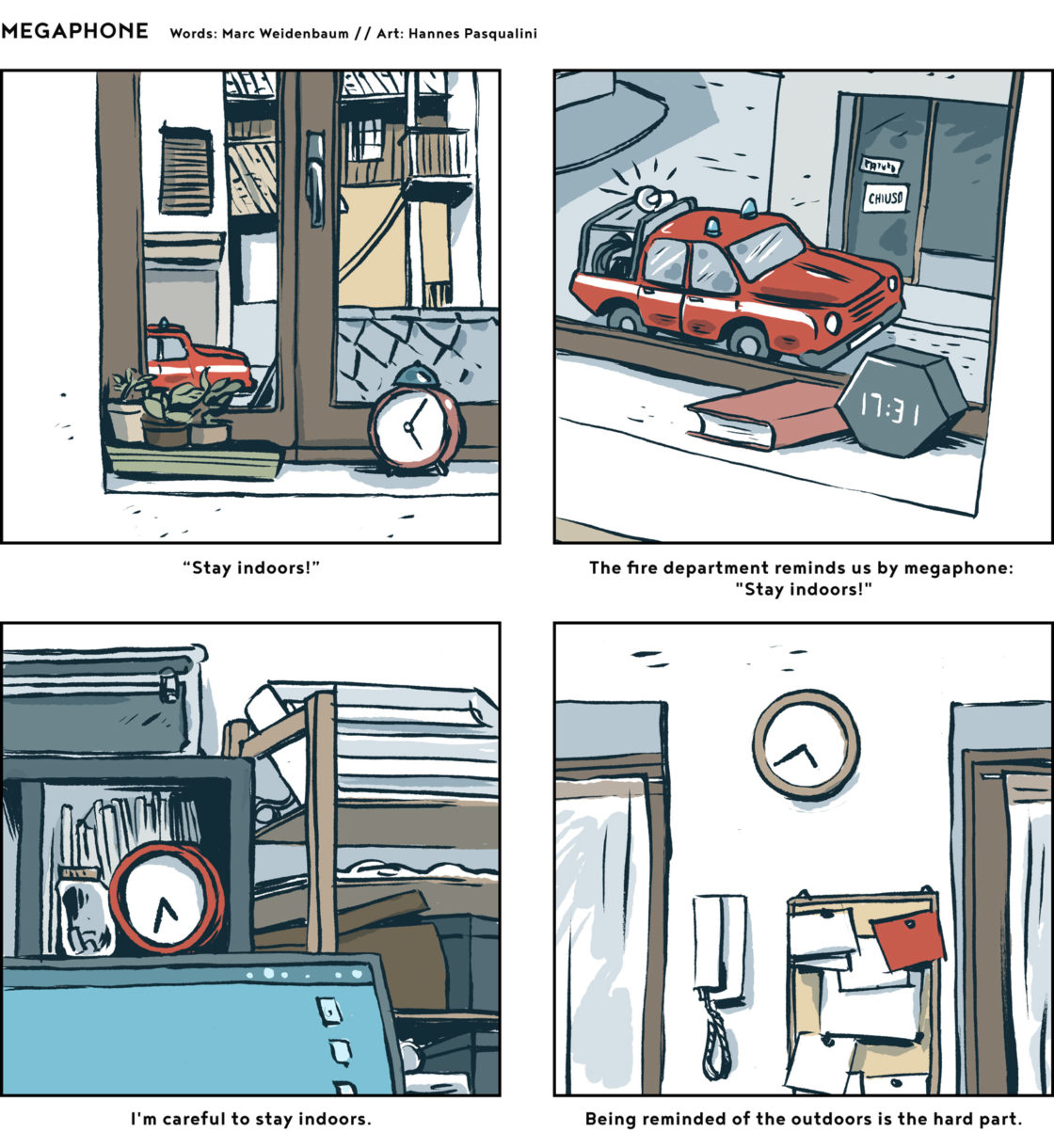
Many thanks to illustrator Hannes Pasqualini (horizontalpitch.com, papernoise.net) for the collaboration. See a full index of Frame by Frame comics at disquiet.com/fxf.
If you watched the excellent new Why We Bleep Podcast (video) interview with Tom Whitwell of Music Thing Modular, you may, right at the [50-minute mark](https://youtu.be/a46zesS_8dw?t=3002), have heard Tom talk about a little MIDI device he prototyped with me in mind. I thought I’d share some images and some context, by way of saying thanks to Tom.
I’d been asking online (via Twitter and Facebook mostly) for some time as to why there isn’t a super small, portable MIDI device that has faders, pots, and endless knobs. I’d located various DIY projects with varying degrees of clarity in their instructions, and fixated for awhile on one, the k4b4, that I found [on a Japanese website](https://www.switch-science.com/catalog/2394/) (picture below in case the site ever goes dead), but it appeared to be sold out; nothing else seemed to come close to what I had imagined. And even this one lacks faders:

Height wasn’t of particular concern, but I figured something roughly the length and width of a credit card or small mobile phone would be perfect. I wanted something I could keep in my backpack without ever having to consider its volume or heft.
Then Tom got in touch. Let’s start with the finished object, before getting to some process materials. This is the top and bottom view.
The length is just under 4 inches, and the width is just over 1.75 inches.


And this is it fit snug in one of the smallest Pelican cases, along with a USB cable:

Tom ran a few PCB (printed circuit board) designs by me in rapid succession, with different combinations and permutations of controls. Ultimately, I decided that the pairing of pots and endless knobs was more important than buttons, since I’d often be using it with something like a laptop. Keyboards have more than enough buttons.
In retrospect, various factors show how my preparation for the current health crisis began earlier than I was fully conscious of. I think the most recent live performance I attended may have been way back on January 30, 2020, at the Luggage Store, here in San Francisco, where the weekly series occurs each Thursday night. Well, did happen, before all live in-person concerts stopped happening. (Two days later I posted a photo of [the graffiti-covered stairwell](https://disquiet.com/2020/02/01/the-coit-tower-of-graffiti/) at the Luggage Store, which is an art gallery, not a luggage store.) I was due to attend several other shows after that, and bowed out, most recently on March 7, judging by my calendar. Along the lines of my [“last night”](https://disquiet.com/2020/03/29/the-night-before/) experience in Manhattan a week prior, that’s another moment when things seemed to speed up — in this case, to cascade. Barely 48 hours later, the following Monday, March 9, all classes at the school where I teach once a year were announced to be transitioning online, and well before the end of the work week the local public school district had done the same.

And so, these are two shots from the last time I saw music live in the flesh. That’s the duo Mit Darm (Edward Shocker, left, and Suki O’Kane), and sharing the bill with them were Steve Adams, left, and John Hanes. I’d sat next to O’Kane one evening at the most recent San Francisco Tape Music Festival, and was looking forward to hearing her perform. Adams is a member of the Rova Saxophone Quartet, of whom I’m a longtime admirer. I was excited to hear what he was up to when he put his sax aside in favor of a laptop.

After the Luggage Store show was over, I started to head home, and passed, barely a block away, the Center for New Music, where another Rova member, Jon Raskin, had just finished a separate performance. Such nights, where lives and artistic pursuits overlap and intersect on the street and in venues, are on hold for an extended moment. And for the moment, live performances are flourishing online. I’m hopeful, for the musicians’ sake, that virtual attendees are putting some money in the tip jars, and signing up for online shows where there’s a proper ticket fee.
Speaking of which, I noticed something this morning at [bayimproviser.com](https://www.bayimproviser.com/calendar.aspx), an excellent concert listing service that has been essentially my local social calendar for as long as I can remember. It’s one of a few dozen sites I have bookmarked to look at each morning over coffee. For weeks, it had become a list of cancelled and postponed performances, but that seems to have changed, at least a little. Now it’s also listing some live online events by local musicians. I had been depressed each morning seeing all the non-events, and now look forward to what starts popping up.
Accompanied by archival footage from the height of the Space Age, the track “Quanta Skylab” by the Polish musician Grzegorz Bojanek is the background music you’re looking for right now. We’re all aboard a spacecraft at the moment, Starship Earth. We’re hurtling around the sun in our individual or shared cabins, waiting for our respective captains to give the all-clear alert. None of us expect that message to appear anytime soon. We’re balancing work and family, privacy and community, aspirations and needs, responsibilities and desires, and making the best of a bad, worldwide situation. Bojanek’s music is the proper room tone for such a scenario — for our Personal-Space Age — especially the more solitary moments. Its shifting drones match the way time feels fluid and confusing. It embraces the newfound quiet without presenting a challenge. And it introduces melodic fragments but never expects your full attention.
Video originally posted at Bojanek’s [YouTube channel](https://www.youtube.com/watch?v=GIRvgv5GkOc). More from him at [bojanek.bandcamp.com](https://bojanek.bandcamp.com/)
