Disquiet Junto Project 0124: Derive and Thrive

Recombinate work from the netlabels addSensor, As4cords, and Audiotalaia.

Update 2014.05.16: Please note there were two text errors when this project was first posted. The netlabel Audiotalaia was misidentified as Audioitalia, and the Kayaka track “O”was misidentified as “Blackening.”

20140213-actsofcommons

Each Thursday at [the Disquiet Junto group on SoundCloud.com](https://soundcloud.com/groups/disquiet-junto/) a new compositional challenge is set before the group’s members, who then have just over four days to upload a track in response to the assignment. Membership in the Junto is open: [just join and participate](https://soundcloud.com/groups/disquiet-junto/).

Tracks by participants will be added to this playlist as the project proceeds:

This project was published in the early evening, California time, on Thursday, May 15, with 11:59pm on the following Monday, May 19, 2014, as the deadline.

These are the instructions that went out to the group’s email list (at [tinyletter.com/disquiet-junto](http://tinyletter.com/disquiet-junto)):

Disquiet Junto Project 0124: Derive and Thrive

Create a new piece of music by using nothing but the first 45 seconds from these three pieces of music:

Erissoma’s “The miracle in the human brain” from the addSensor netlabel:

http://goo.gl/7bnDFS

Kayaka’s “O” from the As4cords netlabel:

http://goo.gl/NqjrYi

D’Incise’s “Graphein” from the Audiotalaia netlabel:

http://goo.gl/G1C15g

Background: All of this music is available for free, non-commercial download and creative reuse thanks to a Creative Commons license. This project is part of a series of “netlabel remixes”intended to promote that sort of thoughtful, collaborative sharing.

Deadline: Monday, May 19, 2014, at 11:59pm wherever you are.

Length: Your finished work should be between 2 minute and 4 minutes.

Information: Please when posting your track on SoundCloud, include a description of your process in planning, composing, and recording it. This description is an essential element of the communicative process inherent in the Disquiet Junto.

Title/Tag: When adding your track to the Disquiet Junto group on Soundcloud.com, please include the term “disquiet0124-deriveandthrive” in the title of your track, and as a tag for your track.

Download: Due to the nature of the source material, your track should be set as downloadable, and with a license that allows for attributed remixing (i.e., a Creative Commons license permitting non-commercial sharing with attribution).

Linking: When posting the track, please be sure to include this information:

More on this 124th Disquiet Junto project — “Recombinate work from the netlabels addSensor, As4cords, and Audiotalaia”— at:

Disquiet Junto Project 0124: Derive and Thrive

More on the Disquiet Junto at:

The Disquiet Junto Project List (0001 – 0639 …)

Join the Disquiet Junto at:

http://soundcloud.com/groups/disquiet-junto/

The source audio for this track is available for free download from these three netlabel websites:

More on Erissoma’s “The miracle in the human brain” at:

http://www.addsensor.com/addsensor_html.htm

More on Kayaka’s “O” at

https://archive.org/details/Kayaka-Cp

More on D’Incise’s “Graphein” at

http://www.audiotalaia.net/catalogue/at071-dincise/

Help Gizmodo Create the Soundscape of the Home of the Future

Disquiet Junto Project 0123: All Tomorrow's Domesticity

20140508-home

Each Thursday at [the Disquiet Junto group on SoundCloud.com](http://soundcloud.com/groups/disquiet-junto/) a new compositional challenge is set before the group’s members, who then have just over four days to upload a track in response to the assignment. Membership in the Junto is open: [just join and participate](http://soundcloud.com/groups/disquiet-junto/).

Tracks by participants will be added to this playlist as the project proceeds:

This project was published in the late evening, Oregon time, on Thursday, May 8, with 11:59pm on the following Monday, May 12, 2014, as the deadline.

These are the instructions that went out to the group’s email list (at [tinyletter.com/disquiet-junto](http://tinyletter.com/disquiet-junto)).

Disquiet Junto Project 0123: All Tomorrow’s Domesticity

This week we’re helping Gizmodo explore what the future sounds like. Specifically we’ll be creating the sounds of the future of domestic life. From May 17 to May 21, Gizmodo is staging “an immersive, real-life” depiction of “the urban home of tomorrow” in New York’s SoHo neighborhood, at 268 Mulberry Street (that’s near the Broadway-Lafayette stop, for locals and visitors). It’ll be free to visit the site. Sounds produced for this week’s Disquiet Junto will be considered for playback in the Gizmodo installation.

So, here’s how the project works. In order to get a variety of potential tomorrows, you will be randomly assigned an aspect of the home of the future. Here are the steps:

Step A. Roll a single, six-sided die.

Step B. The result of that roll determines which of the following household devices is assigned to you:

1: refrigerator

2: washer/dryer

3: home security system

4: solar energy generator

5: food replicator / 3D printer combo

6: [make up something that doesn’t yet exist]

Step C. Compose a track of what you think that object will sound like, in the context of daily life at home three decades from now, in the year 2044. This means both the sound of the device in question, as well as the location (kitchen, bedroom, living room, etc.) in which the device would be present. This domestic soundscape should be between approximately 90 seconds in length. Er, and because this is an event for the general public, please keep option 6 family-friendly. Thanks.

Deadline: Monday, May 12, 2014, at 11:59pm wherever you are.

Length: The length of your recording should be approximately 90 seconds.

Information: Please when posting your track on SoundCloud, include a description of your process in planning, composing, and recording it. This description is an essential element of the communicative process inherent in the Disquiet Junto.

Title/Tag: When adding your track to the Disquiet Junto group on Soundcloud.com, please include the term “disquiet0123-homeofthefuture” in the title of your track, and as a tag for your track.

Download: It is preferable that your track is set as downloadable, and that it allows for attributed remixing (i.e., a Creative Commons license permitting non-commercial sharing with attribution).

Linking: When posting the track, please be sure to include this information — and make note of which domestic scenario you created sound for:

More on this 123rd Disquiet Junto project — “Help Gizmodo record the soundscape of the home of the future”— at:

Help Gizmodo Create the Soundscape of the Home of the Future

More on the Disquiet Junto at:

The Disquiet Junto Project List (0001 – 0639 …)

Join the Disquiet Junto at:

http://soundcloud.com/groups/disquiet-junto/

More on the Gizmodo Home of the Future at:

http://homeofthefuture.gizmodo.com/

Two Disquiet Nights in Portland: May 7 + 8

Wednesday Disquiet Junto show + Thursday Aphex Twin reading/concert

mm-social-marc-weidenbaum-2014

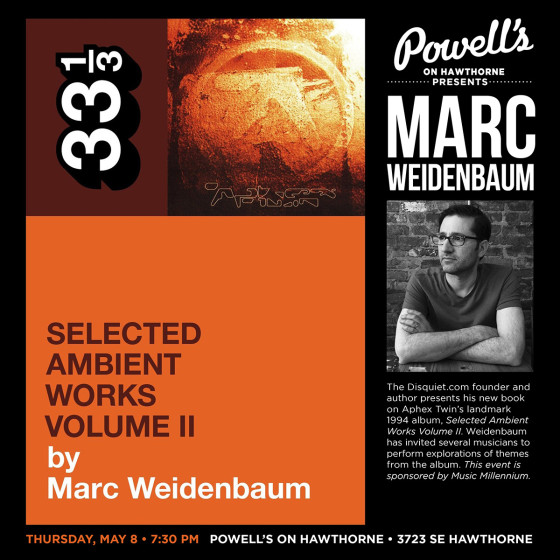
I’m excited to travel to one of my favorite cities later this week. I get in on May 7, Wednesday, in time for a Disquiet Junto concert we’re having at Townshend’s Tea (2223 NE Alberta St), and then on Thursday I’ll be reading from my recent 33 1/3 book on Aphex Twin’s album *Selected Ambient Works Volume II* at Powell’s on Hawthorne (3723 SE Hawthorne Blvd). As at the [City Lights reading](https://disquiet.com/2014/01/14/aphex-twin-33-13-march-20-city-lights/) I did back on [March 20](https://disquiet.com/2014/01/14/aphex-twin-33-13-march-20-city-lights/), local musicians will be joining me at Powell’s on Hawthorne for the Aphex Twin reading.

Here’s the lineup for the Townshend’s Tea concert of Disquiet Junto participants. They will play pieces inspired by past Junto projects, and talk about their compositional and performance process. The event will begin at 8pm on May 7. There’s a [Facebook event](https://www.facebook.com/events/1480463275516718/) page for the Junto show. Carlson, I should note, is the developer of the iOS app Borderlands, one of the most popular apps among Disquiet Junto members.

* Chris Carlson
* Ted Laderas – the OO-Ray
* Bob Phillips – Rawore
* Keith Spears

And here’s the lineup of musicians assisting me at my Aphex Twin reading. The event will begin at 7:30pm on May 8. There’s a [Facebook event](https://www.facebook.com/events/1387773218175233/) page for the Aphex Twin 33 1/3 date.

* Brumes
* Ted Laderas – the OO-Ray
* Marcus Fischer

And I’ll be in town until late in the day on Friday, so if anything interesting is going on, please let me know.

Disquiet Junto Project 0122: 8bit Undead ET

Create music for a fake movie whose plot is "Poltergeist meets Wreck-It Ralph."

20140501-8bET

Each Thursday at the Disquiet Junto group on SoundCloud.com a new compositional challenge is set before the group’s members, who then have just over four days to upload a track in response to the assignment. Membership in the Junto is open: just join and participate.

This project was published in the early evening, California time, on Thursday, May 1, with 11:59pm on the following Monday, May 5, 2014, as the deadline.

These are the instructions that went out to the group’s email list (at [tinyletter.com/disquiet-junto](http://tinyletter.com/disquiet-junto)).

Disquiet Junto Project 0122: 8bit Undead ET

This week’s project is fairly open-ended. The essential thing is that your music has an “8bit flavor” — define that as strictly as you wish.

You will write the opening theme music for a movie that doesn’t really exist. The film is a horror flick. The elevator pitch of the movie’s plot is “Poltergeist meets Wreck-It Ralph.” The opening sequence involves a housing development being constructed on the site of a former city dump. The construction crew discovers the burial site of one million cartridges of the ET Atari video game. The developer decides to pour concrete over the ET cartridges and continue building. But something has been awakened. Hundreds of thousands of 8bit ETs cannot be kept down!

Your music will accompany a film montage (again, this is entirely imaginary) covering the above description, which should last between two and four minutes.

Deadline: Monday, May 5, 2014, at 11:59pm wherever you are.

Length: The length of your recording should be between two and four minutes.

Information: Please when posting your track on SoundCloud, include a description of your process in planning, composing, and recording it. This description is an essential element of the communicative process inherent in the Disquiet Junto.

Title/Tag: When adding your track to the Disquiet Junto group on Soundcloud.com, please include the term “disquiet0122-8bET” in the title of your track, and as a tag for your track.

Download: It is preferable that your track is set as downloadable, and that it allows for attributed remixing (i.e., a Creative Commons license permitting non-commercial sharing with attribution).

Linking: When posting the track, please be sure to include this information:

More on this 122nd Disquiet Junto project — “Create music for a fake movie whose plot is ‘Poltergeist meets Wreck-It Ralph'” — at:

Disquiet Junto Project 0122: 8bit Undead ET

More on the Disquiet Junto at:

The Disquiet Junto Project List (0001 – 0639 …)

Join the Disquiet Junto at:

http://soundcloud.com/groups/disquiet-junto/

Is There Such a Thing as a Sonic QR Code?

One needn't watch the new Spider-Man movie for a possible answer.

20140430-shazampdf

There are at least two things that Sony Pictures marketing executives did not consider when preparing a cross-promotion between its new Spider-Man film and the song-identification app Shazam. I first read about this promotion this morning on [io9.com](http://io9.com/first-looks-at-amazing-spider-mans-sinister-six-plus-g-1569578720), because pretty much the first thing I read every morning is [Morning Spoilers](http://io9.com/tag/morning-spoilers) on io9.com. The film in question, *The Amazing Spider-Man 2*, opens this Friday, May 2, in the United States. Expecting extended discussion about Peter Parker’s doomed romance with Gwen Stacy or the rise of his frenemy Harry Osbourne to lead the high-tech firm founded by his father, instead there was news of an intriguing little digital-audio phenomenon.

The Sony-Shazam promotion involves viewers of the Spider-Man movie waiting until the end credits, during which the Alicia Keys song “It’s On Again” is heard. Viewers can then use the Shazam app to identify the song. Doing so brings up a special opportunity to add, for free, photos that hint at members of the Sinister Six — villain characters from Sony’s rapidly expanding Spider-Man franchise — to their personal photo galleries. (It should be noted that the Keys song is itself a sort of cross-promotion. It’s full credit is: Alicia Keys feat. Kendrick Lamar – “It’s On Again.”)

The first of these things that Sony Pictures may not have considered is that Shazam shares a name with a superhero from a rival comics publisher, DC. Would it have been too difficult to sign up, instead, with Soundhound, or MusixMatch, or the elegantly named Sound Search for Google Play, among other song-identification services? Perhaps none of this matters. Sony is already engaged in a cold war with other studios among whom the Marvel universe of characters is subdivided. A second-tier, if beloved, character from another universe entirely means nothing when there are already two Quicksilvers running around in your own. For reference, below is an uncharacteristically stern Shazam, drawn by Jeff Smith (best known for his work on *Bone*):

20140430-shazam

In any case, the second and more pressing matter is that one needn’t stay until the end credits of the new Spider-Man film to activate the Shazam code with the Alicia Keys song. One needn’t even see the Spider-Man film, let alone wait for it to open in a theater near you. Right now, two full days before the film’s release in the United States, you can [pull up the Alicia Keys video on YouTube](https://www.youtube.com/watch?v=T9B3z-8P_7s), and the Shazam app on your phone will recognize that as the correct song, and your phone will, indeed, then provide you with the prized photos. In fact, at this point you don’t even need to do that, since the photos have already proliferated around the Internet. (See them at [comingsoon.net](http://www.comingsoon.net/news/movienews.php?id=117678) and at the above io9.com link.)

But an interesting question arises, which is: How different would the Alicia Keys song played during the end credits have to be from the original version of the song for only the credits rendition to be recognized by Shazam as the correct one to cough up the Sinister Six photos? More to the point, can a specific version of a song function as the sonic equivalent of a QR code. QR codes are those square descendents of zebra codes, such as the one shown below. The “QR” stands for “quick response.” They can contain information such as a URL, which when activated by a phone’s camera can direct the phone’s browser to a particular web page. This QR code links, only semi-helpfully, to the web page on which this article originally appeared:

20140430-qrsonic

Of course, from a procedural standpoint, Sony could have gotten around this alternate-version approach by having the song only be available in the credits, but that would have cut into sales of the soundtrack album — which would either have to lack the song entirely, or have its release delayed until several weeks after the film’s debut.

The recipes of these different song-identification apps, such as Shazam and its arch enemy Soundhound, are closely guarded secrets. Enough information is provided to allow for developer-level discussion, but ultimately the apps’ success (both in terms of successful-identification statistics and user adoption) depend on the how-to being at least semi-obscured. But there is quite a bit of information out there, including a 2003 academic paper by Shazam co-founder Avery Li-Chun Wang outlining the company’s approach at the time ([PDF](http://www.ee.columbia.edu/~dpwe/papers/Wang03-shazam.pdf)), which I found thanks to [a October 2009 article by Farhad Manjoo on Slate.com](http://www.slate.com/articles/technology/technology/2009/10/that_tune_named.html). The summary at the opening of the paper reads as follows:

>We have developed and commercially deployed a flexible audio search engine. The algorithm is noise and distortion resistant, computationally efficient, and massively scalable, capable of quickly identifying a short segment of music captured through a cellphone microphone in the presence of foreground voices and other dominant noise, and through voice codec compression, out of a database of over a million tracks. The algorithm uses a combinatorially hashed time-frequency constellation analysis of the audio, yielding unusual properties such as transparency, in which multiple tracks mixed together may each be identified. Furthermore, for applications such as radio monitoring, search times on the order of a few milliseconds per query are attained, even on a massive music database.

The gist of it, as summarized in handy charts like the one up top, appears to be that an entire song is not necessary for identification purposes, that only key segments — “higher energy content,” he calls it — are required. At least in part, this allows for songs to be recognizable above the din of everyday life: “The peaks in each time-frequency locality are also chosen according amplitude, with the justification that the highest amplitude peaks are most likely to survive the distortions listed above.” It may also explain why much of my listening, which being ambient in nature can easily be described as “low energy content,” is often not recognized by Shazam or any other such software. As a side note, this gets at how the human ear listens differently than a microphone. The human ear can listen through a complex noise and locate a a particular subset, such as a conversation, or a phone ringing, or a song for that matter.

Now, of course, there’s a difference between the unique attributes of emerging technologies and the desired results of marketing initiatives. Arguably all that Sony wanted to come out of its Shazam cross-promotion was to get word out about Spider-Man, and to buy some affinity for the Sinister Six with a particular breed of fan, and to that end it has certainly succeeded. Perhaps it also hoped to gain a little tech cred in the process, even if that cred is more window dressing than truly innovative at a technological level.

Still, the idea of a song as a true QR code lingers. Perhaps Harry Osbourne and Peter Parker could team up and develop a functional spec.