
I just sent this out to paid subscribers of my This Week in Sound email newsletter. There was also a bonus Steve Reich piece.
I just sent this out to paid subscribers of my This Week in Sound email newsletter. There was also a bonus Steve Reich piece.
Each Thursday in the Disquiet Junto music community, a new compositional challenge is set before the group’s members, who then have five days to record and upload a track in response to the project instructions.
Membership in the Junto is open: just join and participate. (A SoundCloud account is helpful but not required.) There’s no pressure to do every project. The Junto is weekly so that you know it’s there, every Thursday through Monday, when your time and interest align.
Tracks are added to the SoundCloud playlist for the duration of the project. Additional (non-SoundCloud) tracks also generally appear in the lllllll.co discussion thread.
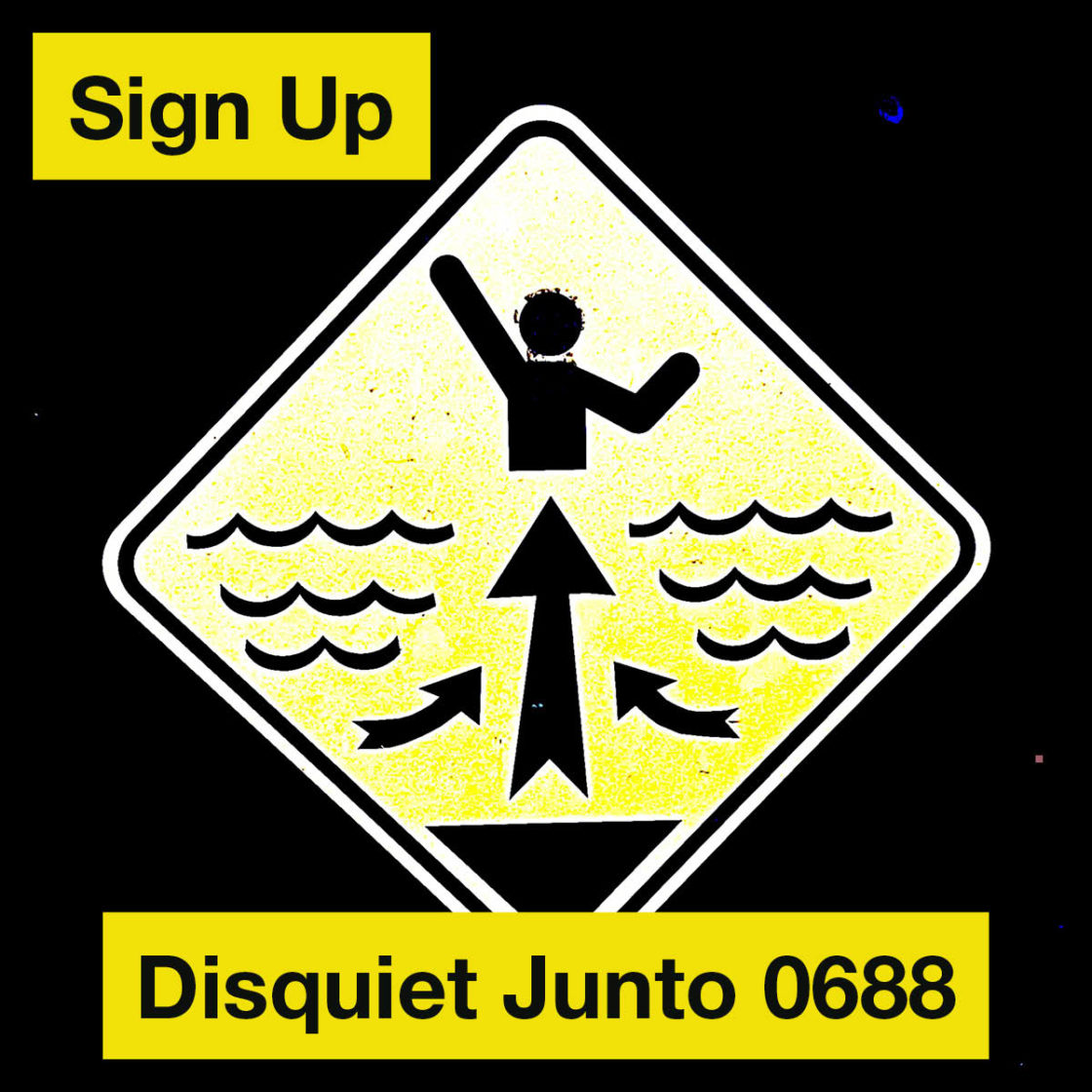
Disquiet Junto Project 0688: Sign Up
The Assignment: Interpret a routine public sign as a musical instruction.
Step 1: Think about signs you see near where you live or work, the sort of routine public signage one generally takes for granted. Consider in particular signs that, unintentionally, are open to broader interpretation than might have been intended.
Step 2: Choose a sign from Step 1.
Step 3: Willfully interpret the sign you selected in Step 2 as a musical instruction of some sort.
Step 4: Record a track in which you follow the musical instruction you inferred in Step 3.
Note: When posting the track, please, if possible, include a photograph or other rendering of the sign you employed.
Tasks Upon Completion:
Label: Include “disquiet0688” (no spaces/quotes) in the name of your track.
Upload: Post your track to a public account (SoundCloud preferred but by no means required). It’s best to focus on one track, but if you post more than one, clarify which is the “main” rendition.
Share: Post your track and a description/explanation at https://llllllll.co/t/disquiet-junto-project-0688-sign-up/
Discuss: Listen to and comment on the other tracks.
Additional Details:
Length: The length is up to you.
Deadline: Monday, March 10, 2024, 11:59pm (that is: just before midnight) wherever you are.
About: https://disquiet.com/junto/
Newsletter: https://juntoletter.disquiet.com/
License: It’s preferred (but not required) to set your track as downloadable and allowing for attributed remixing (i.e., an attribution Creative Commons license).
Please Include When Posting Your Track:
More on the 688th weekly Disquiet Junto project, Sign Up — The Assignment: Interpret a routine public sign as a musical instruction — at https://disquiet.com/0688/
15: Number of minutes an ice cream truck is allowed to be in one place (unless there is a line) in Coral Gables, Florida, if rules currently under discussion are enacted
55: Years of age after which, in a recent study, individuals with hearing loss who didn’t employ hearing aids had a measurable decline in cognitive function
26: Percent of UK residents who have reported receiving deepfake phone calls in the past 12 months
Sources: ice cream (miamiherald.com), cognitive (nature.com), and deepfake (msn.com).
▰ Coach Class:
The train's whistle, which twenty-four hours ago had lulled her to sleep, took on a new, urgent keening: repeated triple blasts radiating across the infinite prairie like smoke signals in the dark. It was, she well knew, a way of summoning medical help to the next whistle-stop. ... Those who lived in such places were accustomed to rolling over and going back to sleep after being wakened by the long blasts of the Empire Builder's whistle, and some could even identify the engineer by his signature. The triple blast, however, would visit their sleep as a nightmare and draw them toward the station in an unsettled frame of mind.That is from Polostan, the recent novel from Neal Stephenson (Snow Crash, Cryptonomicon), and the first in a trilogy, though it reads more like he turned a characteristically monolith-size book, and someone finally convinced him to break it into thirds. And just as a side note, if you read Stephenson’s 2019 novel, Fall; or, Dodge in Hell, then this moment serves as a conscious chronological premonition of the brutal futuristic road trip in that book: “This was the bad side of the high plains: communities so remote that people could get away with anything, and, lacking contact with settled places, could wander far down strange thoughtways from which there was no route back to sanity.”
. . .
▰ On Brand:
I wanted a day when the enemy would be so overwhelmed by the sound of my ancestors dragging their chains that they would be killed by the clamour.That is Canadian poet and novelist Dionne Brand, as excerpted in an appreciation by Andrea Brady in the London Review of Books. The same issue has Anne Carson writing about, in part, a friend “who wanted to compose an entire symphony out of the sound of people sighing,” and Frances Morgan surveying the work of Yoko Ono (“The liberating conceptual shift proposed by the Fluxus movement, which made a flushing toilet or a struck match a performance, is not unrelated to the process that puts an audiotape in a vitrine or transforms a dead musician’s clothes into an auction lot”). It’s quite the issue.
. . .
▰ By the Numbers:
So, then, silence it is, Cage's 4'33" on infinite repeat, which, basically, has been this place's playlist for the last year and a half, a soundtrack ambient in its absence.That is Alan Moore (Watchmen, From Hell, V for Vendetta) on the penultimate page of his recent novel, The Great When, which like the Stephenson one mentioned above is the first in a new series — and also like the Stephenson, is uncharacteristically brief for this author. Thanks to my friend Darko Macan, who read the book before I could get around to it, pointed out this but to me, and says “this epilogue is mostly about the coming attractions.”
I don’t drive much, though these days I drive more than I had for a couple decades. This recent driving has, as I mentioned in a blog post here two years ago (“Message to Self: Lessons, conundrums and opportunities in voice-first EV interfaces”), helped me catch up on the role of audio interfaces in a mode of life that had become unfamiliar to me. As a result of the gap, I leapfrogged right into fairly mature CarPlay, which is Apple’s system that lets your phone become the car’s interface. The experience has been interesting, informative, and sometimes even useful. I’ve managed to come up to speed on various ways that sounds, including voice commands, have gained utility in digitally mediated vehicular activity.
I’ve touched on numerous aspects of this topic in blog posts and my This Week in Sound email newsletter. Throughout, the one thing that really seemed (note the past tense) to be missing, at least for me, was an easy, dependable way to record a voice memo. I won’t go into the details of the benefits of recording voice memos here; if you don’t find voice memos useful, more power to you, and if you do find voice memos useful, then you know what I’m talking about. I will add that with the recent rise of affordable excellent voice-to-text transcriptions (my primary app for this is MacWhisper, though I use the rev.com service on occasion), voice memos are more useful than ever.
As it turned out, CarPlay was (again, note the past tense) really lacking when it came to voice memos. Apple’s iOS operating system even comes with an app literally called Voice Memos (and in a recent update, this app came to include automatic transcription, though I find MacWhisper to be superior), and I use it every day at my desk and when I got for walks. However, unlike Messages and Maps and Podcasts and other such apps — even many non-Apple apps, like YouTube Music and Libby and Hoopla — Apple’s Voice Memos app has zero presence in CarPlay. I’ve mentioned this functional void routinely on social media, and I’ve summed up my frustration and confusion in the article linked to above.
And I’m not alone. A search for variations on “CarPlay voice memo” (and for its Google equivalent, Android Auto) yields numerous online discussions about makeshift fixes, such as leaving yourself a voice mail or texting yourself a voice recording. None of these options, I’ve found, has been particularly useful. The best I’ve been able to do is to use Apple’s Shortcuts feature to create a button on my phone’s home screen and lock screen to record right into the Voice Memos app — which works well, except it means I still have to use my phone, physically, which is not great when you’re driving a car.
And then, out of the blue, a person named David Kellas added a comment to my two-year-old blog post, saying he had gone ahead and made the app himself. “I wanted an app like this for ages,” he wrote in his post, “so built it for everyone to use without any subscription.” And it’s true: the app, which is named Auto Memo Recorder, costs just $1.99, a one-time fee. And it does what it says.
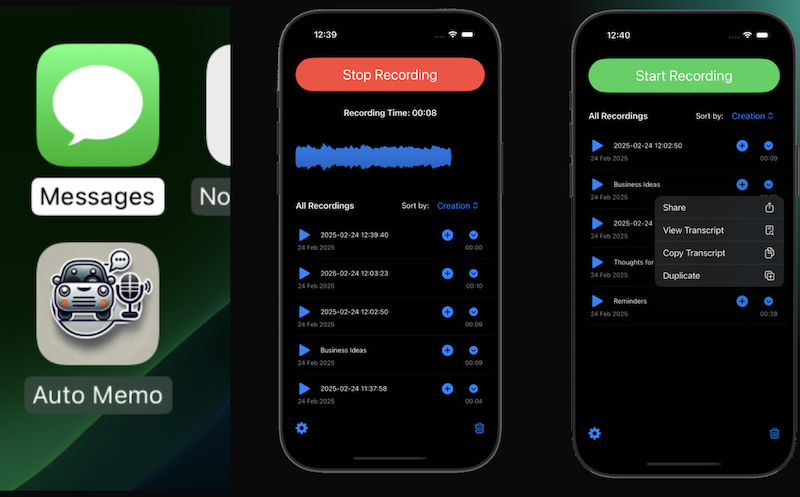
I installed Auto Memo Recorder on my iPhone (an iPhone 13 Pro) and I have been trying it out. It works well. It’s nothing fancy, just pure function. I generally am more of a touchscreen user than a voice-activation user, so my habit so far is to have the app on the home screen, which makes for a two-click or three-click process. I click on the app, and then I click to start recording. The third click is if CarPlay already has an app open (like Maps or Plex or YouTube Music), which actually is most of the time.
Right now, pretty much the only thing that, for my purposes, would improve upon what Auto Memo Recorder offers is for it to sync recordings via iCloud or Dropbox. I’ll keep using it, and I’ll report back on any other observations I have.
Auto Memo Recorder is available through the App Store. More details at invisiblestorm.co.uk/auto-memo. The website mentions “AI enhanced applications,” but the only apparent AI in Auto Memo Recorder is that it will transcribe the voice recording to text. The above image is a screenshot from the app’s website.