Today I wrote a post to the This Week in Sound email list just for paid subscribers. It’s an experiment, and supplements the usual (and still free) Tuesday and Friday issues.
Just yesterday I asked what people would potentially pay for, or more to the point what people who do pay might appreciate, and so far in the poll recommended ambient music came up on top, seconded by an additional email issue. Today’s email accomplished both those ideas. We’ll see how it goes.
The items in this first issue of the TWiS Listening Post were (1) a remix, (2) a demo, and (3) a clip. The remix was a sneak listen to Karen Vogt’s upcoming album (the cover image of this issue is a still from the video for one of the tracks). The demo was a short video of a piece of looping/sampler software. The clip was a video by Orbital Patterns on Instagram.
I don’t love paywalls, but I figure one out of three posts requiring a paid subscription may not be a bad idea. Or it may be a bad idea. Experimenting means experimenting, and as Brian Eno says, something really only is an experiment if there’s a potential it will fail.
Plus: sound gadgets for infants, onomatopoeia ingenuity, and more
/ By Marc Weidenbaum
These sound-studies highlights of the week originally appeared in the May 9, 2023, issue of the Disquiet.com weekly email newsletter, This Week in Sound.
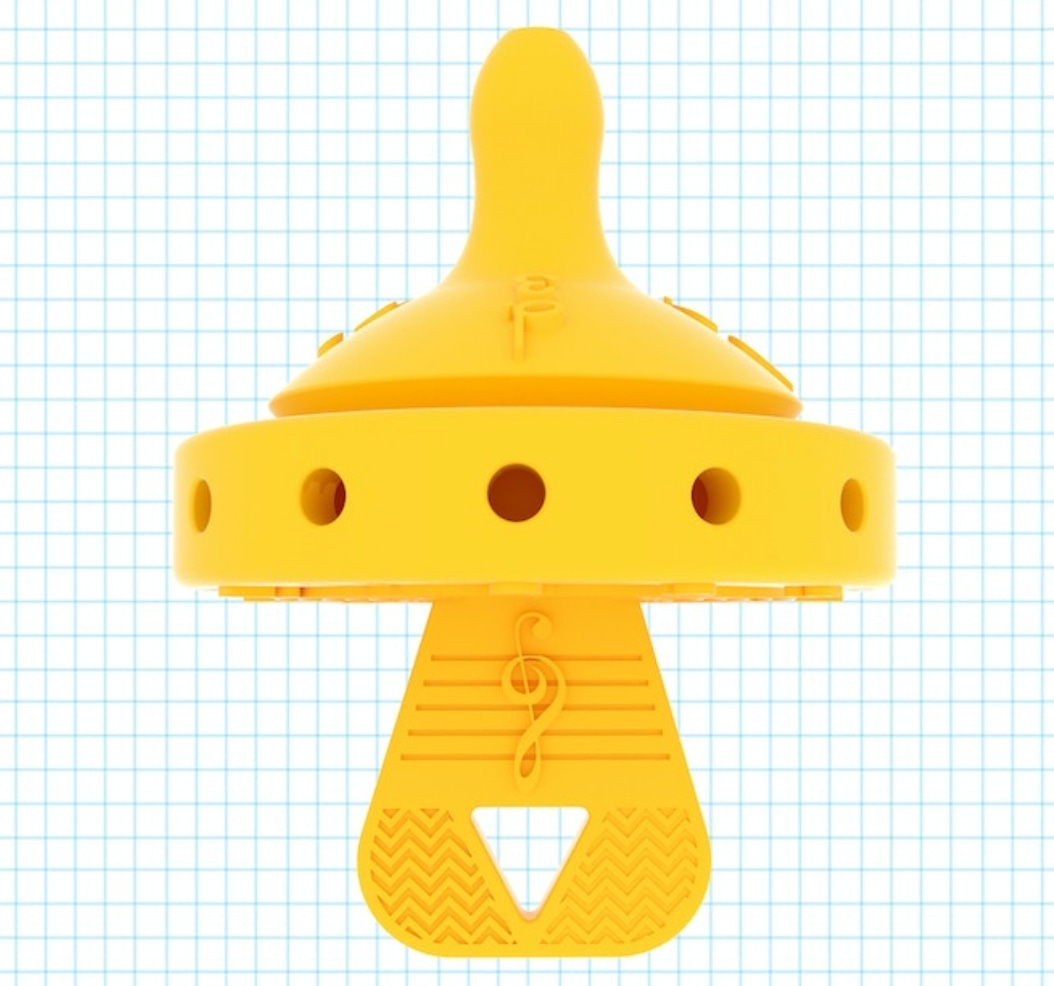
JUST KIDDING: There is a Kickstarter (I have no association with it) for a “smart pacifier.” The little device, which seems to combine a harmonica and a binky, is designed to “activate the creative mind at an early age, making passive listeners into musicians before they can say their first words.” … And separately, news about a nursery device that turns “patented auditory sequences into soothing melodic and other background tracks to help the infant brain do its job of paying attention to environmental sound changes.” It’s the Smarter Sleep Sound Soother from RAPT Ventures.
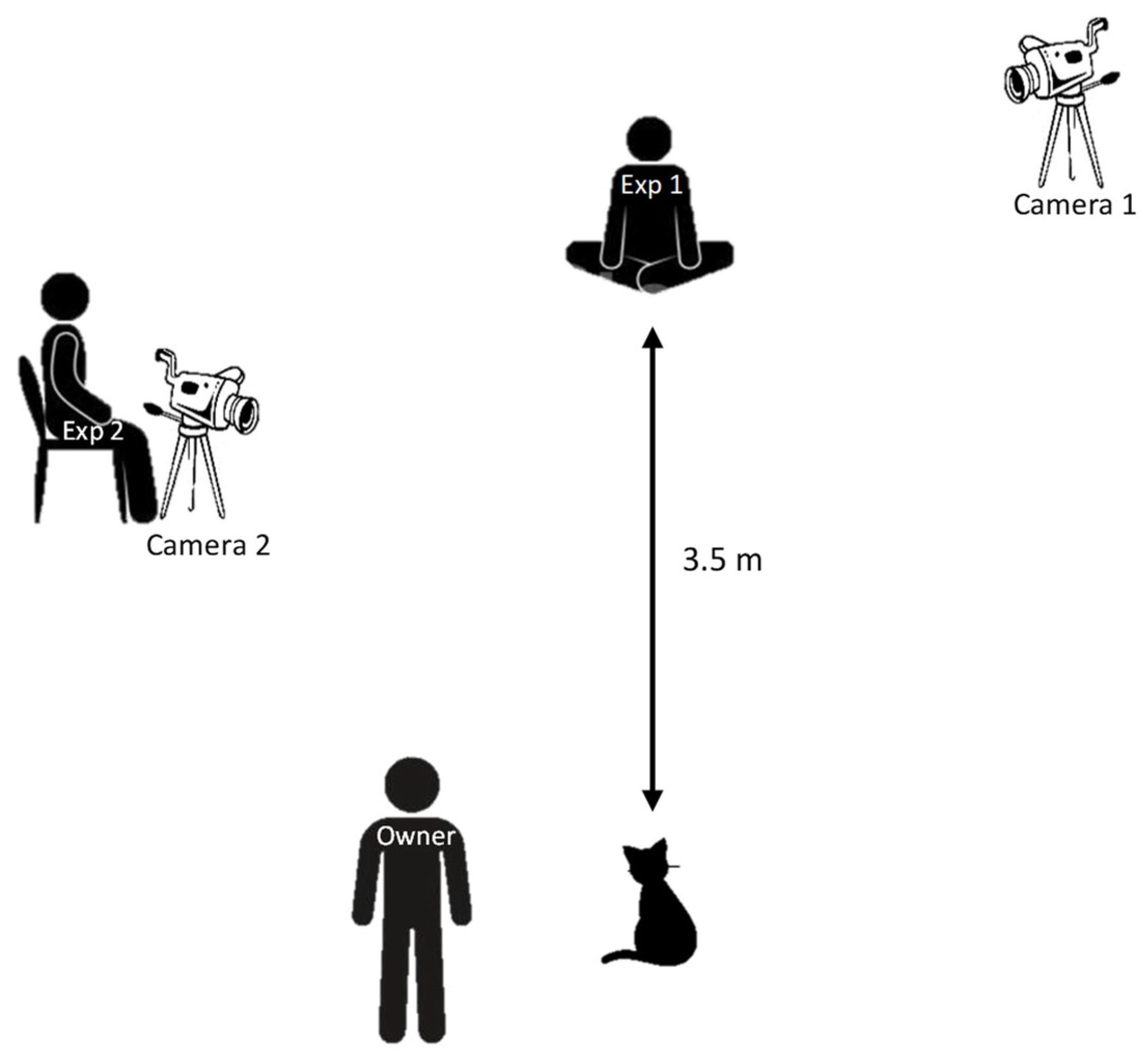
WHISKER WHISPERERS: “Scientists in France might have just found the most effective way to catcall an unfamiliar cat. The team discovered that cats living at a cat cafe responded most quickly to a human stranger when the stranger used both vocal and visual cues to get their attention. The cats also appeared to be more stressed out when the human ignored them completely,” writes Ed Cara at Gizmodo. Here’s a helpful diagram of how the experiment, by Charlotte de Mouzon and Gérard Leboucher at Paris Nanterre University’s Laboratory of Compared Ethology and Cognition, was undertaken:
THE THIX OF IT: “Irish inventors Rhona Togher and Eimear O’Carroll created an advanced acoustic material that reduces noise and can be used with household appliances, as well as in the automotive, construction, and aerospace industries.” The material is called SoundBounce, and it “has a cellular structure that works in tandem with a thixotropic gel placed inside the cells that allow sound to be dampened, reducing noise transmission from one space to another.” FYI, “thixotropic” means “Becoming a fluid when agitated but solid or semi-solid when allowed to stand.” Togher and O’Carroll are currently in the running for a European Inventor Award 2023.
CROSSTOWN TRAFFIC: The ecommerce/delivery reality is making life louder: “With millions of Americans now living in close proximity to a warehouse, it’s time to start treating these drab, feature-less buildings like pollution hotspots, says a recent report by the Environmental Defense Fund. Warehouses are quickly popping up all over the US, bringing truck traffic and tailpipe emissions with them. And yet there is no federal database to see where current or proposed warehouses are located, unlike other major sources of pollution like oil and gas facilities. … [T]here’s significantly more traffic, air pollution, and noise in census tracts with warehouses compared to those without them, another study based in California found last year.”
QUICK NOTES: Rim Shot: Netflix has a news desk (I don’t know how new it is) and it’s called “Tudum” — i.e., onomatopoeia for the network’s sonic brand logo — and that is sorta genius (netflix.com/tudum). ▰ Bank Teller: Voice biometrics was the focus of a letter sent by Senator Sherrod Brown, chairman of the Senate Banking, Housing and Urban Affairs Committee, reportedly to JP Morgan Chase, Bank of America, Wells Fargo, Morgan Stanley, Charles Schwab and TD Bank. ▰ Moon Man: Austin Kleon did a new blackout poem inspired by comments I madein recent issue of This Week in Sound. ▰ Bull Market: The Shriek of the Weekwas the bullfinch, “adept mimics” that “can be taught to whistle a human tune like a parrot.” ▰ Mo’ Mojang: There’s new ambient music in Minecraft (update 1.20) and Rohan Jaiswal knows where to find it. ▰ Street Scene: Check out this microtonal composition based on data related to Krasnodar Public Transport in Russia. (Thanks, Glenn Sogge!) ▰ Blue Jay Way: Soundfly, which offers courses for musicians and connects them to mentors, has a story about bird song — I love the idea of musicians having an avian tutor.
There’s a cool recent video game called Season in which you wander the rural landscape on a bicycle, taking pictures and, quite wonderfully, making audio field recordings — all in the shadow of a looming catastrophe. I have a full page review of it in the new issue of The Wire (June 2023: the one with a bright red cover that’s dedicated to The Fall).
I’ll post the full text in a month when the next issue comes out. Meanwhile, here’s the opening paragraph:
Have you ever paused in the middle of a video game simply to contemplate your virtual surroundings? Not paused as in hit the pause button — not turned off the game, just eased your urge to level up: to shoot or run or jump, or whatever adrenaline-raising action the game was engineered to impel you to accomplish. Now, what if a game was explicitly designed for you to take such a pause? What if paying attention to the world around you — to the world within the game, the world of the game — was the goal of the game? What if observing — looking, listening, recording — was itself the principal game mechanic?
From Tallinn, Estonia (previously Boston): studying with Morton Feldman and adding beats
/ By Marc Weidenbaum
This Junto Profile is part of an ongoing series of short Q&As that provide some background on various individuals who participate regularly in the online Disquiet Junto music community.
What’s your name? My name is Paul Beaudoin, though lately I have been toying with being DJ Shostakovich — somehow, that name amuses (and inspires) me.
Where are you located? I live in a former Soviet Union military zone in Tallinn, Estonia — though I was born in the US and spent most of my professional life in Boston. Today, I am a full-time interdisciplinary artist working fluidly with sound, paint, video, and text. But it hasn’t always been that way: long story, mostly happy ending.
I have a Ph.D. in music theory and composition from Brandeis University in the US and have pursued the academic ladder of success for many years. I didn’t realize that the ladder was disintegrating until recently. It left me frustrated, lonely, and angry. Two years ago, I read Steven Pressfield’s The War of Art. One of the final chapters changed my life.
So, while I have been a hard-core academic composer (read somewhere between Milton Babbitt’s twelve-tone serialism and Morton Feldman’s softly repeating sonorities — both, by the way, had been my teachers), today I find myself using these strategies but within the ambient soundscape. I still think about sets and orchestration, but far removed from academia. I still compose music for the concert hall, which is radically different. That work is now published by editions wandelweiser in Haan, Germany — something I am proud of.
What is one good musical habit? Do not try to please your teachers or public or impress your friends or neighbors. Don’t make art to show you are a genius, a misunderstood giant, or to get laid. Make art you love, want to live with, and be at peace with. And, if you are lucky, others will respond.
And for that, yeah, be a good person.
— it’s one of the quotes I post annually on my social media.
What are your online locations? I am on the usual social media culprits for artists: Soundcloud, Instagram, and Facebook — just search by my name.
What was a particularly meaningful Junto project? The Junto Project prompts challenge me to step out of my comfort zone. For nearly my entire life, I have been a “beatless” person — with Junto projects, I find a way to include rhythm tracks and use traditional harmony and forms. I often thought I should use a pseudonym for these projects, but then I thought: Hey, this is me! Many years ago, a student told me, “All you have to do is put a beat to it, and people will listen.” So I did. For a Junto project called “the best advice I ever got,” I started with a dance hall beat and harmony and then layered all kinds of animal sounds, chanting, and noise. Before the track was released, it had more than 350 listens, which is “huge” for me.
I recently compiled a few Junto projects into a recording called “Disquiet Music,” released by Camembert Electrique. You can download it for free here: camembertelectrique.bandcamp.com.
Could you tell a story or two about studying with Morton Feldman? What a paradox Feldman was. His music lives at the border of silence (or so the canon likes us to think), but Feldman was a very imposing man. Brash and large, he spoke with the voice of an authority that was not to be questioned. In a composition seminar, there was a heated discussion about musical motion — that music somehow “moves.” Feldman insisted that music did not move, and to prove his point, he picked up a chair and threw it across the room. “There,” he practically yelled, “that’s motion.”
Does being in Tallinn sound different from being in Boston, and if so, has the location change had an impact in some way on your music? There is no doubt that my move to Tallinn influenced the radical shift my music took. There is a kind of continuous low rumble in Boston — whether it comes from the “T” or the roar of the crowd at Fenway Park (which I always heard from my apartment window). And since Boston has so many colleges, there is a constant influx of young people who come to benefit from their new independence. Parties, college-style shenanigans, arguments, you can hear it all. Here in Tallinn, the sound world is entirely different.
Estonians are, by their very nature, quiet. They do not engage in small talk and very much keep to themselves. I can go for days without having someone talk to me. There is also a deep respect for the natural environment here — so many lakes, forests, and meadows have been untouched for millennia. This quiet landscape was the perfect prescription for me to regroup. It gave me the resonance I needed to look inward; it forced me to slow down — like, really slow down. My music softened, it also got quieter, and it began to incorporate field recordings. A composer’s world is a kind of autobiography, and there can be no doubt that their environment finds its way into the work. I remember being in Boston and being asked what my music might sound like in 30 years. I joked that it would be so quiet one might doubt its existence. Now I don’t think it is a joke but a real possibility.