Mapping Kjartansson’s The Visitors

Looking for clues in the famed art installation

The Visitors, Ragnar Kjartansson’s nine-screen audio-video masterpiece, has been on display at SFMOMA in its own dedicated room for just over two years, and I’ve lost track of how many times I’ve seen it. I stopped by the museum on November 26, a Tuesday, for another hour-long viewing.

If you haven’t seen, or heard of, The Visitors, it’s a popular art installation that has toured the world. In it, a group of musicians play the same single, simple, hypnotic song comprised of just a few repeating verses for approximately an hour straight. Each musician is in a different part of an 1815 mansion in New York’s Hudson Valley, and each gets their own screen, though occasionally a member of the ensemble will cross from one to the next. If you observe what is happening closely enough, you can sort out which spaces are near each other within the mansion.

Each time I go, I tend to sit near one or two screens, and I pay attention to them specifically, and also listen to how the audio from the other screens correlates with what is happening in their part of the house. On the ninth screen, a small audience sits outdoors on the house’s porch, and just to keep things interesting — as if they are not enough already — there’s an elderly man who not once but twice sets off a portable cannon.

There are some electric instruments in the mix — guitars, a bass — but the majority are acoustic: banjo, cello, accordion, and so forth, including a lot of singing. And, even though every musician is wired for video and audio (and to each other through headsets), the vibe remains very acoustic, with a deep resonance that is as harmonically and tonally rich as it is melodically straightforward. A testament to the musicianship — members of the bands Múm and Sigur Rós are in the group — is how little they all do, no one hogging the spotlight, no one showing off.

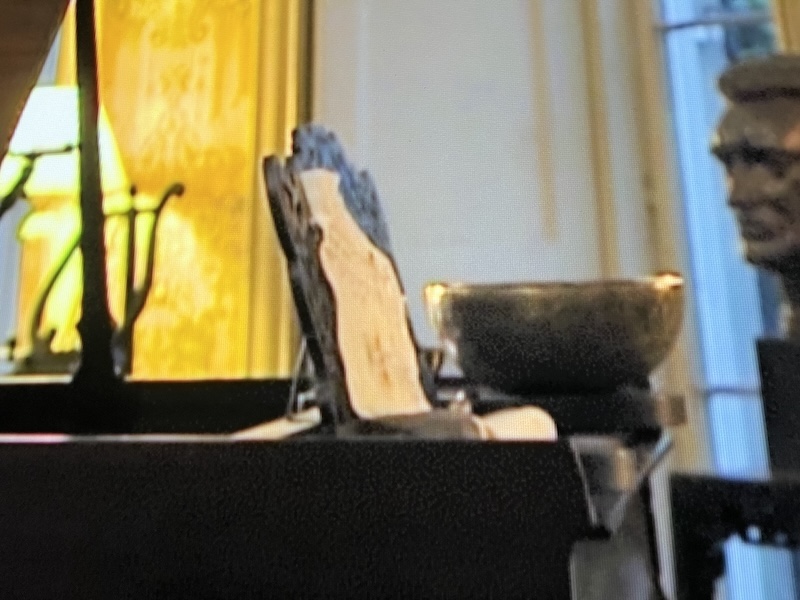
This time around, I focused on the drummer, Þorvaldur Gröndal, and I noticed something I hadn’t before, something that at first looked like sheet music or a page from a notebook. It was resting on a chair near Gröndal’s drum set. This is a close-up:
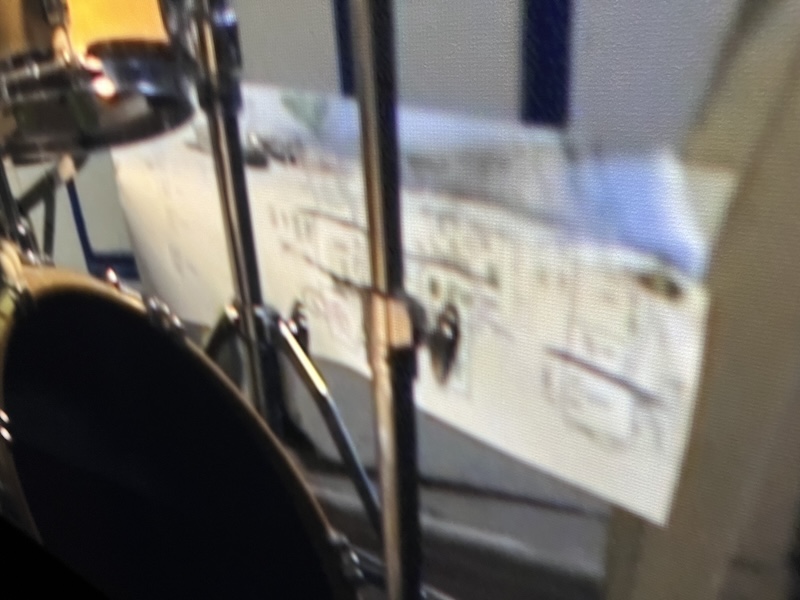
I went back toward the end of the video, when all the musicians wander down the hillside together, and pretty much everyone in attendance at the museum had gathered around that one screen. I walked back around to the other screens, where no one was lingering, and looked more closely. This will sound funny, but I felt more comfortable looking then because the musicians had all vacated their rooms. With their individual performance spaces uninhabited, I didn’t feel like I was encroaching on their privacy.

The drummer’s document no longer looked like sheet music; it had started to look to me like a map of the floor plan of the mansion. I then recalled this image from the fantastic aural history of The Visitors by Sebastian Smee, Gabriel Florit and Joanne Lee that the Washington Published back in 2021:
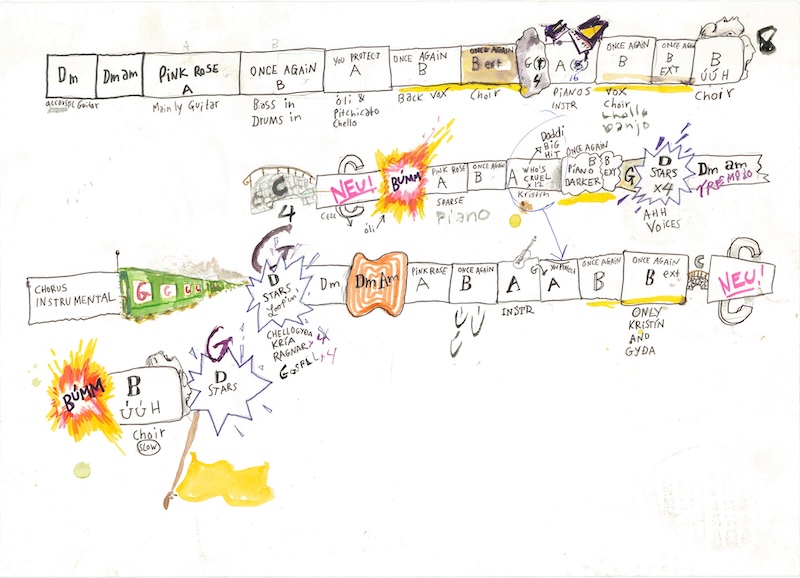
A lot is revealed in this document, which is essentially a score in the form of graphic notation. For example, there are the two “búmm” (or “bomb”) markers when the cannons go off, and there are the spots labeled “Neu!” in a way that nods to the covers of albums by the great German band of that name.

I confirmed after I left the exhibit that the drummer’s sheet and this image were the same. Gröndal’s version does seem to have been marked up, with thick vertical lines identifying several junctures. It also appears that at least two other musicians had these same charts in plain view. Here are details from each of the two pianists’ screens:
Every time I visit The Visitors I hear and see something new. It’s running at SFMOMA until September 28, 2025, and I’m sure to spend at least two or three more hours in the dark with it between now and then.

Note: When I wrote this post and published it, on November 26, 2024, the closing date for the exhibit of The Visitors at SFMOMA was January 26, 2025, and that is the date I included. However, I received a flyer in the mail the very next day, and it showed a later date: September 28, 2025. There was much rejoicing in my household. (In fact, even as I type this, the SFMOMA website still lists the January 26 closing date.) The exhibit opened on November 5, 2022. I believe I first saw the work when it was included, previously, in the Soundtracks exhibit at SFMOMA in 2017, though I may have seen it earlier. The Visitors dates from 2012, and SFMOMA made a joint purchase of it with MoMA (the one in Manhattan) in 2014, “through the generosity of Mimi Haas and Helen and Charles Schwab.”
Arriving at Hogwarts

The sounds of a PS5 game, early levels

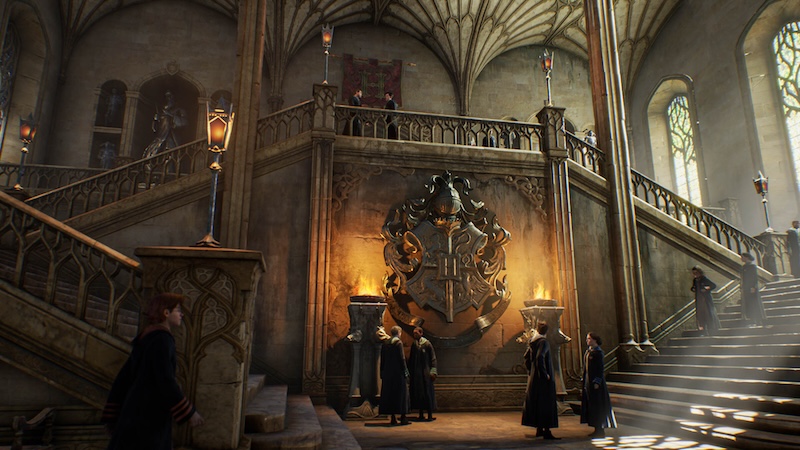
I’ve got this week off, mostly from work, entirely from social media, though only slightly from writing, and late in the afternoon I got in some time on the PS5 with a video game, Hogwarts Legacy (2023). The decision as to what to play was based in large part on its industry recognition: Game Developers Choice Awards Best Audio (honorable mention), British Academy Games Awards Music and Audio Achievement (longlisted), and Grammy for Best Video Game Soundtrack (nominee). As is my habit, I dialed down the score to a little under a quarter of the relative volume, and the dialog to about 90%, and I let the “world sounds” of the game take the primary spot.

Two key things stood out, as of our arrival at Hogwarts — which is to say, right up until the title card — following extended cut scenes and some necessary wand — that is, controller — training:

First is how drastic shifts in the tonal quality of the imaginary spaces signal the transitions, and how stark those transitions are, given the magical transport that is involved in getting from most places to the next. For example, at one point we’re in a massive interior space, with an echoing room tone, and then suddenly we just barely escape a pillar leaning toward us, felled by something a bit like the Destroyer from the first Thor movie. Then we move instantly through a portal into the outside world, a forest after dark. Not only are the nocturnal sounds of the bugs prevalent, but they highlight the otherwise seemingly blank audio slate, the relative silence of the forest. Throughout, the significant tonal shifts are markers of stages.

Second is the small speaker built into the PS5 controller. This is a subject I want to explore more thoroughly. I’m used to vibrations from controllers. For example, in the game, we don’t just hear the footsteps of our character; we also feel them. But the controller sounds are something else entirely. During a fight sequence, we hear aspects of the spell-casting as if the wand is right in our hands. There is something beyond the mere distinction between diegetic and non-diegetic sound here, between the real-time sounds of a given scene and those, such as score or voiceover, outside the world of the story. The sound from the controller has a power different from the one coming from the living room television. This controller speaker sound is hyperdiegetic.

Scratch Pad: Gregorian, Beat, Jig

From the past week

I  do this manually at the end of each week: collating lightly edited recent comments I’ve made on social media, which I think of as my public scratch pad. I find knowing I’ll revisit my posts to be a positive and mellowing influence on my social media activity. I mostly hang out on Mastodon (at post.lurk.org/@disquiet), and I’m also trying out a few others. And I generally take weekends off social media.

And this is the final Scratch Pad entry of the year, since as of of yesterday afternoon, I’m off social media until the first week of January 2025.

▰ I often take time off social media between (our American) Thanksgiving and the end of the (Gregorian calendar) year. Not sure I did last year, but I think I will this year. Maybe hit pause the end of this week. I can feel the year winding down.

▰ When there’s a new Scottish TV show you want to see, and you turn it on — and the subtitles aren’t available yet, so you cannae watch it

▰ The clothes dryer plays a little jig at the end, like an old-school performance of a Shakespeare play at the Globe

▰ Each Thursday in the Disquiet Junto music community, a new compositional challenge is set before the group’s members, who then have five days to record and upload a track in response to the project instructions.

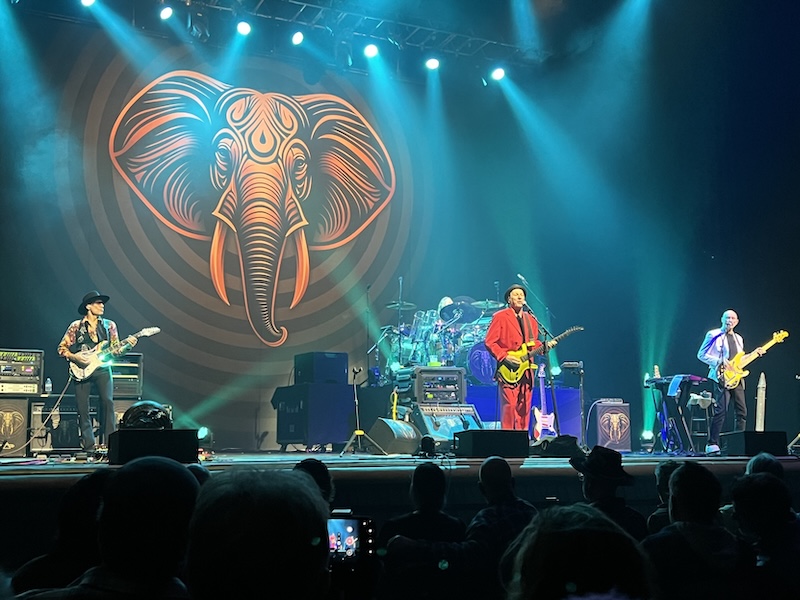
▰ Caught the King Crimson quasi-reunion tour last night, aka the Beat tour, with Adrian Belew and Tony Levin from the classic ‘80s trio of albums, and Steve Vai in Robert Fripp’s seat (except he stood) and Danny Carey in Bill Brufford’s. It was a lot of fun, especially the second set.

▰ I get literally 100s of music releases each week. I download what strikes my interest, or I listen online, or both. The things that stick with me, I write about. It’s just about that simple. And I can’t reply to all the inbound requests for coverage. That time simply doesn’t exist.

For some reviewers, it may feel important to be on top of releases other people are talking about. I think they might be convincible that something is topical, and for that reason worthy of review consideration. That thinking plays about 1% of a role in my decision-making, but that’s just me.

It’s a bit of a mystery to me, how my ears work. I just pay attention to what they tell me.

▰ New microwave. New drones. New beeps.

▰ If you’re on the Disquiet Junto project email announcement list and didn’t receive the one that went out on Thursday, November 21, could you let me know? Thanks.

▰ Me: I’m taking my annual social media break starting November 22 and through the end of the year.

Friend: Do you find that difficult?

Me: What I find difficult is locating all the different ways required to turn off notifications I hadn’t even realized were on.

▰ I think about how hitting the record button when making a field recording focuses my hearing. As I near the juncture when I take a long holiday break from social media, I get a similar sensation — of the world both closing in and opening up. I don’t foresee giving up social media, but these long breaks do remind me of a different way of being present.

The Salamander Lives in the Fire

Digital social life on pause

“The salamander lives in the fire because it has forgotten how to live any other way.”

I was reading Nick Harkaway’s new novel, Karla’s Choice (which involves George Smiley, the legendary character created by Harkaway’s father, John le Carré), over breakfast earlier this week, and I was thinking about the breaks I take from social media (evenings, weekends, end of the year), and then I arrived perchance at the above sentence. To say it registered with me would be an understatement.

To wit: Right on schedule, as we gear up for Thanksgiving, I’m off social media (Mastodon, Bluesky, Threads, Instagram, Facebook) and for the most part Slacks and Discords and Discourses and so forth through at least January 2, 2025, and likely January 7, the first Tuesday of the new year. I’ve also paused several email discussion groups I’m in (groups.io, for one, makes this quite easy).

I’m fully aware I’ll inevitably end up peeking, because something I’m doing — writing, music-making, coding, gaming, reading — will lead to me identifying that the best available resource is, in fact, a thread in some useful corner of the Miasma (if you made it through Neal Stephenson’s Fall; or Dodge in Hell, you get the reference). I won’t, however, be actively engaging. It’s time to take some time off: digital social life on pause.

I’ll still be typing away here at Disquiet.com (my website turns 28 years old on December 13, 2024) and in my newsletter, and the Disquiet Junto music community (which turns 13 years old on January 2, 2025, the first Thursday of the new year) will continue weekly.

I’l have my social media notifications turned decidedly off throughout. I dream of taking an email break, as well, but I don’t see that happening anytime soon.