Classical Rashomon (MP3s)

Listening to wild Up's Shostakovich source material for the 13th Disquiet Junto


When considering the 13th Disquiet Junto project, it’s helpful to remember that the subject material is itself a remix. The Disquiet Junto is a Soundcloud.com-based group in which musicians respond each week to a proposed compositional project. The 13th such project involves reworking a recording of the first movement of the Chamber Symphony, Op. 110a, by Dimitri Shostakovich. The source audio was recorded live by the ensemble wild Up. The project was announced on Thursday, March 29, and is due by 11:59pm on Monday, April 2.

I usually wait until the end of a Junto project to comment on it, but this one is special, so I want to get some thinking out while it is still in progress. It is is worth thinking of the Chamber Symphony as a remix unto itself, because the symphony is an arrangement by another man, Rudolph Barshai. With Shostakovich’s blessing, Barshai took the contours of Shostakovich’s String Quartet No. 8 and expanded them into something orchestral. Likeiwse, with the full permission of the Los Angeles chamber ensemble wild Up, the Junto participants are extrapolating from the wild Up recording of the Barshai’s symphonic version of Shostakovich’s quartet. If that sounds meta, then I am accomplishing at least part of my goal.

This 13th Junto project is a particularly special one, because it’s only the second time we are working from not only a commercial release, but from constituent parts of a track on that release. (The previous time was when Marcus Fischer, for the fourth Junto, provided stems — that is the music-production terms for individual subparts — of a song off his Collected Dust recording.) This is an essential distinction. Much “remixing” these days means working with the commercially released version of a piece of music, a single track: cutting it up, moving pieces around, transforming it, adding to it, subtracting from it. But in the case of both the Fischer project and, now, the Shostakovich project, the Junto participants were provided the pieces from which the commercial track was constructed. The wild Up recording of Shostakovich was done live, so the “parts” are in fact 10 simultaneous recordings of the symphony, recorded on variously placed microphones. The folder containing these parts looks like this:

For the time being, those recordings are freely available for download, and even if you are not participating in the project as a musician, I highly recommend giving them a listen. They’re available at each of the following URLs:

http://dl.dropbox.com/u/2293299/WildupForRemix.zip
http://junto.havesomemusic.com/WildupForRemix.zip
http://lownote.net/audio/WildupForRemix.zip
http://vuzhmusic.com/junto/WildupForRemix.zip

To hear the performance 10 times from different vantages is to get a Rashomon version of the piece. In part, it is simply an opportunity to hear it akin to how the performers hear it: if you listen to the woodwinds, then you’re hearing it sort of how a member of the woodwind portion of the ensemble heard it while it was being performed. But more importantly, to listen to it is to hear different parts of it come to the fore. Because it was recorded live, there is no clear “isolation” between parts. In each of the tracks you hear the entire work, just with different sections given different relative prominence.

Listen to the original recording, also streaming below, at: wildup.bandcamp.com

And for comparison’s sake, here is a performance of the String Quartet No. 8 by the Kopelman Quartet, via youtube.com:

The remixes are unfolding at this very moment at soundcloud.com/groups/disquiet-junto.

More on wild Up at wildup.la and wildup.tumblr.com.

(Stencil of Dimitri Shostakovich up top generously provided by Chris Hutson, of chrishutsonart.com. He is based in Peoria, Illinois.)
Disquiet Junto Project 0013: Classical Textures

The Assignment: Remix a Shostakovich recording by the ensemble wild Up.

*Each Thursday evening at [the Disquiet Junto group on Soundcloud.com](http://soundcloud.com/groups/disquiet-junto/) a new compositional challenge is set before the group’s members, who then have just over four days to upload a track in response to the assignment. Membership to the Junto is open: [just join and participate](http://soundcloud.com/groups/disquiet-junto/).*

This assignment was made in the afternoon, California time, on Thursday, March 29, with 11:59pm on the following Monday, April 2, as the deadline.

More on the project here: [“Classical Rashomon.](https://disquiet.com/2012/03/30/wild-up-shostakovich-junto-remix-barshai/)

These are the instructions that went out to the group’s email list:

>Disquiet Junto Project 0013: Classical Textures
>
>Instructions:
>
>Deadline: Monday, April 2, at 11:59pm wherever you are.
>
>Plan: For the 13th Disquiet Junto project, we’ve been given something special. This is a shared-sample project. There is a tremendous classical chamber-music ensemble in Los Angeles. Its name is wild Up, and it has provided to us the first movement of its recording of the Chamber Symphony, Op. 110a, by Dimitri Shostakovich. Better yet, wild Up has provided to us the individual stems from a live multi-track recording of the symphony. There are 10 tracks in all, ranging from the bass to the woodwinds, and everything in between. There is no isolation between tracks. What there is is an emphasis on different aspects of the ensemble — and, thus, of the original composition. You are invited to make something new from this source material. Please use only the source material — as few or as many of those 10 source tracks as you desire.
>
>Samples: The source audio is downloadable from these URLs:
>
>http://dl.dropbox.com/u/2293299/WildupForRemix.zip
>http://junto.havesomemusic.com/WildupForRemix.zip
>http://lownote.net/audio/WildupForRemix.zip
>http://vuzhmusic.com/junto/WildupForRemix.zip
>
>Length: Please keep your piece to between two and seven minutes in length.
>
>Title/Tag: When adding your track to the Disquiet Junto group on Soundcloud.com, please include the term “disquiet0013-wildup”in the title of your track, and as a tag for your track.
>
>Download: As always, you don’t have to set your track for download, but it would be preferable.
>
>Linking: When you post your track, please include this information:
>
>More on wild Up at:
>
>http://wildup.la
>http://wildup.tumblr.com/
>
>Listen to the original recording at:
>
>http://wildup.bandcamp.com
>
>More details on the Disquiet Junto at:
>
>http://soundcloud.com/groups/disquiet-junto/

*(Stencil of Dimitri Shostakovich up top generously provided by Chris Hutson, of [chrishutsonart.com](http://chrishutsonart.com). He is based in Peoria, Illinois.)*

Disquiet Junto Project 0011: “Daily Rhythm”

The Assignment: Record an everyday mechanical rhythm, and make something of it.

Each Thursday evening at the Disquiet Junto group on Soundcloud.com a new compositional challenge is set before the group’s members, who then have just over four days to upload a track in response to the assignment. Membership to the Junto is open: just join and participate.

The 11th weekly assignment had been on my mind since early in the development of this series: to take an existing everyday sound and to make something of it. We’d explored that idea previously from various different approaches. The very first project involved an especially mundane source audio: ice cubes in a glass. The fifth, a personal favorite, required participants to add sounds to an unedited recorded document of real life. Many other projects employed source audio from the real world. This time, though, the source audio was intended to serve a very specific role: a rhythmic undergirding to the track. In one way, this was an unusual proposal, because by requiring a rhythm, it was perhaps the first project that suggested aesthetic context. Previous projects had left it up entirely to the participant whether or not there would be an inherent rhythm to their track. As I said at the time of its unfolding, if any Disquiet Junto project could be collected into a standalone album, I’d say this is the one.

The assignment was made late in the day on Thursday, March 15, with 11:59pm on the following Monday, March 19, as the deadline. View a search return for all the entries: disquiet0011-motoring. As of this writing, there are 42 tracks associated with the tag.

Here are the instructions that were presented to members of the Disquiet Junto:

Disquiet Junto Project 0011: Daily Rhythm

Instructions:

Deadline: Monday, March 19, at 11:59pm wherever you are.

Plan: The eleventh Junto project requires you to make an original field recording, and to then make something of it. This project focuses on rhythm. The field recording should be of some rhythmic mechanical sound from everyday life: a dishwasher, a car’s turn signal, a hard drive, a bicycle, whatever you choose. That recording should serve as the main rhythmic element of your track. You can edit the recording, certainly, but it should remain recognizable; you should only edit it to whittle it down to a core rhythmic section. To it you can add whatever sounds you like, but the rhythm should be central and prominent in the finished track.

Length: Please keep your piece to between two and five minutes in length.

Title/Tag: When adding your track to the Disquiet Junto group on Soundcloud.com, please include the term “disquiet0011-motoring”in the title of your track, and as a tag for your track.

Download: As always, you don’t have to set your track for download, but it would be preferable.

Linking: When you post your track, please include this information:

More details on the Disquiet Junto at:

http://soundcloud.com/groups/disquiet-junto/

The projects ranged widely in their source audio, including a door, car fan control, clothes dryer, potato slicer, multiple hard drives, and microwave beep, among many others. One highlight was a track built around a bicycle wheel, which included a video, shown up top. The track, posted at soundcloud.com/emremeydan, is by M. Emre Meydan, who has been providing the Turkish translations to the weekly projects.

One Night in Brooklyn (MP3)

A brief excerpt of Taylor Deupree and Stephen Vitiello live in concert


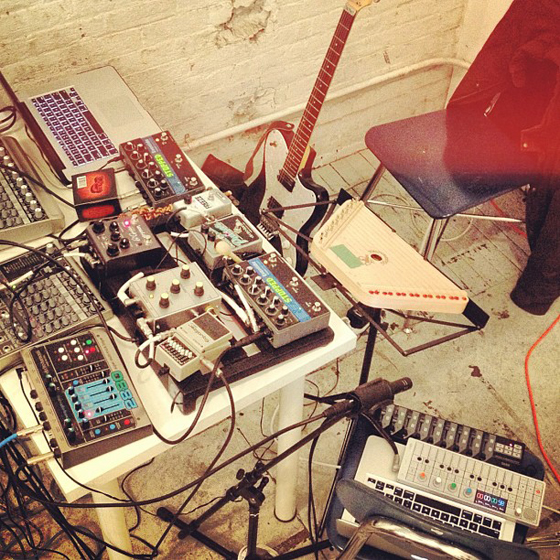
Taylor Deupree and Stephen Vitiello played a concert together earlier this month. If you follow either musician, and anyone who admires ambiguously melodious ambient music should, then you knew this, because they mentioned it on Twitter, and posted photos as they were gearing up, such as the one above. It took place in Brooklyn, and fortunately for those of us not in the area, Vitiello has subsequently posted a six-minute piece from the show. It’s an enticing teaser, a mix of deep, midtempo swells and rough, light textures — and, toward the end, what could be distant screams, like cat calls in a cemetery. The swells seem to consume the textures as much as the textures seem to pierce the swells. The result, until that dramatic turn toward the close, is an expert study in uneasy balance. That closing section, the muted call, lends a kind of retrospective sense of narrative to what had preceded it.

The live recording is from a show at the Presents Gallery in Brooklyn, New York, from a concert organized by John P. Hastings as part of the gallery’s Sound Series. Track originally posted for free download at soundcloud.com/stephenvitiello. More on the event at soundatpresents.tumblr.com. More on the gallery at presentsgallery.net. Vitiello at stephenvitiello.com, Deupree at 12k.com.

Tangents: defining electronica, jamming speech, updating apps, …

News, quick links, good reads


Jargon Watch: Last week I happened to watch an episode of CSI (the “original” series). Titled “Trends with Benefits” it was a foray into the interpersonal impact of surveillance culture, and into the perceived — perhaps the best word is “purported” — generational technological gaps. The key episode-specific character, the dead body around which the narrative circles, was a precocious Las Vegas college student who aspired to the gossip profession (the TMZ enterprise was name-checked). His dorm room was found to be loaded with prosumer technology, including cameras and various other recording devices. One of the CSI staff (the character named Greg Sanders, shown above) observed the collected digital equipment and said of it, “The kid had all kind of electronica.” It’s worth noting that this Sanders character is on the young end of the CSI staff, and was displayed in stark counterpoint to the character played by Ted Danson; Danson’s character isn’t quite sure what “trending” meant in regard to social networks, and he sometimes holds a smartphone like it’s the first time he’s ever been handed a pair of chopsticks. This usage, by Sanders, of the term “electronica” in this manner is interesting, and promising. (The episode’s script is credited to Jack Gutowitz, who according to IMDB.com spent a lot of time on Aaron Sorkin’s West Wing and Studio 60 on the Sunset Strip.) It employs it to describe not a specific and dated subset of popular electronically produced music, but the broader flotsam of general digital-era activity. That is along the lines of the sense in which I use the term, and why I have resisted the urge, over the years, to remove it from this site’s logo.

Speech Jam: Geeta Dayal, author of the 33 1/3 book on Brian Eno’s Another Green World, has taken residence at Wired’s website, which is good news. In one of her first wired.com posts, she covered the “Japanese speech-jamming gun” and smartly highlights precedents ranging from J.G. Ballard to Karlheinz Stockhausen. (Additional coverage at technologyreview.com and io9.com.)

App Updates: These are all iOS, though some if not all also apply to their Android versions. Thicket has added three new modes. NodeBeat has added MIDI support, and expanded the number of savable recordings. Ambiance has added the ability to record sounds and to play sounds in “background” mode, among other things. The eDrops app has added new sounds and the ability to load and save patterns. Audioboo seems to have mostly focused on infrastructure for its latest update. Air has added AirPlay support. Reactable has added access to the community area, “save and view” performances, and more.

Social Bullet: I wrote the following to someone asking for how to “use” “social media” to “promote” their music: “The whole social media thing is complicated. There is no generally applicable answer. I would say the following, broadly: make sure you participate. For example, the Junto project had rules, and to have posted on it without reading the Info page was a matter of not really participating. Make sure if you’re on Twitter and Facebook and SoundCloud that you actively participate: post, reply to other people’s posts, comment on their music. This will, in time, lead to a stronger sense of community. You’re find musicians with whom you have things in common, and you’ll support each other in your pursuits.” (The context was correspondence with someone who had posted a track to the Disquiet Junto project on Soundcloud.com that didn’t have anything to do with the current project.)