Music from Aircraft (The Inventors of Aircraft, That Is)

The airplane is closely associated with ambient music for no reason other than Brian Eno’s landmark album Music for Airports (1978). That album didn’t only comfortably propose itself as background music, something quite au courant these days, but quite anathema to musical expression at its time; it also focused that background to interstitial moments, periods of transition. It took the pregnant pause that is waiting to travel, and rather than filling it with visions of potential, it extended the pause itself.

The Eno album contextually had it both ways, taunting the ego of musicians and the expectations of listeners alike by expressing comfort with playing, almost literally (there’s no violin on the Airports, but there is piano), second fiddle to the mundanity of life’s experience — but also suggesting that the place in which it was appropriate to be heard was flush with opportunity, even adventure, an alignment still lingering from the late-’60s/early-’70s associations of flying with luxury, something long since muffled by complaints about tarmac delays, lost baggage, and bad food.

The music on the new album by the Inventors of Aircraft is even more background-able than the four tracks that comprise Music for Airports. If anything, it sounds like how people remember Music for Airports, until they actually listen to Music for Airports and realize just how recognizable its melodic material and the instrumentation can be. Titled with the stasis-friendly phrase As It Is, the new Aircraft collection of five songs is maximalist ambient music, gaseous expanses of still moments, such as the cloud-burst-in-slow-motion that is its third track, “Let Me Give You What You Want” (MP3). The piece is both intimate and big-screen, its contemplative pace and slowly rising and quieting waves of lushness belying its majestic propensity. Tiny little bits of activity, what sound like objects being moved around, or a light wind hitting a microphone, further ground the enterprise, while simultaneously infusing it with a bit of narrative-coaxing mystery.

[audio:http://www.archive.org/download/rb088/03-Let_me_give_you_what_you_want.mp3|titles=”Let Me Give You What You Want”|artists=The Inventors of Aircraft]

Get the full set at the releasing netlabel, restingbell.net. More on the Inventors, which is in fact the singular Phil Tomsett, pictured above, at theioa.com. Tomsett/Aircraft has a previous release, 2008’s Unknown Language, on the Serein netlabel, at archive.org.

Cello + Guitar (MP3)

In the past, Ted Laderas has named other musicians in the process of describing his own work, the founding shoegazer figures My Bloody Valentine in particular — though he plays in a generally less melodically circumspect manner, the comparison is a deserved one; his work is rich with barely sublimated emotion. But for his latest outing, a four-and-a-half minute solo work titled “Palimpsests,” he names William Basinksi, specifically Basinski’s Disintegration Loops, as inspiration, and describes the track as follows: “Heavily reverbed guitar and reserved layered cello.” That sounds about right. The material has an especially elegiac quality, and the contrast between the two string instruments provides just the right mix of resemblance and friction.

Laderas performs at Ooray. Track originally posted at 15people.net.

Happy 20th Anniversary, Ninja Tune

The year 2010 marks the 20th anniversary of the Ninja Tune label, founded by Matt Black and Jonathan More. There’s enough archival coverage on Disquiet.com of Ninja Tune — home to Kid Koala, Cinematic Orchestra, Funki Porcini, and the founding duo’s own Cold Cut enterprise — to allow for a full-on microsite, but here’s just a handful of past interviews:

Label co-founder Black in 1997 talks about the origins of the label (“Pump Up the HTML”):

We’re not for sale, end of story. Jon and I have tried being a part of working for the man, and it was most unnatural, and we nearly expired. It nearly finished us off. Not an experience you get to repeat. It might be fine for — other people can do what they want. We find it’s best to be independent and free. And I could name a million reasons to justify that but in the end people are going to have to check it out themselves. The music business is in no way different from the hamburger business, and if you want to be the best burger griller at McDonald’s, then go for it, but there is more, and being free is priceless, really.

Also in 1997, Patrick Carpenter gives a walk-through of his remix, under the DJ Food name, of a David Byrne song (“Anatomy of a Remix”):

[Regarding Byrne’s jittery vocal] The track I started working on was 136 beats a minute and it had a heavy swing. To make the vocal fit, I cut it up into syllables, but it sounded crap. I still had all these vocals cut up into syllables, so I put little loops in each syllable.

And three conversations with Amon Tobin, one from 1997 regarding the release of his album Bricolage (“Bric House”) — note that this is almost a decade before he put together a live band for the production of Chaos Theory – Splinter Cell 3 Soundtrack:

I wish I’d learned one instrument and become really competent on that one instrument, but I think that my instrument now is the sampler, and that’s what I’m focused on. I think there’s a lot more that can be done with it and I’m just skimming the surface, really. I’m not really interested in using live instruments at all. I could get session musicians in or whatever as well, and sessions to do samples for me, but I’m really quite into using sounds that come from other places.

… one from 1998 regarding Permutation (“Evolution & Permutation”) — it’s especially interesting to look back to a time when the use of a laptop was both cost-prohibitive and, in terms of power, somewhat unfeasible:

I’m seriously considering buying a little laptop the next tour I do, and maybe one of those portable record players too, maybe just doing some stuff on the road, that’d be wicked. I haven’t had the chance to do that yet, haven’t been able to afford a big enough laptop, a powerful enough machine to be able to run Cubase, whatever. In the future I’m going to do that, make tunes on tour.

…. and one from 2002 regarding Out from Out Where (“Psych Out”):

You can’t make people have a wider view of things than they do. I think only time does that. As each new piece of technology comes, and becomes oversaturated in the media, etc., then people become used to it. Everyone’s listening to electric guitars with not too much trouble, and they were having lots of trouble with it when it first came out, so I suspect the same thing will happen with electronic music.

And here’s a little review of the label’s decade-anniversary Xencuts collection: “Ninja Tune Turns 10.”

A search for “Ninja Tune” yields a wealth of material, going back to 1996, when coverage included a “Best CDs of 1996” list and to an intro-to-electronica titled “Ambient: A Starter Kit.”

Visit the label’s anniversary site at ninjatunexx.net. (And for what it’s worth, no one appears to have yet purchased the URL “ninjatunexxx.net.”)

Cage and the Poetry of Sound in The New Yorker

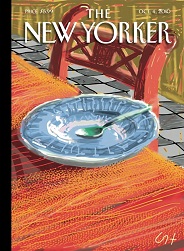
It’s probably a coincidence, but the October 4, 2010, issue of The New Yorker, the same one that contains Alex Ross‘ extended piece on John Cage (“Searching for Silence”), features two poems that involve descriptive passages about sound. This is the Cage article in which Ross reflects on 4’33” — the composer’s famous “silent” work — and notes that “its purpose is to make people listen.” Ross describes the sounds that were coincident with the work’s 1952 premiere, near Woodstock, and later the sounds that emanated from the Chelsea neighborhood in which Cage lived. “Did Cage love noise? Or did he merely make peace with it?” asks Ross.

Perhaps the article was on the mind of the magazine’s poetry editor, Paul Muldoon, when he selected the two poems in the issue. There’s the late Eunice Odio‘s “To W.C.W.,” of which this is the opening half:

The whole arbor
is contained in him.

It is his will,

an entrance
to the clear design
of the waters.

Heavenly music
wakes in his ear.

(When God stirred,
the moon never varied
nor the wind,

a rumor
of approaching dawn,

stillness become
God’s silence.)

It’s heavily Thoreau-ean, to name one of Cage’s naturalist heroes, and its equation of silence with music is especially appropriate in this context. A biographical sketch at poetrymagazines.org.uk says that Odio was from Costa Rica, and lived from 1919 through 1974. The “W.C.W.” of the title is William Carlos Williams, who passed away more than a decade before Odio did, and who is responsible for the translation that appears in the magazine. (Full poem at newyorker.com.)

And there is “Discrepancies” by Stephen Dunn (newyorker.com), a not infrequent presence in the magazine (he won the Pulitzer Prize in 2001). This is a stanza and a quarter from about midway through the piece:

The small brown bird outside my window
has a lilt and a tune. Elsewhere, a baby
is screeching. Watch out, little ones,
there are hawks, there are sleep-deprived

parents, utterly beside themselves.

Like Odio, Dunn makes an immediate association between natural sound and music — the bird sound, while never called bird-song, is noted for its constituent tune. Dunn goes a step further by taking the child’s sound and putting it firmly in the natural world. It is a screech — vocal, yet pre-verbal — which puts the child comfortably alongside the hawks.

Cage taught us many things, as Ross lists them — he prepared us for laptop music, helped get Fluxus and happenings going, welcomed the contrasting elements of chance and procedural instructions. And he taught us to listen. The inclusion in the two poems of sonic imagery, so to speak, reminds us that we don’t just listen with our ears. Sonic attention in the world also means recognizing sound in what we read.

The last poem I noticed in The New Yorker that was especially sonic-minded was back in April, a piece of suburban observation by Jessica Greenbaum: disquiet.com.

Past Week at Twitter.com/Disquiet

  • Re: Medal of Honor fracas: 1, seeing adversary role-play as "fun" misunderstands "play"; 2, shebang ignores military recruitment via gaming #
  • Gonna be a silent Christmas, at least in UK: "John Cage's 4'33'': festive sound of a defeated Simon Cowell" http://is.gd/fGK59 via @guardian #
  • .@npseaver Quite amazing how much sound's in Fringe, like episode when they took pane of glass from window and replayed incident like an LP. in reply to npseaver #
  • Edward Rothstein on cam-phones in museums: "looking–for which museums were created–becomes a memory before it has even begun" via @nytimes #
  • Man, Fringe's aural fixation made itself heard in last night's episode, "The Box": Peter going deaf in order to defuse a hypersonic bomb? #
  • 35,474: number of plays of Brian Eno's "2 Forms of Anger" on @soundcloud in past 48 hours. http://is.gd/fCvoO And still no samizdat remixes? #
  • I'm sure my four-week-old child's fingernails make a sound when I trim them with a scissor, but my utter fear deafens me to it. #
  • You know if you'd told me in my Asimov-drunk teens that some day I'd think negatively about the term "robocall" I wouldn't have believed you #
  • Baby's first vinyl: The Pharcyde's Labcabincalifornia (Instrumentals). #
  • Looking forward to the Music App Summit next Tuesday in San Francisco. Will be there all afternoon. #
  • Afternoon listen: Philip Jeck and Janek Schaefer on BBC in conversation re: their recording histories and favorite music: http://is.gd/fFcjN #
  • Couldn't make it out of town to #planningness in Denver. Hope everyone had an informative and great time. #
  • My review of the recent Underworld album, Barking: http://is.gd/fEQzt "third-party producers lend…a welcome mix-tape vibrancy." #
  • Leonardo Rosado (aka @sbtrmnl) asks listeners to rate tracks he's recording to cull best work for next CD: http://opaqueglitter.tumblr.com/ #
  • #ff geo-locative sonic hub @urban_sound + composer/critic @felsenfeld + electronic musician @mystified131 #
  • Lessig re: #fb film: "Imagine a jester from King George III’s court, charged in 1790 with writing a comedy about the new American Republic." #
  • Morning sounds: breathing of two sleepers (wife, child); occasional bus and car; no birds, planes, or (first time in a while) foghorns. #
  • Some friends are doing an amazing urban art project in/about New Orleans, where I lived from 1999-2003. Please support: http://kck.st/dqyDpC #
  • Just fixed a lovely typo. Thanks for the alert, @earslend #
  • Cartoonist Megan Kelso will be at #APE2010 in SF, and I'll be interviewing her on Saturday, October 16, at noon. Details: http://is.gd/fCYbV #
  • OK, Brian Eno's quasi-post-punk song "2 Forms of Anger" off forthcoming album has been out for 24 hours. Where are the communal remixes? #
  • Detailed post-mortem on making of game Canabalt by @adamatomic. Just wish there'd been some mention of music/sound role. http://is.gd/fCKtP #
  • Best way to grok Daniel Lanois' impact on Neil Young's Le Noise is to watch Young play (live in studio) & hear recording http://is.gd/fCyoC #
  • Baby's first Brian Eno is this free-streaming track off forthcoming album, appropriately titled Small Craft on a Milk Sea http://is.gd/fCvoO #
  • Autechre remix of the Bug that @factmagazine had online is back up via @selftitledmag http://is.gd/fCuoW / Best thing Ae's done in long time #
  • Noticed that I hadn't put ice cubes in my morning iced coffee in a month — reunited now with the crackling and popping. #
  • On Facebook added a "suggested friend" I know is dead. I trust it's a tribute site since he died several years before Facebook ever existed. #
  • Last line of Goodnight Moon: "Goodnight noises everywhere" (File under: The things we remember when we have kids.) #
  • More detail on @internetarchive removing Anki Toner's silent-groove appropriations http://is.gd/fALnc More on this later (via @mystified131) #
  • ♫ Afternoon tune: "Soft Like Leaves Falling" http://is.gd/fAKVA by Leonardo Rosado aka @sbtrmnl #
  • Afternoon counterpoint: electric kid swing versus breast pump. #
  • In the future, every noun will instigate 15 Twitterbots. (A tweet on Sons of Anarchy sound earned me a motorcycle-bot.) #
  • "From orbit: Listening to Sting on my ipod watching the world go by ”“ literally" @astro_mike http://is.gd/fADdp via @juliandibbell #space#
  • Every time a motorcycle passes by, I think TiVo has accidentally replayed Sons of Anarchy. #
  • Saw scraggly K Records logo in someone's Twitter-follow list; in-brain iPod immediately played half-remembered Dub Narcotic Sound System. #
  • "Bodhisattva, let me take you by the app": Hong Kong programmer's #android Buddha Machine; elegant interface, four tracks http://is.gd/fAnov #
  • "Weather conditions, wind direction, everyday sounds around this time must be considered." http://is.gd/fAksm #rippedfromtheheadlines #
  • "police to investigate and report on distance/direction of a scream of kidnapped boy" http://is.gd/fAksm via @tobiasreber (thanks, man) #
  • Morning sounds: foghorns, oddly quiet and remote. #
  • RIP, Texas tenor saxophonist Ed Wiley, Jr. (b. 1930). #
  • Interesting @kickstarter project I just kicked in on, all about "the sound of art" http://kck.st/92ElnD // Deadline is Oct 7. #
  • Messing with instrumental hip-hop MP3s in Plogue Bidule, based on use by @cinchel (the software, not the tunes). #
  • Joseph Horowitz on the #Singularity (made you look) … of George Gerswhin: "keenings that can only be called Slavic." http://is.gd/fylIQ #
  • Nearby jackhammer, just far enough away to be pleasant. #
  • Weird that #newtwitter right-hand column truncates top tweet after two lines. (At least in Firefox on Win 7.) #
  • Beastie Boys nominated for Rock'n'Roll Hall of Fame; hope someone they sampled — maybe Zeppelin's Page or Plant — does their introduction. #
  • Meaning of wolf's howl: "The coyote is saying to everyone, fellow barking dogs or otherwise, 'We are here.'" http://is.gd/fyaIx via @nytimes #
  • Neil Young's Le Noise is a wool sweater knitted with barbed wire. #
  • Echo on Daniel Lanois' production of Neil Young's Le Noise sounds like he rented Pauline Oliveros & Stewart Dempster's Deep Listening cave. #
  • Wonder how hard it'd be for RSS/Atom to allow some sorta background-image code to allow for visual continuity between feed and source-site. #
  • Old-school music publicity: Tracking lost packages. New-school music publicity: Dealing with broken MP3 archives and stalled downloads. #
  • .@sublamp @mapmap I think there's a subcategory of "music by graphic designers for graphic designers." Maybe there's a photog equivalent. #
  • Of all the technology in this home, the refrigerator has the most complex and varied sounds. #
  • Buying records after midnight: the $2.99 deal for the Trent Reznor / Atticus Ross score to The Social Nework. http://amzn.to/TSNalbum #
  • Hip-hop forensics, sampling genealogy, and how context beats (and, of course, builds on) crowd-sourced data: http://is.gd/fwrzY #
  • .@tedfriedman RJDJ is the MSG of everyday sonic life. As a phở addict, I mean that as a compliment. #
  • My Spanish is poor but http://is.gd/fwhst seems to say @internetarchive yanked Anki Toner's album made of silent LP grooves due to © concern #
  • "[M]usic can be remixed. Books aren’t remixed," says @greatdismal (aka William Gibson) http://bit.ly/ah7BVs via @significobs #
  • Family drama: Life's fancier with a soundtrack playing in background of Skype conversation. Question is: Carl Stalling or Ennio Morricone? #
  • San Francisco soundscape tour tomorrow at 3pm http://is.gd/fw6yg led by Dennis Paoletti, principal at Shen Milsom Wilke acoustic consultancy #
  • Lanois "tweaked and toyed with…sounds, processing…signals"; "looped, echoed…multiplied fragments of…performances" http://is.gd/fvRED #
  • Neil Young on producer Daniel Lanois' role: "He does a performance in the mix, and I do a performance in the performance" http://is.gd/fvRED #
  • Morning sounds: surf whoosh of traffic, plumbing of a child, skeletal shifting of an old home, tinnitus ring of hard drives. #
  • Sorry to read of 21 Grand's zoning issues. Space zoned for “community assembly”and the Orwellian "cultural non-assembly" http://is.gd/fuRKO #
  • If 5 other San Francisco parents have Fisher-Price Power-Plus Plug-In Swings we could make some excellent "Steve Reich playdate" music. #
  • Presumably the "10 songs" in this Fisher-Price Power-Plus Plug-In Swing don't count the enchanting metronomic techno of its 6 speed settings #
  • The new(ish) remixes by Autechre (of the Bug) and Burial (of Commix) have reinvigorated my interest in both. Maybe I prefer them as filters. #
  • Follow-up advice in that "shark attacks hydrophone" discussion: "Tow in greater speeds," "Hide shiny components," "Carry a rabbit’s foot" #
  • Anyone contributing #soundart to http://www.art4dilla.com/ contest? Rules do say "original artwork (of any medium)." Voting begins Sept 30. #
  • Sunday-morning shout-out to @luvsound & the musicians involved in this incredible, generous, neonate-friendly compilation http://is.gd/fltDp #
  • Foghorns especially mellifluous this morning. Feel like I'm waking up from a nap in the middle of a concert. #
  • A Prophet is Godfather 2”“good, but why does flick about Arab kid maturing in French prison end w/ Texan singing Americanized song by German? #
  • DeLillo on interactive fiction's PoV narcissism: "Novels will become user-generated … with [reader] as main character" http://is.gd/ft82Q #
  • Soundgrid (for iOS) now can import original instrument packages (aka samples) and upload to soundcloud? That's pretty excellent. #
  • "Quiet alert" = "when a neonate is calm and attentive, with eyes open, ready to become acquainted with an adult person" http://is.gd/fsTBW #
  • Embrace the cliché: new dad selling old Technics 1200s. #
  • Great Google (mis)Translate incident from a Japanese musician's blog: a "last minuet announcement" #