Images of the Week: Retro-Futurist Instruments

The musical instruments created by Arius Blaze, and his partner Ben Houston, are retro-futurism at its best.

This isn’t solely decorative — it’s not cyberpunk window-dressing, or the musical equivalent of computer case-modding. As exemplified by the Feedback Harmonizer, created by Blaze and shown here, their work mixes homespun materials (old guitar parts, burnished wood casing, utilitarian knobs) in the development of new musical tools that require musicians to adopt from various existing performance traditions, and to contribute to new hybrid techniques.

More on the Feedback Harmonizer at folktek.blogspot.com, including video of it in action, and links to the above photos in much larger format.

Past Week at Twitter.com/Disquiet

  • Lao New Year celebration at Civic Center in San Francisco: minor chords on massive Casios are traditional, as in Russian & Thai festivities. #
  • Military aircraft just shattered unusually sunny day with its jet engines. Not sure if the sound lingers in the sky, or just in my ears. #
  • The bus is oddly quiet. Something should penetrate my iPod’s chamber music. My entire neighborhood has decided to make it a 3-day weekend. #
  • Favorite new-to-me phrase: “festina lente,”Latin for “to make haste slowly.”#
  • Neat insta-rewind: Play MP3 in Quicktime in Firefox to the end; hit Command/Backarrow & it plays backward with no clipping. #
  • RIP, pop provocateur Malcolm McLaren (b. 1946). Tonight: Duck Rock & Fans. Here he is on 8-bit as the new punk from 2003: http://is.gd/bkyzg #
  • Garbage truck rumbles past clumsily, continues for a block, turns down another street. Someone else’s sonic Thursday morning is my Monday. #
  • Q: “What is that sound/Where is it coming from/All around”–Billy Bragg … A: The hum of the industrial carpet cleaner a few houses down. #
  • The office printer at various points during the day performs a hypnotic, deeply modal qawwali-like drone for minutes at a time. #
  • Wondering what sound on a given morning triggers the activity of noting sounds. Today: hard drive, airplane, bus, ice in glass of coffee. #
  • Both @bandcamp and @soundcloud are great web platforms for musicians. I just wish the latter had “clickable tags”the way the former does. #
  • Morning sounds: hard drive, fridge, bus, shower, heater, plane overhead. Each truly ordinary but in combination a kind of ambient cacophony. #
  • From George Prochnik’s book In Pursuit of Silence: “I was as tired of hearing myself complain about noise as I was about the noise itself.”#
  • Lovely quiet after long, intense rain. Is the water-logged street quieter, are our wet walls thicker, or are there just fewer cars out? #
  • Sunday morning = new Ava Mendoza album. #
  • There are mornings when the refrigerator sounds like a body shop for hovercraft. This is one of them. #
  • Just saw flick Staten Island, with great Seymour Cassel as deaf mute deli worker in trouble with mob. Great handling of his lack of hearing. #
  • Washing machine is sound of industriousness. Birdsong reminds me I need to clean the yard. #

Quote of the Week: The Silence Inside Basketball

Excising a few lines from a longer poem can be as invasive an act as displaying a detail of a larger piece of visual art. Free of (though not entirely free from) its original context, the segment can take on an abstraction, a peculiarity, that is entirely unintended by its author. With that warning, and all the caution that comes with it, below appears a section of “Next Door,” a poem by Jessica Greenbaum. “Next Door” appears in the current issue of The New Yorker, dated April 12. (The full poem is viewable at newyorker.com.) Each week I read the poems in the magazine, and in recent months had begun to actively seek out references to music (to noise, to silence) that might appear in the poems. I’ve been surprised how infrequent such reference have proved to be … and then Greenbaum’s poem appeared:

… while the shooter sized up the competition or
focussed his solitary mind, and then the bomb-fuse ticktickticktick
while he feinted right, moved left, setting up the shot
and the listener (not trying to listen) and then the blank
space of the arcing quiet as he shoots. That silence
is also like the space between the reader and the page,
the little nation between the writer’s words and our
particular way of receiving them, or the blank station
we fill in between ourselves and passing strangers,
or between ourselves and people we presume to know,
but most achingly in the ones we try to know.

The combination of basketball onomatopoeia (“the bomb-fuse ticktickticktick“) and the description of silence is striking, in particular how Greenbaum connects the silence that follows the toss of the ball (“the arcing quiet,” as she puts it exquisitely) to the silence between reader and page — that is, between the reader and the very poem we’re reading. She cements it by having the “achingly” aspect of loneliness echo that “arcing quiet.”

Even though she’s written the poem as an adult, it contains the silence, which here signifies a distance from others, that she recalls from her youth.

Music for Dust & Turntable (MP3)

Achim Mohné‘s new podcast isn’t particularly new. It was recorded in July 2000 at the Museum Ludwig in Cologne. But it sounds as fresh as a new layer of dust, and just as delicate.

To hear the piece in 2010 for the first time is as if a room had been left undisturbed for a decade — or, given the title of Mohné’s piece, “Aufzeichnungen im Kellerloch (Recordings in the Cellar),” not a room but a cellar.

This is music to listen to while reading Caleb Kelly’s recent MIT Press book, Cracked Media, a scholarly survey of music (and related enterprises) made from the broken bits and threadbare sounds and technical errors that either symbolize or actually result from, as Kelly puts it in the book’s subtitle, “malfunction.” (The book’s full subtitle is “The Sound of Malfunction.”) Mohné doesn’t figure in Kelly’s book, but fans of those musicians, acts, and artists who do — Oval, whose stuttered techno helped define the word “glitch”; Christian Marclay, one of the first to see the vinyl record as the foundation of artistic practice; and Nam June Paik and John Cage, among the earliest to recognize the beauty in static (television and radio) — will immediately appreciate the manner in which such a super-quiet recording can nonetheless be so intrinsically compelling.

The Mohné piece (MP3) was posted recently as the 50th entry by touchradio.org.uk, the podcast-series spinoff from the Touch record label. Very few details are provided on the TouchRadio page dedicated to the MP3 (not much more than performer, title, date, location), but over at Mohné’s website, achimmohne.de, there’s plenty of information about the July 2000 performance. The music was performed on a pair of turntables, on which he manipulated the locked grooves at the end of vinyl LPs. It opens with a thud on slow repeat, like a mechanical heart beat, the groove coming around and around as an LP rotates. In time, it gets rich with static: the fine sound of particulates.

[audio:http://www.touchmusic.org.uk/touchradio/Radio50/Radio50.mp3|titles=”Aufzeichnungen im Kellerloch (Recordings in the Cellar)”|artists=Achim Mohné]

The sound doesn’t merely resemble dust particles; it served as the score to a projection of illuminated dust. Mohné describes the projection system as follows:

Dust, collecting in the light beam of a film projector, is being recorded by a video camera. The light beam is being absorbed by a velvet “light bag”, therefore the projection itself is invisible.

The video camera is connected to a video beamer, which projects “dancing dust” (real-time and extremely enlarged). The more people enter the installation space,the more dust gets moved around, the more intense “the flight through space” is.

This is the set-up (projector on the right, “light bag” on the left):

And these are images of the projected dust:

As Mohné notes, the parallel between the images of dust and the sound of the grooves is not just about delicacy and fragility. It is also a practical matter:

The “ending grooves” sound very different, depending on how dust has effected and transformed the soft surface of the vinyl.

In addition to this information, Mohné’s site, achimmohne.de, includes a downloadable catalog of his Ludwig show (albeit only in German) and a low-resolution video of his performance.

One side note: The TouchRadio podcast has an interesting lag. It’s not uncommon for the audio to pop up in the service’s feed (RSS) in advance of when the framing descriptive content is posted to its website. As a result, subscribers to the feed get access to the audio before they’re entirely clear what, exactly, they are listening to. This isn’t an intentional act of new-critical focus, nor is it an occasion of art-prank obfuscation, on the part of Touch, but it does provide a nice opportunity to focus on the music before the facts come into view. (I noted this production time lag via twitter.com/disquiet on April 1, and in retrospect I realize I should have noted that it was no joke.)

Neon Night in Shanghai, with Qin Accompaniment

From state-sponsored propaganda posters featuring broad-shouldered exemplars of the People to mid-century paintings that dare to embrace European techniques, from ceiling-high scrolls that hide human details in the plain sight of nature worship to contemporary films that comment on the realities of life in a rapidly metastasizing empire, the Shanghai exhibit currently occupying the main floor of the San Francisco Asian Art Museum displays a wildly broad array of Chinese art.

This includes a floor-spanning installation as well as restored footage of early cinema. There are images of life in the streets and harbors of the exhibit’s namesake city going back at least a century and a half, and brand new (well, dated 2009) pop art that mashes up such distinctly Western figures as cigarette mascot Joe Camel and film legend Marlene Dietrich.

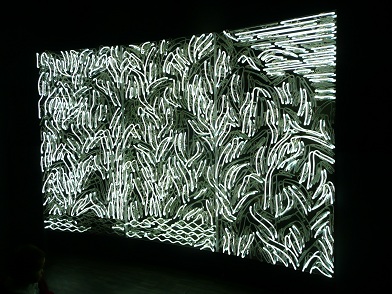
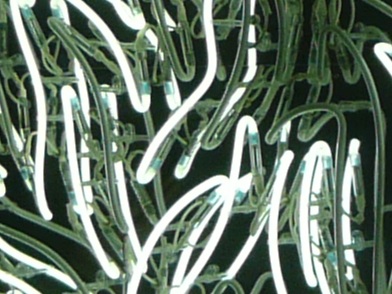
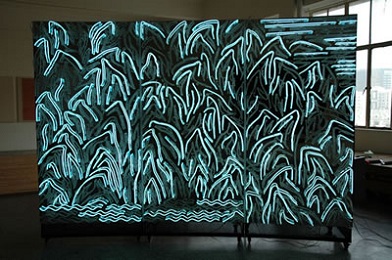
And then in one dark corner, there is “Landscape — Commemorating Huang Binhong — Scroll“ (2007) by Shen Fan (ç”凡). The choice of location isn’t neglectfully dark, but purposefully so, thus letting the piece’s light maximize its impact. The work (pictured up top) is a massive, free-standing wall of neon, comprised of small pieces, each one a little curlicue, all of them fitting together in a manner that suggests brushstrokes, jigsaw-puzzle pieces, and loose foliage. The illumination is enhanced by a reflective backing material, which gives each piece of neon the effect that it is hanging in air. The complexity of the overall pattern masks the electrical infrastructure. Unless you really focus on a specific spot in the work, you don’t see the un-illuminated wiring and tubing that makes it all possible. Here’s a detail from the above photo:

The artist has reportedly said that the choice to employ neon was inspired by the geographic setting for the piece’s debut — it was featured at the 2006 Shanghai Biennial, which took place in a neighborhood famed for its neon. It’s unlikely, though, that the blinking lights of that urban territory were as sonorous as Shen Fan’s “Scroll.”For each time one of those little snippets of neon flicker on or off, a single note of a qin, or zither, resounds. According to the wall text at the Asian Art Museum exhibit, “The length, shape, angle, and location of the neon tubes decide the length and tone of the musical notes.”

That correlation isn’t so causal that the piece in any way seems predictable. It’s more playful than anything, as every 30 seconds or so a new piece of neon turns on, and another qin note is played. The pacing has a considered sensibility, like a ritual, a playful ritual. Shen Fan’s “Scroll”is a self-contained spectacle that makes you loiter and pay attention, waiting expectantly for the next tone to sound, for the next neon tube to flicker into view.

The piece appears in what a gallery map lists as the tail end of the “Revolution” section of the exhibit — you can hear the qin through partial walls while you look at darkly humorous political cartoons and a portrait of Chairman Mao that makes him resemble a Chinese version of Mister Rodgers. But by materials, artistic tradition, and chronology, it really helps constitute the “Today” section of Shanghai, the section that focuses on emerging art.

Here’s another image of the piece, from the selected items highlighted in the museum website’s online tour of the show:

More on the Shanghai exhibit, which runs through September 5 in San Francisco, at asianart.org.